Why the 2026 Semi-Monthly Payroll Calendar Matters for Small Business Owners
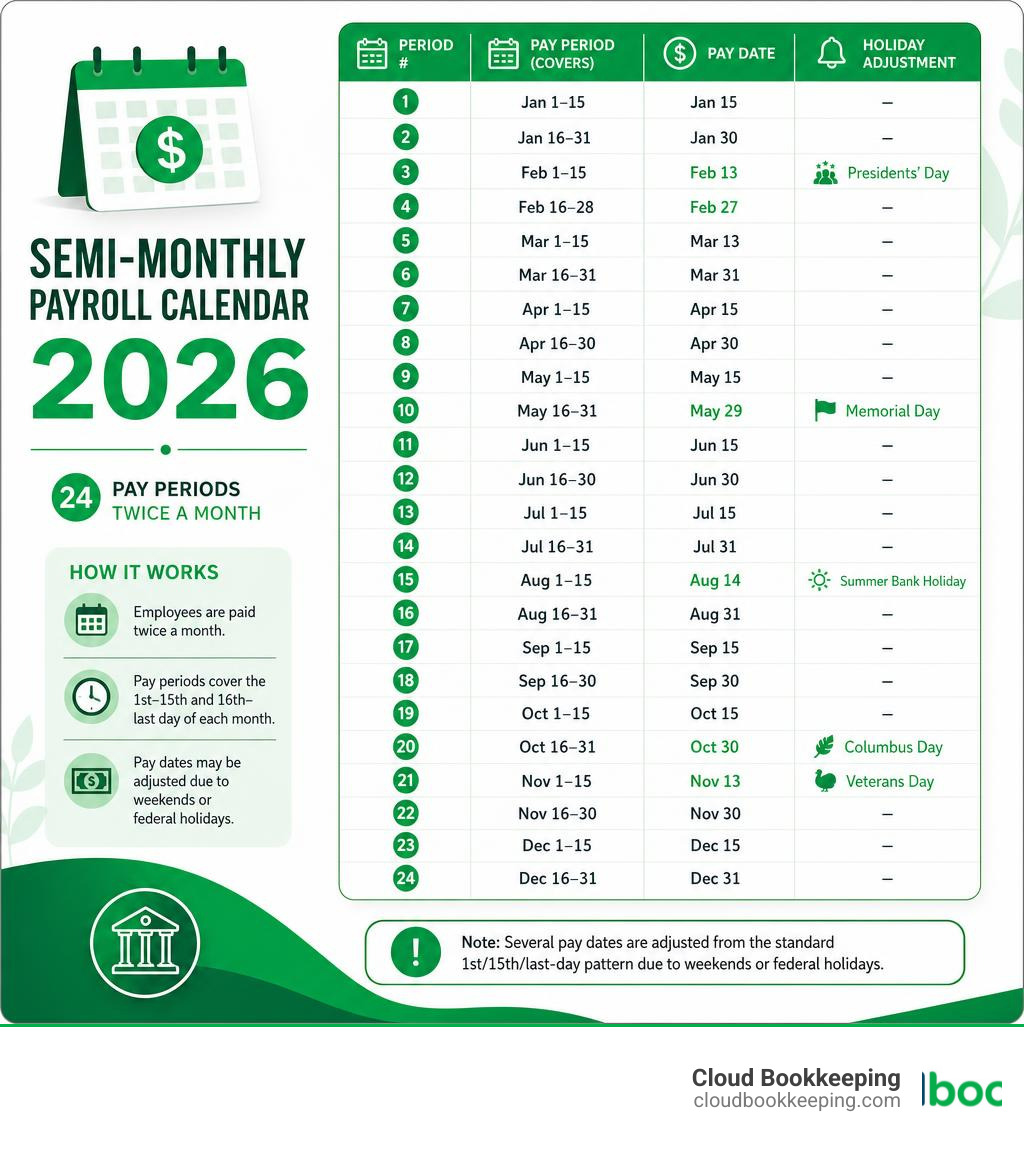
The semi monthly payroll calendar 2026 gives salary-based businesses exactly 24 pay dates across the year — two per month, every month, without exception.
Here are all 24 semi-monthly pay dates for 2026 at a glance:
| # | Pay Period | Pay Date |
|---|---|---|
| 1 | Jan 1–15 | Jan 15 |
| 2 | Jan 16–31 | Jan 30 |
| 3 | Feb 1–15 | Feb 13 |
| 4 | Feb 16–28 | Feb 27 |
| 5 | Mar 1–15 | Mar 13 |
| 6 | Mar 16–31 | Mar 31 |
| 7 | Apr 1–15 | Apr 15 |
| 8 | Apr 16–30 | Apr 30 |
| 9 | May 1–15 | May 15 |
| 10 | May 16–31 | May 29 |
| 11 | Jun 1–15 | Jun 15 |
| 12 | Jun 16–30 | Jun 30 |
| 13 | Jul 1–15 | Jul 15 |
| 14 | Jul 16–31 | Jul 31 |
| 15 | Aug 1–15 | Aug 14 |
| 16 | Aug 16–31 | Aug 31 |
| 17 | Sep 1–15 | Sep 15 |
| 18 | Sep 16–30 | Sep 30 |
| 19 | Oct 1–15 | Oct 15 |
| 20 | Oct 16–31 | Oct 30 |
| 21 | Nov 1–15 | Nov 13 |
| 22 | Nov 16–30 | Nov 30 |
| 23 | Dec 1–15 | Dec 15 |
| 24 | Dec 16–31 | Dec 31 |
Note: Several pay dates are adjusted from the standard 1st/15th/last-day pattern due to weekends or federal holidays.
Running payroll twice a month sounds simple — until a holiday falls on payday, a timecard gets submitted late, or your direct deposit window closes before you realize it. For small business owners managing salary employees, even one missed deadline can mean delayed paychecks, frustrated staff, and compliance headaches.
This guide walks you through every pay date, cutoff window, and holiday adjustment you need to know.
I’m Charlie Perrin, founder of Cloud Bookkeeping, and with over 24 years of experience helping small businesses streamline their financial operations, I’ve helped countless business owners take the stress out of managing a semi monthly payroll calendar 2026 and beyond. Let’s make sure your 2026 payroll runs without a hitch.
Helpful 2026 payroll planning resources:
- Plan ahead with better QuickBooks forecasting
- Compare biweekly and semi-monthly pay schedules
semi monthly payroll calendar 2026: Complete 24-Date List
A semi-monthly payroll calendar divides the year into 24 pay periods. Most businesses use either:
- The 1st through the 15th and the 16th through the last day of the month
- Paydays on the 15th and the last business day of the month
- Adjusted earlier paydays when the normal pay date falls on a weekend or bank holiday
For reference, here is a sample 2026 semi-monthly payroll schedule that follows the same general pattern: two pay periods per month, with dates adjusted when needed.
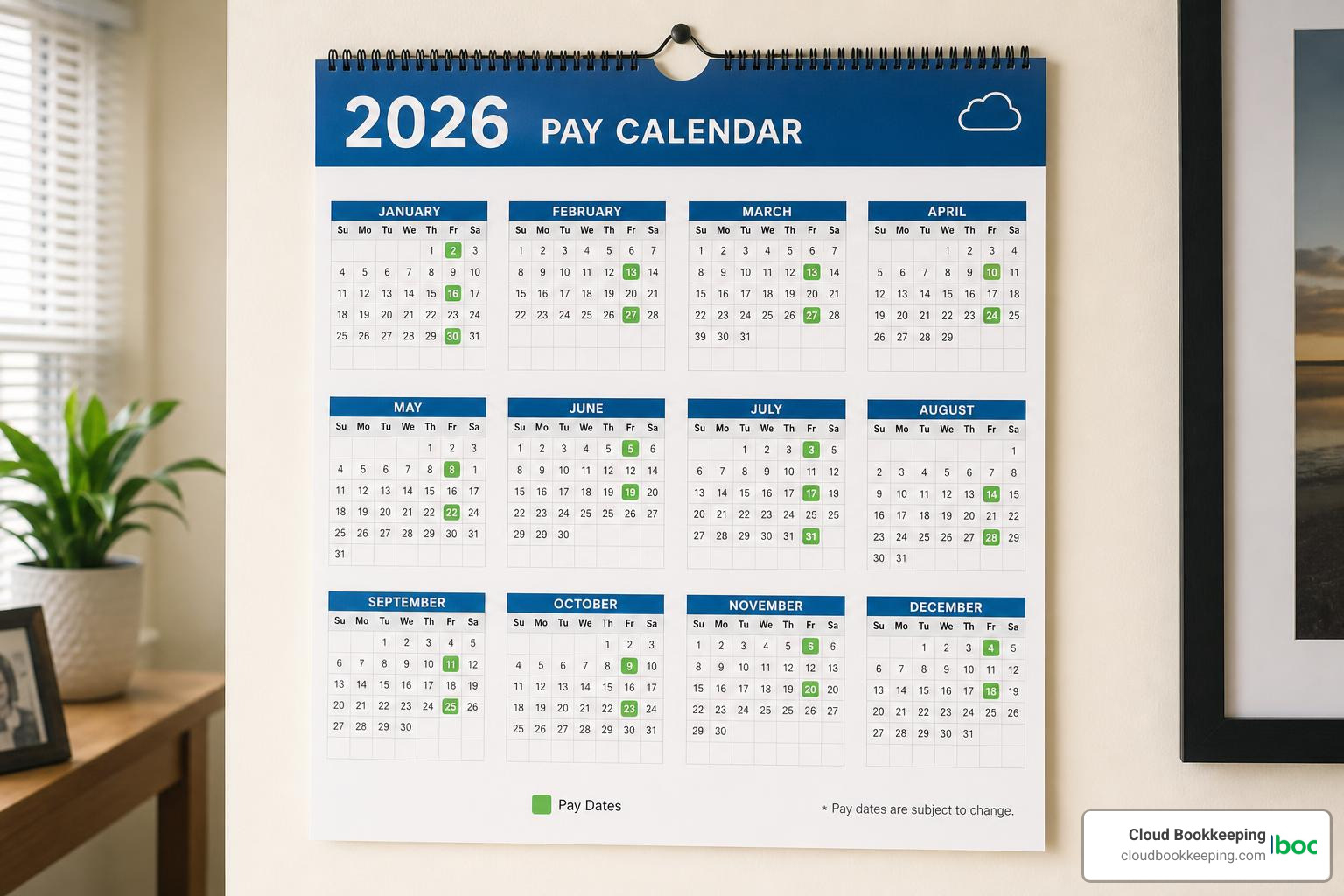
January–June semi monthly payroll calendar 2026 dates
The first half of 2026 includes several adjusted pay dates. January 31, February 15, February 28, March 15, and May 31 fall on weekends, so those payments are moved earlier in this calendar.
| # | Pay Period | Pay Date | Notes |
|---|---|---|---|
| 1 | Jan 1-15 | Jan 15 | Regular payday |
| 2 | Jan 16-31 | Jan 30 | Jan 31 is Saturday |
| 3 | Feb 1-15 | Feb 13 | Feb 15 is Sunday; Feb 16 is a federal holiday |
| 4 | Feb 16-28 | Feb 27 | Feb 28 is Saturday |
| 5 | Mar 1-15 | Mar 13 | Mar 15 is Sunday |
| 6 | Mar 16-31 | Mar 31 | Regular payday |
| 7 | Apr 1-15 | Apr 15 | Regular payday |
| 8 | Apr 16-30 | Apr 30 | Regular payday |
| 9 | May 1-15 | May 15 | Regular payday |
| 10 | May 16-31 | May 29 | May 31 is Sunday |
| 11 | Jun 1-15 | Jun 15 | Regular payday |
| 12 | Jun 16-30 | Jun 30 | Regular payday |
For small businesses, the trickiest dates in this section are February 13 and May 29. They come right before adjusted weekend or holiday timing, which means approvals and direct deposit files need to be finished earlier than usual.
July–December semi monthly payroll calendar 2026 dates
The second half of the year includes year-end payroll pressure, holiday weeks, and several weekend adjustments. December is especially important because final payroll often intersects with tax reporting, benefit deductions, bonuses, and year-end bookkeeping.
| # | Pay Period | Pay Date | Notes |
|---|---|---|---|
| 13 | Jul 1-15 | Jul 15 | Regular payday |
| 14 | Jul 16-31 | Jul 31 | Regular payday |
| 15 | Aug 1-15 | Aug 14 | Aug 15 is Saturday |
| 16 | Aug 16-31 | Aug 31 | Regular payday |
| 17 | Sep 1-15 | Sep 15 | Regular payday |
| 18 | Sep 16-30 | Sep 30 | Regular payday |
| 19 | Oct 1-15 | Oct 15 | Regular payday |
| 20 | Oct 16-31 | Oct 30 | Oct 31 is Saturday |
| 21 | Nov 1-15 | Nov 13 | Nov 15 is Sunday |
| 22 | Nov 16-30 | Nov 30 | Regular payday |
| 23 | Dec 1-15 | Dec 15 | Regular payday |
| 24 | Dec 16-31 | Dec 31 | Year-end payday |
November and December deserve extra attention. Thanksgiving week, Christmas week, and year-end banking schedules can compress payroll processing time. Translation: do not wait until the last minute unless you enjoy stress as a hobby.
Recommended payroll cutoff dates for each pay period
Payroll cutoff dates are the internal deadlines for collecting and approving everything needed to run payroll, including timecards, salary changes, PTO, bonuses, reimbursements, and deductions.
A safe rule for 2026:
- Employee time and payroll paperwork due: about 3 business days before payday
- Final payroll approval and ACH submission: at least 2 business days before payday
- Holiday weeks: add one extra business day when possible
| Pay Period | Pay Date | Recommended Internal Cutoff | ACH Submit By |
|---|---|---|---|
| Jan 1-15 | Jan 15 | Jan 12 | Jan 13 |
| Jan 16-31 | Jan 30 | Jan 27 | Jan 28 |
| Feb 1-15 | Feb 13 | Feb 10 | Feb 11 |
| Feb 16-28 | Feb 27 | Feb 24 | Feb 25 |
| Mar 1-15 | Mar 13 | Mar 10 | Mar 11 |
| Mar 16-31 | Mar 31 | Mar 26 | Mar 27 |
| Apr 1-15 | Apr 15 | Apr 10 | Apr 13 |
| Apr 16-30 | Apr 30 | Apr 27 | Apr 28 |
| May 1-15 | May 15 | May 12 | May 13 |
| May 16-31 | May 29 | May 26 | May 27 |
| Jun 1-15 | Jun 15 | Jun 10 | Jun 11 |
| Jun 16-30 | Jun 30 | Jun 25 | Jun 26 |
| Jul 1-15 | Jul 15 | Jul 10 | Jul 13 |
| Jul 16-31 | Jul 31 | Jul 28 | Jul 29 |
| Aug 1-15 | Aug 14 | Aug 11 | Aug 12 |
| Aug 16-31 | Aug 31 | Aug 26 | Aug 27 |
| Sep 1-15 | Sep 15 | Sep 10 | Sep 11 |
| Sep 16-30 | Sep 30 | Sep 25 | Sep 28 |
| Oct 1-15 | Oct 15 | Oct 9 | Oct 13 |
| Oct 16-31 | Oct 30 | Oct 27 | Oct 28 |
| Nov 1-15 | Nov 13 | Nov 9 | Nov 10 |
| Nov 16-30 | Nov 30 | Nov 24 | Nov 25 |
| Dec 1-15 | Dec 15 | Dec 10 | Dec 11 |
| Dec 16-31 | Dec 31 | Dec 28 | Dec 29 |
These are recommended planning dates, not legal advice. Your actual deadlines may depend on your payroll provider, bank, employee count, internal approval process, and whether payroll includes commissions, tips, bonuses, or manual checks.
How Semi-Monthly Payroll Works Compared With Bi-Weekly and Monthly Pay
Semi-monthly payroll is popular for salaried employees because it lines up neatly with months, accounting periods, and benefit deductions. If you are weighing it against another schedule, this guide to choosing between biweekly and semi-monthly pay explains the practical differences.
| Pay Frequency | Paychecks Per Year | Common Payday Pattern | Best Fit | Main Challenge |
|---|---|---|---|---|
| Weekly | 52 | Same weekday every week | Hourly teams | More payroll runs |
| Bi-weekly | 26, sometimes 27 | Every two weeks | Hourly or mixed teams | Some months have 3 paydays |
| Semi-monthly | 24 | Twice per month | Salaried teams | Workdays vary by period |
| Monthly | 12 | Once per month | Some salaried roles | Long gap between checks |
What is a semi-monthly payroll calendar?
A semi-monthly payroll calendar is a schedule showing:
- When each pay period starts
- When each pay period ends
- When payroll information is due
- When managers must approve hours, leave, and changes
- When payroll is processed
- When employees are paid
For a deeper definition, see our simple guide to semi-monthly payroll.
In plain English: it is the map that keeps payroll from becoming a twice-a-month fire drill.
How many semi-monthly pay periods are there in 2026?
There are 24 semi-monthly pay periods in 2026.
That is always the case for a true semi-monthly schedule because there are 12 months and employees are paid twice per month. This makes salary planning straightforward:
- Annual salary divided by 24 = gross pay per paycheck
- Monthly benefit deductions can often be split across two checks
- Payroll cash flow is easier to forecast
- Employees know they will receive two checks each month
For example, an employee with a $72,000 annual salary would receive $3,000 gross per semi-monthly paycheck before taxes, deductions, and benefits.
If you want more detail, here’s a simple breakdown of how semi-monthly payroll deductions work.
Why semi-monthly is not the same as bi-weekly
Semi-monthly and bi-weekly payroll are often confused because both feel like “twice a month.” But they are not the same.
Semi-monthly payroll:
- Pays 24 times per year
- Uses fixed calendar dates, such as the 15th and last day
- Usually creates two paychecks every month
- Works well for salaried employees
Bi-weekly payroll:
- Pays every 14 days
- Usually creates 26 paychecks per year
- Can occasionally create 27 paychecks depending on calendar alignment
- Often works well for hourly employees because workweeks align more cleanly
The biggest difference is timing. Semi-monthly pay periods have uneven numbers of workdays. One period may have 10 business days, while another may have 11 or 12. For salaried employees, that is usually manageable. For hourly employees, overtime and time tracking can be more complicated.
Cutoff Dates, Paperwork Deadlines, and Late Payroll Submissions
Payroll depends on clean information. If the information is late, incomplete, or unapproved, payroll can be delayed.
That includes:
- Timecards
- Leave reports
- PTO requests
- Work schedules
- Bonuses
- Commissions
- Expense reimbursements
- New hire paperwork
- Termination details
- Salary changes
- Benefit deduction updates

If you want a broader overview of the moving parts, we break down the full payroll workflow in this guide.
How cutoff dates affect when employees get paid
Cutoff dates determine what gets included in the next paycheck.
For example, if your internal payroll cutoff is Tuesday at noon and a manager approves PTO on Wednesday, that PTO change may miss the current payroll run. Depending on your policy, it may need to be corrected in the next pay cycle.
A strong cutoff process answers these questions:
- When are employee time entries due?
- When do supervisors approve time?
- When are payroll changes locked?
- When is the ACH file submitted?
- Who reviews the final payroll register?
- What happens if something is missed?
San Antonio employers can also review general semi-monthly pay date guidance for an example of how organizations communicate payroll deadlines and pay dates.
What happens when paperwork is submitted late?
Late paperwork creates three common outcomes:
- The item is paid on the next scheduled payday.
- The business runs an off-cycle payroll.
- A correction is made in a later payroll period.
Each option has tradeoffs. Paying on the next scheduled payday is administratively simple, but it can frustrate employees. Off-cycle payroll may solve the employee issue faster, but it can add fees and extra work. Corrections can fix the record, but they may complicate reporting if they happen after month-end or year-end.
Late submissions can also create compliance risk if wages are not paid according to applicable rules. That is why we encourage businesses to document deadlines, publish calendars early, and keep an audit trail.
Best practices for payroll due dates in 2026
Use a payroll calendar that includes more than paydays. It should include all the steps before payday.
Best practices include:
- Publish the full 2026 payroll calendar before the year starts
- Put cutoff dates on a shared calendar
- Require supervisor approvals by a specific time
- Set reminders 5 business days, 3 business days, and 1 business day before payroll
- Review new hire and termination paperwork before each payroll run
- Keep PTO and leave balances current
- Lock payroll after final approval
- Save payroll registers and approval records
- Add extra processing time during holiday weeks
If you are evaluating systems, this guide to choosing payroll support can help you compare software, service levels, and internal controls.
Weekends, Holidays, and Compliance Rules That Affect 2026 Pay Dates
Weekends and holidays matter because banks and ACH networks do not process payroll every day. If payday falls on a Saturday, Sunday, or bank holiday, employers usually pay on the prior business day or the next business day, depending on company policy and applicable rules.
For employee morale, the prior business day is often preferred. Nobody complains when payroll arrives early. Funny how that works.
2026 federal holidays that may affect payroll processing include:
- New Year’s Day: January 1
- Martin Luther King Jr. Day: January 19
- Washington’s Birthday: February 16
- Memorial Day: May 25
- Juneteenth National Independence Day: June 19
- Independence Day observed: July 3
- Labor Day: September 7
- Columbus Day: October 12
- Veterans Day: November 11
- Thanksgiving Day: November 26
- Christmas Day: December 25
2026 semi-monthly pay dates that need weekend adjustment
These standard semi-monthly dates fall on a weekend in 2026 and should be adjusted based on your payroll policy:
| Standard Date | Day | Recommended Pay Date |
|---|---|---|
| Jan 31 | Saturday | Jan 30 |
| Feb 15 | Sunday | Feb 13 |
| Feb 28 | Saturday | Feb 27 |
| Mar 15 | Sunday | Mar 13 |
| May 31 | Sunday | May 29 |
| Aug 15 | Saturday | Aug 14 |
| Oct 31 | Saturday | Oct 30 |
| Nov 15 | Sunday | Nov 13 |
February is especially important because February 16, 2026 is a federal holiday. If your normal payday is February 15, moving payroll to Monday the 16th will not work for standard bank processing. Paying Friday, February 13 is the cleaner approach.
How holidays can delay payroll processing
Holidays affect payroll in two ways:
- Employees may not be working.
- Banks may not be processing ACH files.
That second point is the one that catches businesses off guard. Even if your team is working, your bank or payroll provider may not be able to move funds on a federal holiday.
Watch these 2026 windows closely:
- February 13 payroll because of Presidents Day on February 16
- May 29 payroll because of Memorial Day week
- July payroll because Independence Day is observed July 3
- November payroll because of Veterans Day and Thanksgiving
- December payroll because of Christmas and year-end reporting
During holiday weeks, submit payroll at least 3 business days before payday when possible.
How employers can stay compliant with payroll deadlines
Payroll compliance is not just about paying people. It also includes tax deposits, wage records, employee classifications, deductions, overtime rules, and required reports.
A simple compliance checklist for 2026:
- Confirm your pay frequency follows applicable Texas and federal requirements
- Document your official payday policy
- Communicate adjusted pay dates in writing
- Keep accurate payroll records
- Track hours for non-exempt employees
- Review overtime calculations carefully
- Maintain PTO and leave records
- Reconcile payroll taxes and liabilities
- Submit tax deposits on time
- Keep employee wage and deduction authorizations
- Review final pay rules before terminations
- Keep payroll reports organized for year-end filings
For more help, see our guides on payroll compliance requirements and staying ahead of payroll rules.
Pros, Cons, and Planning Tips for Salary Employees
Semi-monthly payroll is often a great fit for salary employees. It is predictable, clean, and easy to align with monthly financial reporting. But like every payroll schedule, it has tradeoffs.
Advantages of a semi-monthly payroll schedule
For employers, semi-monthly payroll can offer:
- Fewer payroll runs than weekly or bi-weekly schedules
- Easier monthly cash flow planning
- Cleaner benefit deduction timing
- Better alignment with monthly accounting
- Predictable salary expense by month
- Simpler budgeting for salaried teams
For employees, it offers:
- Two paychecks every month
- Predictable pay timing
- Easier monthly bill planning
- More consistent benefit deductions
- No surprise 3-paycheck months to budget around
For business owners, 24 payrolls per year can also reduce administrative time compared with 26 or 52 payrolls. That time savings may not sound exciting, but neither does spending Friday afternoon fixing payroll errors. We know which one we would choose.
Disadvantages of a semi-monthly payroll schedule
Semi-monthly payroll is not perfect.
Common challenges include:
- Pay periods have different numbers of workdays
- Hourly payroll can be harder to calculate
- Overtime does not always align neatly with semi-monthly periods
- Weekend paydays require adjustments
- Holiday weeks can compress deadlines
- Employees may confuse semi-monthly with bi-weekly
- Manual tracking can lead to missed approvals
If your business has hourly staff, changing schedules, overtime, shift differentials, or multiple pay types, semi-monthly payroll may need extra review. We break down common payroll trouble spots in this guide to avoiding payroll headaches.
What employers should consider for salaried employees in 2026
For salaried employees, semi-monthly payroll usually starts with this formula:
Annual salary / 24 = gross pay per paycheck
But payroll planning does not stop there. Employers should also review:
- Pre-tax benefit deductions
- Post-tax deductions
- Retirement contributions
- Employer payroll taxes
- PTO accruals
- Leave reporting
- Bonus timing
- Commission timing, if applicable
- Year-end reimbursements
- Final payroll timing in December
If you are a small team without a full HR department, it may help to outsource or streamline payroll support. We also put together a simple guide on choosing payroll help for a smaller team.
Frequently Asked Questions About the 2026 Semi-Monthly Payroll Calendar
How many pay periods are in a semi-monthly payroll schedule for 2026?
There are 24 pay periods in a semi-monthly payroll schedule for 2026.
Employees are paid twice per month, usually for the 1st-15th and the 16th through the end of the month. Unlike bi-weekly payroll, semi-monthly payroll does not create a 27th paycheck year. That makes annual salary planning more predictable.
Should employers pay before or after a weekend or holiday?
Most employers pay on the previous business day when a scheduled payday falls on a weekend or bank holiday. This is often the most employee-friendly approach and helps avoid late-payment concerns.
However, your official policy should be written, consistent, and compliant with applicable rules. If you choose to pay after a weekend or holiday, communicate that clearly before employees are affected.
When should payroll be submitted for on-time direct deposit?
For standard ACH direct deposit, payroll is commonly submitted at least 2 business days before payday. During holiday weeks, we recommend allowing 3 business days when possible.
A good 2026 payroll process should include:
- Employee time due before the internal cutoff
- Manager approval by a set deadline
- Payroll review before submission
- ACH file submission at least 2 business days before payday
- Extra buffer time around federal holidays
- Employee communication if anything changes
Conclusion
The semi monthly payroll calendar 2026 gives employers 24 pay dates to plan around, but the real success comes from what happens before each payday: clean cutoff dates, timely approvals, holiday planning, and accurate records.
For small businesses, especially salary-based teams, semi-monthly payroll can be efficient and predictable. But it still needs structure. Weekend adjustments, bank holidays, late paperwork, and year-end deadlines can turn a simple calendar into a payroll puzzle if you are not prepared.
At Cloud Bookkeeping, we help small businesses keep payroll organized with clear reporting, practical systems, and the kind of support that makes payroll feel less like a monthly cliffhanger. If you want help planning and managing your 2026 payroll, contact us today and learn more about our payroll services.