What Does Semi Monthly Payroll Deduction Mean for Your Paycheck?
What does semi monthly payroll deduction mean is a question many employees ask the first time they see money pulled from their paycheck on a schedule they don’t quite recognize. Here’s the short answer:
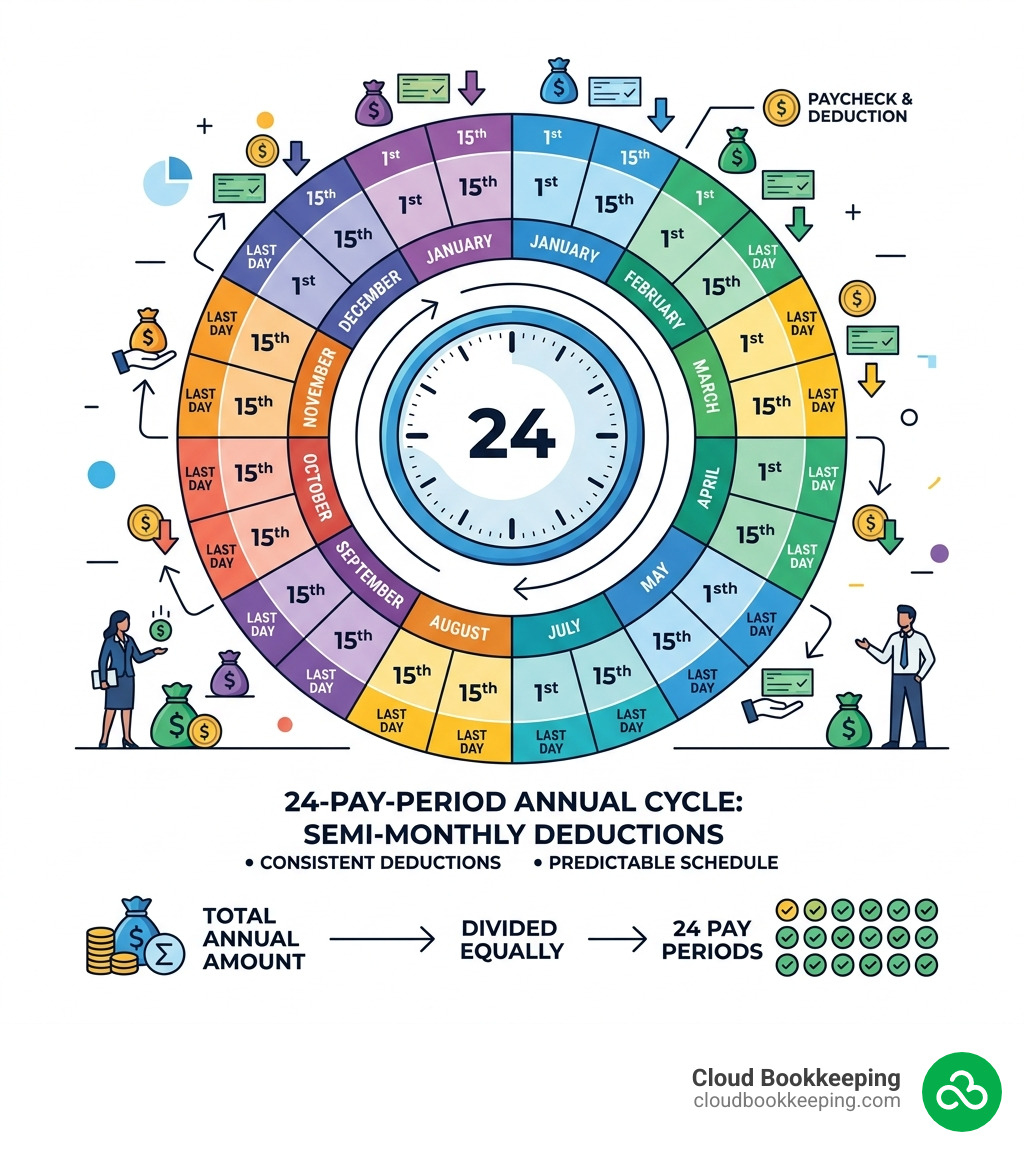
A semi-monthly payroll deduction is any amount withheld from your paycheck when you’re paid twice per month — resulting in exactly 24 paychecks per year. These deductions include taxes, health insurance premiums, and retirement contributions, each split evenly across those 24 pay periods.
| Key Detail | Semi-Monthly Payroll |
|---|---|
| Pay frequency | Twice per month |
| Paychecks per year | 24 |
| Common pay dates | 1st & 15th, or 15th & last day |
| Gross pay (example: $50,000/yr) | $2,083.33 per check |
| Deductions | Taxes, benefits, retirement — split across 24 periods |
So if your employer deducts $200/month for health insurance, you’ll see $100 taken out of each semi-monthly paycheck. Simple, predictable, and consistent.
For a lot of small business owners and their employees, that predictability is exactly what makes this schedule appealing — once you understand how it works.
I’m Charlie Perrin, founder of Cloud Bookkeeping, and over my 24 years of experience helping small business owners clean up their finances, I’ve answered the question of what does semi monthly payroll deduction mean more times than I can count. In this guide, I’ll walk you through exactly how these deductions work — so you can read your pay stub with confidence.
What Does Semi Monthly Payroll Deduction Mean?
To truly grasp what does semi monthly payroll deduction mean, we first have to look at the rhythm of the calendar. Unlike a bi-weekly schedule where you get paid every other Friday, a semi-monthly schedule is tied to specific dates. Most commonly, these are the 1st and the 15th of the month, or the 15th and the final day of the month.

When we talk about “deductions” in this context, we are referring to the gap between your gross pay (what you earned) and your net pay (what actually hits your bank account). Because there are exactly 24 pay periods in a year, your annual salary is divided by 24 to reach your gross pay per period. Your deductions follow the same logic.
There are two primary flavors of deductions you’ll see on your pay stub:
- Statutory Withholdings: These are mandatory. Think of Federal Income Tax, Social Security, and Medicare. Because your gross pay is consistent each period, these tax withholdings remain steady, making it much easier to track your year-to-date totals.
- Voluntary Deductions: These are the items you choose or agree to, such as health insurance premiums, 401(k) retirement contributions, or life insurance.
In our Semi-Monthly Payroll Guide for Businesses, we often highlight how this schedule simplifies life for the accounting department. Since most bills—like the company’s health insurance invoice—arrive once a month, splitting that cost into two equal deductions is mathematically clean. For you as an employee, it means your “take-home” pay doesn’t fluctuate wildly from month to month.
How Semi-Monthly Payroll Deductions Are Calculated
Calculating your pay on a semi-monthly basis requires a slightly different mathematical approach than other schedules. It’s not as simple as looking at a two-week block of time, because months aren’t exactly four weeks long.
For salaried employees, the math is straightforward:
- Annual Salary / 24 = Gross Semi-Monthly Pay.
- If you earn $60,000 a year, your gross pay is exactly $2,500.00 twice a month.
For hourly workers, it gets a bit more “fun” (and by fun, I mean complex). Since pay periods vary in length—some might have 10 workdays, others 11 or 12—your gross pay might change slightly each period based on actual hours worked. However, for a standard 40-hour workweek, we often use an average of 86.67 hours per semi-monthly period (2,080 annual hours divided by 24).
We take managing payroll taxes on time very seriously at Cloud Bookkeeping, and that starts with ensuring the base calculation for every deduction is accurate to the penny.
Calculating Taxes and Benefits for a Semi Monthly Payroll Deduction
Once we have your gross pay, we start the subtraction process. Here is how the most common deductions are handled:
- FICA Taxes: Social Security (6.2%) and Medicare (1.45%) are calculated as a percentage of your gross pay. Since your gross pay is higher on a semi-monthly check than a bi-weekly one, the dollar amount deducted for taxes will look larger per check—but remember, you’re receiving two fewer checks per year.
- Federal and State Withholding: These are based on the IRS tax tables for a 24-period year. Your payroll software looks at your “taxable gross” and applies the appropriate bracket.
- Health Insurance and Benefits: This is where semi-monthly shines. If your premium is $400 a month, your employer simply takes $200 from each check. There are no “magic third paycheck” months where benefits aren’t deducted, which can happen in bi-weekly systems.
- 401(k) Contributions: If you contribute 5% of your pay, that 5% is taken from your $2,500 gross pay (using our $60k example), resulting in a $125 contribution every single payday.
This consistency is a massive win for your personal budgeting. You know exactly what is coming out and when.
Managing Overtime and Your Semi Monthly Payroll Deduction
Now, let’s talk about the “Overtime Trap.” This is the primary challenge of a semi-monthly schedule for non-exempt (hourly) employees.
Under the Fair Labor Standards Act (FLSA), overtime must be calculated based on a fixed 7-day workweek, not the pay period. Because semi-monthly pay periods often end in the middle of a week (like a Wednesday the 15th), your overtime hours might be split across two different paychecks.
For example, if you work 50 hours from the 12th to the 18th, those 10 hours of overtime belong to that specific workweek. However, because the pay period cuts off on the 15th, your employer has to carefully track those hours to ensure you are paid the correct time-and-a-half rate, even if the payment is split between the end-of-month check and the mid-month check. This is why having full-service payroll supports recordkeeping is so vital for businesses with hourly staff.
Semi-Monthly vs. Bi-Weekly: Impact on Your Take-Home Pay
It is a common misconception that your pay frequency changes how much you earn. Whether you are paid weekly, bi-weekly, or semi-monthly, your annual salary remains the same. What does change is the “chunk” of money you receive and the frequency of your deductions.
In the U.S., bi-weekly pay is the most common, used by about 43% of businesses. Semi-monthly is used by roughly 19.8% of establishments. Here is how they stack up for someone earning $50,000 per year:
| Feature | Bi-Weekly | Semi-Monthly |
|---|---|---|
| Number of Checks | 26 | 24 |
| Gross Pay per Check | $1,923.08 | $2,083.33 |
| “Extra” Paychecks | 2 months have 3 checks | None (always 2) |
| Deduction Logic | Benefits often skipped on 3rd check | Benefits split evenly across all checks |
Many people prefer our Payroll Services because we help them transition to a schedule that matches their cash flow. Semi-monthly is often the favorite for companies with mostly salaried staff because it reduces the administrative cost of running payroll 26 times a year.
Understanding the Consistency of a Semi Monthly Payroll Deduction
The real “secret sauce” of semi-monthly pay is how it aligns with your life. Most of our major bills—mortgage, rent, car payments, and utilities—are monthly.
When you have a semi monthly payroll deduction, your take-home pay is perfectly predictable. You don’t have to worry about “short” months or “long” months. You receive half of your monthly net income on the 15th and the other half at the end of the month. This creates a level of financial stability that makes it much easier to ensure your rent is covered by the first check and your car payment by the second.
Compliance, Weekends, and Your Pay Stub
If you’re working here in San Antonio, you might wonder how local and state laws impact your check. While Texas generally follows federal guidelines, other states like California or New York have very specific rules about how often manual workers must be paid.
One of the most common questions we get is: “What happens if the 15th falls on a Saturday?”
Most employers will pay you on the preceding business day (Friday). This means your deductions are processed slightly early, but your pay is never late. If a payday falls on a bank holiday, the same rule usually applies. Keeping these dates consistent is a core part of how full-service payroll supports recordkeeping and ensures that your year-to-date (YTD) totals on your pay stub are always accurate.
When you look at your pay stub, you should always see:
- Gross Pay: Your total earnings before anything is taken out.
- Deductions: A line-by-line breakdown of taxes and benefits.
- Net Pay: Your actual take-home amount.
- YTD Totals: The running total of your earnings and deductions for the 2026 calendar year.
Frequently Asked Questions about Semi-Monthly Payroll
What happens to my deductions if payday falls on a Saturday?
As mentioned above, most companies will process your payroll on the Friday before. Your deductions (like health insurance or taxes) are still calculated based on the standard pay period, but the money hits your account a day or two early. It’s like a tiny weekend bonus!
Does a semi-monthly schedule change my total annual tax burden?
No. Your total tax liability is based on your total annual income. Whether that income is divided into 12, 24, 26, or 52 checks doesn’t change what you owe the IRS at the end of the year. The only difference is the amount of withholding taken out of each individual check.
Why is my semi-monthly check larger than a bi-weekly check?
Because you are receiving 24 checks instead of 26, each individual check must be larger to reach the same annual salary. For a $60,000 salary, a semi-monthly gross check is $2,500, while a bi-weekly gross check is roughly $2,307. Since you’re getting more “gross” pay per check, your deductions will also look slightly larger in terms of dollar amount, but the percentage remains the same.
Conclusion
Understanding what does semi monthly payroll deduction mean is the first step toward taking control of your financial life. While the math might seem a bit different at first, the 24-check cycle offers a level of consistency that many people find incredibly helpful for long-term budgeting and stress-free living.
At Cloud Bookkeeping, we pride ourselves on providing unparalleled customer service and clear reporting for small businesses right here in San Antonio. Under the leadership of Charlie Perrin, we help owners navigate the complexities of payroll so they can focus on what they do best: growing their business.
If you’re a business owner struggling to keep your deductions straight or an employee who wants a clearer picture of their pay, we’re here to help. We specialize in stress-free payroll processing that keeps you compliant and your team happy.
Ready to simplify your back office? Get expert help with your payroll services today and let us handle the heavy lifting.