Why Your Pay Cycle Choice Matters More Than You Think
Biweekly vs semi-monthly payroll are two of the most common pay schedules in the U.S. — and while they sound almost identical, they work very differently. Here’s the quick answer:
| Biweekly | Semi-Monthly | |
|---|---|---|
| Pay frequency | Every two weeks | Twice per month |
| Paychecks per year | 26 | 24 |
| Pay dates | Same day each week (e.g., every other Friday) | Fixed calendar dates (e.g., 1st and 15th) |
| Best for | Hourly employees, overtime tracking | Salaried employees, monthly accounting |
| Gross pay ($50,000 salary) | ~$1,923 per check | ~$2,083 per check |
According to the Bureau of Labor Statistics, 43% of U.S. private employers use biweekly payroll, while only about 20% use semi-monthly. But popularity alone shouldn’t drive your decision — the right choice depends on your workforce, your cash flow, and your administrative capacity.
For small business owners in San Antonio, picking the wrong pay cycle can create real headaches: unexpected cash flow gaps, overtime calculation errors, and frustrated employees wondering when payday lands this month.
I’m Charlie Perrin, founder of Cloud Bookkeeping, and with over 24 years of experience helping small business owners streamline their financial operations, I’ve seen how the biweekly vs semi-monthly payroll decision affects everything from employee trust to tax compliance. Let’s break it all down so you can make the right call for your business.
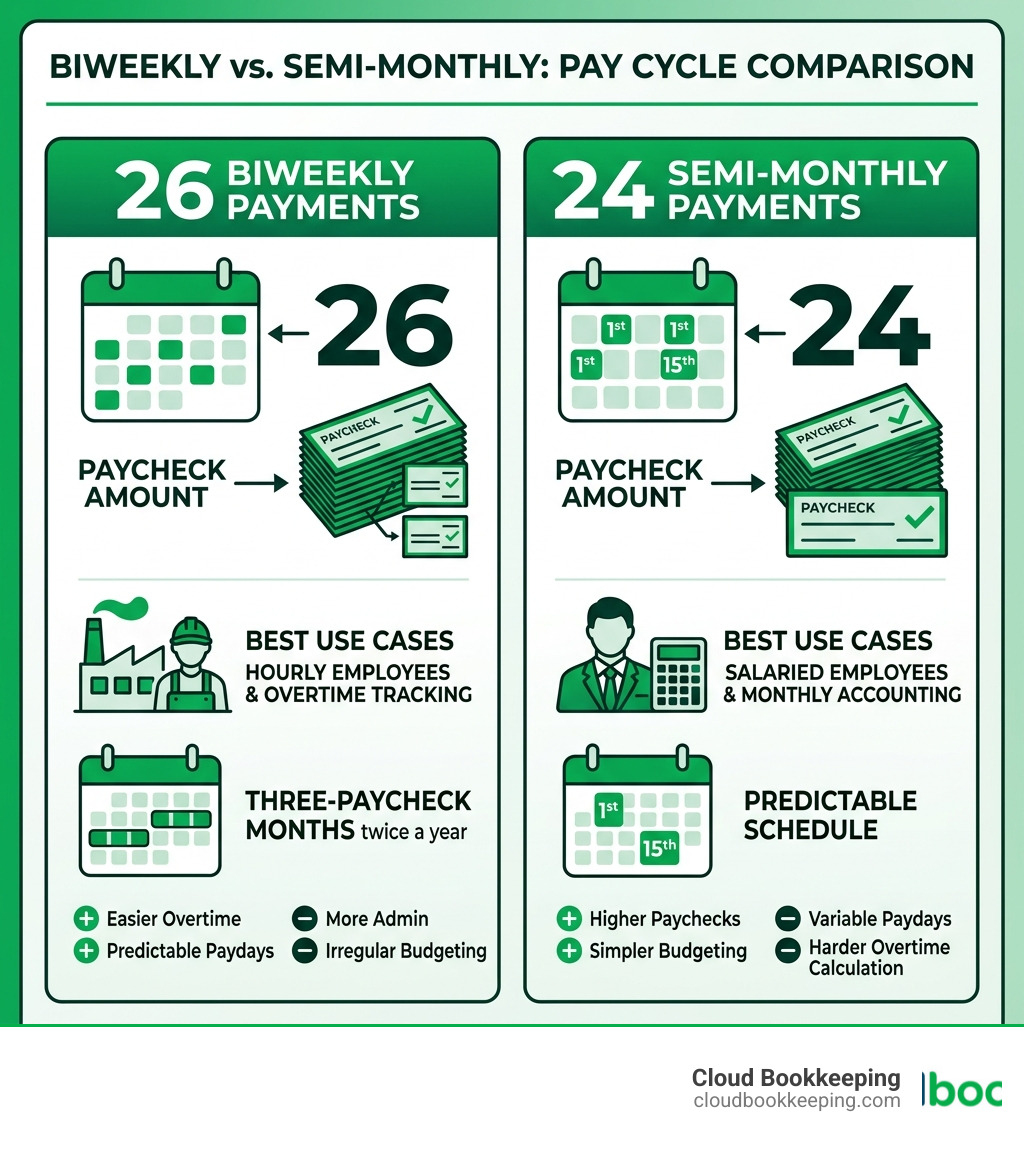
Defining Biweekly vs Semi-Monthly Payroll
To understand the biweekly vs semi-monthly payroll debate, we first need to clear up the terminology. These terms are often used interchangeably in casual conversation, but in accounting and HR, they represent two distinct systems of time and money.
Biweekly payroll means your employees are paid every two weeks. This results in exactly 26 pay periods over the course of a standard year. Because there are 52 weeks in a year, you simply divide by two. The hallmark of this schedule is its rhythm: if you pay on a Friday, your employees know they will receive a check every other Friday, regardless of what the calendar date is.
Semi-monthly payroll, on the other hand, means employees are paid twice per month, typically on fixed dates like the 1st and the 15th, or the 15th and the last day of the month. This results in 24 pay periods per year. While “twice a month” and “every two weeks” sound similar, the math tells a different story. Semi-monthly pay periods are slightly longer on average, and the dates are fixed to the calendar rather than the day of the week.
Getting clear on the difference between biweekly and semi-monthly payroll is a smart first step for improving how payroll runs behind the scenes. In 2026, automation and cloud-based tools make either schedule easier to manage, but your choice still shapes cash flow, timing, and day-to-day payroll planning.
How Pay Dates Differ for Biweekly vs Semi-Monthly
The most visible difference for your team will be when the money actually hits their bank accounts.
With a biweekly schedule, paydays are predictable by the day of the week. Most San Antonio businesses we work with choose “Every other Friday.” This consistency is a huge hit for employee morale and psychological safety—people like knowing that “next Friday is payday.”
Semi-monthly payroll follows set calendar dates, not set weekdays. So if you pay on the 15th and 30th, those dates will sometimes land on a weekend or bank holiday. That means you need a clear rule for when pay goes out, such as moving it to the prior business day. As a result, employees may be paid on a Tuesday one month and a Friday the next. If you want a closer look at how that works, this guide on semi-monthly payroll breaks it down.
Paycheck Amounts and Annual Frequency
Because a biweekly schedule has 26 pay periods and a semi-monthly schedule has 24, the amount of each individual paycheck will differ, even if the annual salary is identical.
Let’s look at the math for a $50,000 annual salary.
| Metric | Biweekly (26 Pays) | Semi-Monthly (24 Pays) |
|---|---|---|
| Gross Pay per Check | $1,923.08 | $2,083.33 |
| Total Annual Gross | $50,000.00 | $50,000.00 |
| Frequency | Every 14 days | Twice a month |
As you can see, semi-monthly paychecks are roughly 8% larger. This can be an attractive selling point for salaried professionals who have large monthly expenses like mortgages or car payments that align with the first of the month. However, for employees living paycheck to paycheck, the longer wait between checks in a semi-monthly system (which can sometimes be 16 days depending on the month’s length) can cause financial strain.
In 2026, tax withholdings and benefit deductions must also be carefully calibrated. Most insurance premiums are billed monthly. On a semi-monthly schedule, you simply split the premium in half. On a biweekly schedule, most companies deduct benefits from 24 checks and leave the two “extra” checks in those three-payday months deduction-free.
Pros and Cons for Employers and Employees
Choosing between these two isn’t just about math; it’s about the “human” in Human Resources. Each system has its own set of administrative burdens and perks.
Biweekly Pros:
- Employee Predictability: Paydays always fall on the same day of the week.
- Easier Overtime: It aligns perfectly with the standard 40-hour workweek (more on this below).
- The “Bonus” Feel: Employees love the two months a year where they get three checks.
Biweekly Cons:
- Higher Admin Costs: You are running payroll 26 times instead of 24. If your provider charges per run, this adds up.
- Cash Flow Spikes: Twice a year, you have to account for three payroll outflows in a single month.
Semi-Monthly Pros:
- Lower Admin Burden: Two fewer payroll runs per year means less time spent on data entry and lower processing fees.
- Accounting Alignment: It aligns perfectly with monthly financial statements and benefit billing cycles.
- Larger Checks: Employees see a higher gross amount on each stub.
Semi-Monthly Cons:
- Overtime Nightmares: Calculating overtime for hourly workers is significantly more complex when a workweek is split between two pay periods.
- Inconsistent Days: Employees can’t always plan for a “Friday payday.”
For HR leaders, this is often a decision that takes careful tradeoffs, balancing the needs of the accounting team with the preferences of the workforce.
The “Magic Third Paycheck” in Biweekly vs Semi-Monthly Payroll
One of the most discussed features of the biweekly cycle is the “magic third paycheck.” Because there are 52 weeks in a year, and 26 biweekly periods, there will always be two months in the year where employees receive three paychecks instead of two.
For employees, these months feel like a windfall. Since most people budget their lives based on two checks a month, that third check is often funneled into savings, used to pay down debt, or saved for holiday spending.
However, these months can put real pressure on a business owner’s cash flow. If you have 10 employees earning $2,000 per check, a three-paycheck month means coming up with an extra $20,000 in available cash. That is why keeping a payroll reserve is such a smart move. Building good systems around handling payroll deadlines smoothly can make these predictable spikes much easier to manage.
Overtime Calculations and FLSA Compliance
This is where the biweekly vs semi-monthly payroll decision becomes a matter of legal compliance. Under the Fair Labor Standards Act (FLSA), overtime must be calculated based on a fixed, 7-day workweek.
In a biweekly system, your pay period consists of exactly two 7-day workweeks. This makes calculating overtime for hourly (non-exempt) employees straightforward. You look at week one, then week two, and pay accordingly.
In a semi-monthly system, the 15th of the month rarely falls at the end of a workweek. It might fall on a Wednesday. This means a single workweek could be split across two different pay periods. This creates the “overtime trap”: your payroll admin has to track hours from the end of the previous period and combine them with the start of the current period to ensure the 40-hour threshold is calculated correctly.
According to the Frequency of Pay – TEXAS GUIDEBOOK FOR EMPLOYERS, Texas law is relatively flexible on frequency, but it is unyielding on the accuracy of overtime pay. If you have a large hourly workforce, biweekly is almost always the safer, more compliant choice.
Strategic Factors for Choosing Your Schedule
As we look toward the remainder of 2026, several strategic factors should influence your decision. The composition of your workforce is the most significant. If your team is primarily salaried executives, semi-monthly payroll is often the preferred route. It simplifies your monthly reporting and gives those employees the larger checks they often prefer.
However, if you run a retail shop, a restaurant, or a construction firm in San Antonio with many hourly workers, the administrative ease of biweekly payroll—especially regarding overtime—cannot be overstated.

Automation has made both payroll schedules easier to manage. Today’s payroll tools can handle the trickier “split week” calculations that often come with semi-monthly payroll, but this setup still usually needs more attention than a straightforward biweekly schedule. If sorting through these options feels like a lot, take a look at payroll support for small businesses to help make sure your chosen cycle runs smoothly and accurately.
Administrative Costs and Processing Burdens
Don’t overlook the “hidden” costs of your payroll frequency. Every time you run payroll, someone (either you or a staff member) has to review timecards, verify deductions, and approve the run.
Running payroll 26 times a year instead of 24 may sound minor, but it creates two more chances for something to slip through the cracks. As we cover in common payroll mistakes to watch for, errors often happen during manual data entry or when payroll is rushed to meet a deadline.
Furthermore, many payroll service providers charge a base fee per “run.” Switching from biweekly to semi-monthly could save you a modest amount in annual fees, but those savings are often wiped out if you have to spend hours manually calculating overtime for hourly staff.
Frequently Asked Questions about Payroll Cycles
Can a company use different payroll schedules for salaried vs. hourly employees?
Yes, this is a very common practice! Many of our clients in San Antonio use a “split” system. They pay their hourly, non-exempt staff on a biweekly basis to keep overtime calculations simple and compliant. Meanwhile, they pay their salaried, exempt management team on a semi-monthly basis to align with monthly budgeting and benefit cycles.
While this does add some extra admin work since you’re managing two payroll calendars, it can also give you the best of both options. The key is having a reliable process in place to keep up with weekly payroll tasks so nothing falls through the cracks.
How do benefit deductions work with biweekly vs semi-monthly payroll?
Benefit providers (health, dental, vision) almost always bill on a monthly basis.
- Semi-Monthly: You simply divide the monthly premium by two and deduct that amount from every check.
- Biweekly: You have 26 checks but only 12 months of premiums. Most businesses divide the annual premium by 24. This means deductions are taken from two checks every month. In the two months with three paychecks, the third check has zero benefit deductions, making it even “larger” for the employee.
What are the cash flow implications for businesses?
Biweekly vs semi-monthly payroll impacts your bank account differently. Semi-monthly is very predictable; your payroll expense is the same every month. This makes it easier for CFOs and owners to forecast their “burn rate.”
Biweekly payroll is predictable for 10 months of the year, but those two “three-paycheck” months can catch a business off guard if they haven’t set aside cash reserves. In 2026, with interest rates and economic shifts, maintaining that liquidity is more important than ever.
Conclusion
Choosing between biweekly vs semi-monthly payroll isn’t a one-size-fits-all decision. It’s a strategic choice that affects your company’s compliance, your bank account’s stability, and your employees’ financial well-being.
At Cloud Bookkeeping, we believe that your payroll should be a “set it and forget it” system that works for you, not against you. Whether you need help navigating the overtime traps of semi-monthly pay or managing the cash flow spikes of a biweekly schedule, our team is here to help.

Under the local leadership of Charlie Perrin, we provide San Antonio small businesses with unparalleled customer service and crystal-clear reporting. We don’t just crunch numbers; we help you understand what they mean for your future.
Ready to simplify your back office? Explore our professional payroll services today and let us help you find the perfect rhythm for your business.