Why 1099 Vendor Compliance in Texas Catches So Many Business Owners Off Guard
1099 vendor compliance in Texas means following federal IRS rules to properly report payments made to independent contractors and non-employee vendors — because Texas has no state income tax, there is no separate state filing requirement.
Here is what you need to know at a glance:
| Key Question | Quick Answer |
|---|---|
| Do I file 1099s with Texas? | No. Texas has no state income tax filing requirement. |
| Which form for contractor pay? | Form 1099-NEC for nonemployee compensation |
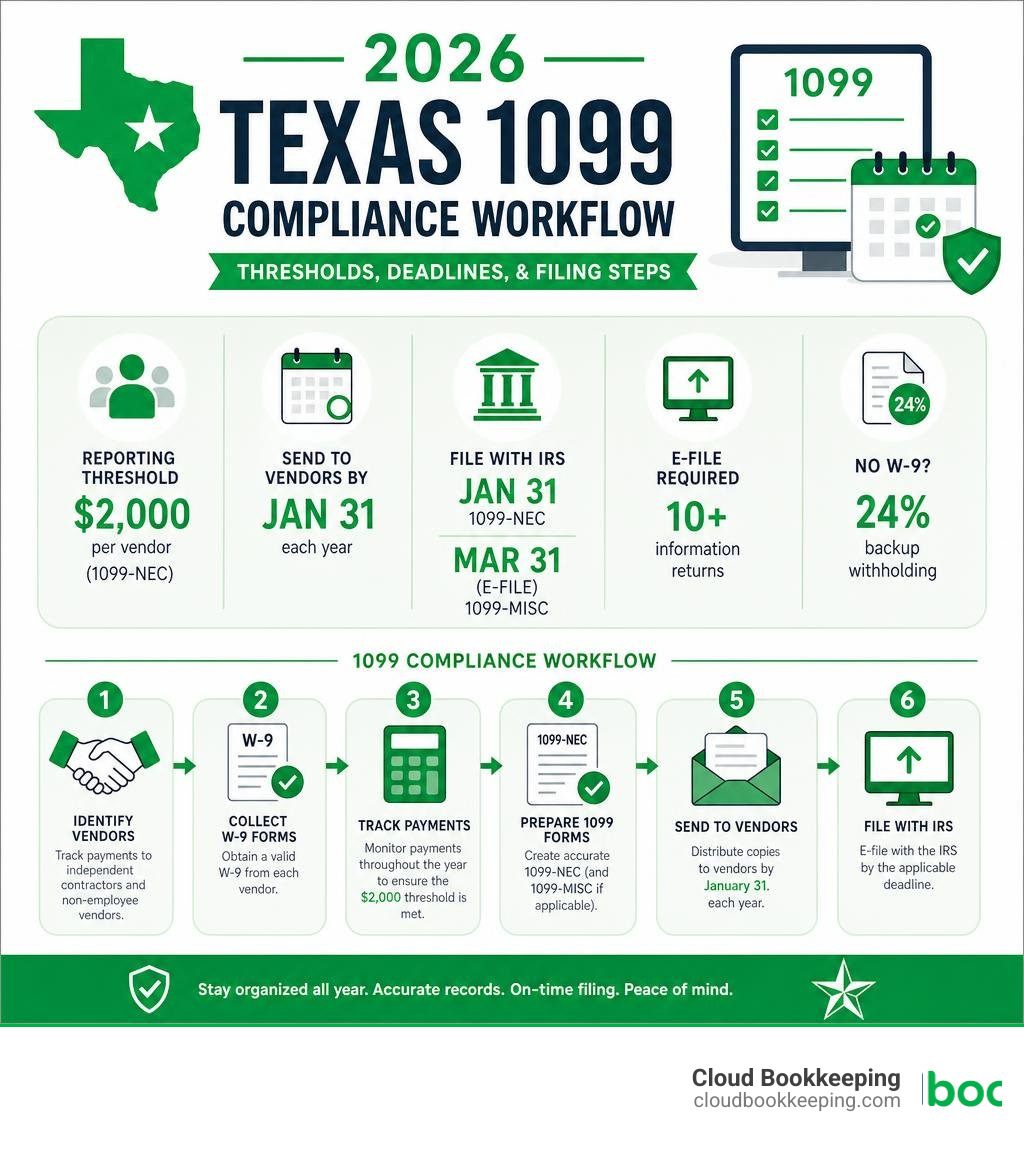
| 2026 reporting threshold (1099-NEC)? | $2,000 per vendor (raised from $600 under OBBBA) |
| Deadline to send copies to vendors? | January 31 each year |
| Deadline to file with the IRS? | January 31 for 1099-NEC; March 31 (e-file) for 1099-MISC |
| Must I file electronically? | Yes, if filing 10 or more information returns |
| What if a vendor won’t give me a W-9? | Withhold 24% as backup withholding |
Running a small business in San Antonio means wearing a lot of hats. Between managing cash flow, paying vendors, and keeping your books in order, 1099 compliance can easily fall through the cracks — until the IRS sends a letter.
The rules changed again in 2026. The threshold for reporting nonemployee compensation jumped from $600 to $2,000 under the One Big Beautiful Bill Act (OBBBA). The e-filing threshold dropped to just 10 returns. And penalties for getting it wrong can hit $330 per missing form — with no cap if the IRS decides it was intentional.
This guide walks you through everything you need to know, clearly and without the jargon.
I’m Charlie Perrin, founder of Cloud Bookkeeping, and I’ve spent over 24 years helping small business owners build cleaner financial systems — including setting up accurate, penalty-free 1099 vendor compliance in Texas processes from the ground up. Let’s break it all down so you know exactly where you stand heading into tax season.
Understanding Federal and State 1099 Vendor Compliance Texas Rules in 2026
When operating a business in the Lone Star State, tax compliance has a unique rhythm. Because Texas is one of the nine states with no individual state income tax, you do not have to file state-level 1099 returns with the Texas Comptroller of Public Accounts. However, this lack of state-level filing does not mean you are off the hook. Federal IRS rules apply fully to every business in Texas, and the federal government is more vigilant than ever.
To understand 1099 rules for contractors in Texas, you must look at how federal legislation shapes your local bookkeeping. The biggest shift in 2026 comes from the One Big Beautiful Bill Act (OBBBA). For years, the magic number for nonemployee compensation was $600. Starting in the 2026 tax year, the OBBBA has officially raised the reporting threshold for Form 1099-NEC to $2,000. If you pay an independent contractor less than $2,000 during the calendar year, you are no longer federally required to issue a 1099-NEC.
But do not let that higher threshold lull you into a false sense of security. The IRS uses 1099 forms to cross-check the income reported by self-employed individuals against the business deductions claimed by companies like yours. If your bookkeeping is messy and you fail to report these payments, you risk triggering audits, back taxes, and heavy fines.
Additionally, while individual contractors do not pay state income tax, your business may still be subject to the Texas Franchise Tax. Keeping your books clean and aligning your contractor payments with your franchise tax reporting is vital to proving your legitimate business expenses. For more on managing these federal cross-currents, check out our guide on IRS Rules for 1099 Vendors.
Classifying Workers: 1099 Independent Contractors vs. W-2 Employees
Before you can file a 1099, you must be 100% certain that the person you are paying is actually an independent contractor and not a W-2 employee. Misclassification is one of the most heavily audited areas for businesses in San Antonio, and getting it wrong can lead to catastrophic financial penalties.
The IRS and the Texas Workforce Commission (TWC) work together to police worker classification. According to the Reporting payments to independent contractors – IRS guidelines, there is no single “magic number” of factors that automatically determines a worker’s status. Instead, the relationship is evaluated across three primary categories of common-law rules:
- Behavioral Control: Does your business direct or control how the worker does the task? If you dictate their specific hours, provide their training, or mandate specific methods, they look like an employee. If they set their own schedule and use their own methods, they lean toward being a contractor.
- Financial Control: How is the worker paid? Do they have a significant financial investment in their own tools and equipment? Can they realize a profit or incur a financial loss? Independent contractors typically invoice for their services, provide their own specialized equipment, and are free to seek other business opportunities.
- Type of Relationship: Do you have a written contract? Do you provide employee-type benefits like health insurance, vacation pay, or a pension plan? Is the work performed a key aspect of your regular, daily business operations?
In Texas, the TWC uses a strict multi-part test to determine employment status for unemployment tax purposes. If the TWC audits your business and finds you misclassified workers, you could be held liable for unpaid unemployment taxes, interest, and penalties, in addition to federal back taxes for unpaid FICA and FUTA.
To protect your business, always document the relationship with a clear, signed independent contractor agreement. For a deeper dive into how to evaluate your team, read our resource on 1099 Requirements for Vendors.
Key 1099 Forms and Payment Thresholds for Texas Businesses
Navigating 1099 vendor compliance Texas requires knowing which form to file for which type of payment. The IRS uses several different 1099 forms, but three are most common for standard business operations.
| Form Type | Purpose | 2026 Reporting Threshold |
|---|---|---|
| Form 1099-NEC | Nonemployee Compensation (services, independent contractors, attorneys) | $2,000 |
| Form 1099-MISC | Miscellaneous Information (rent, royalties, legal settlements) | $600 ($10 for royalties) |
| Form 1099-K | Payment Card and Third-Party Network Transactions | $600 |
If you are paying a local freelance graphic designer, a contract web developer, or an incorporated attorney for professional services, you will likely use Form 1099-NEC. If you need professional help preparing these, check out our 1099-NEC Filing Assistance services.
Navigating 1099 Vendor Compliance Texas for LLCs and Corporations
One of the most common points of confusion for San Antonio business owners is whether to issue a 1099 to an LLC or a corporation.
As a general rule, payments to corporations (both C-Corps and S-Corps) are exempt from 1099 reporting. However, LLCs are trickier because an LLC can be taxed as a sole proprietorship, a partnership, or a corporation.
To determine if an LLC needs a 1099, you must look at Box 3 on their completed Form W-9:
- If they checked “Limited Liability Company” and wrote “P” (Partnership) or left it blank as a disregarded single-member LLC, you must issue a 1099 if they meet the threshold.
- If they wrote “C” (C-Corporation) or “S” (S-Corporation), they are exempt.
The Golden Exception: Payments made for legal services must always be reported on a 1099, even if the law firm is fully incorporated. If you paid an incorporated law firm $2,000 or more in fees for legal services in 2026, you must issue them a 1099-NEC. If you paid them for a legal settlement, that gross proceed amount goes on a 1099-MISC.
Handling Third-Party Payments and 1099-K Reporting
Another area where Texas businesses make mistakes is double-reporting payments made via credit cards, PayPal, Venmo, or other third-party payment processors.
Under IRS rules, if you pay a contractor using a credit card or a third-party payment network, you do not report that payment on Form 1099-NEC. The payment processor itself is responsible for reporting those transactions on Form 1099-K.
For the 2026 tax year, the reporting threshold for Third-Party Settlement Organizations (TPSOs) is set at $600. Your bookkeeping system must clearly distinguish between payments made via bank check or ACH (which you must report on a 1099-NEC) and those made via credit card or payment apps (which you exclude).
How Texas State Agencies Use USAS for 1099 Reporting
While private businesses use standard accounting software like QuickBooks, Texas state agencies and institutions of higher education rely on the Uniform Statewide Accounting System (USAS) and the Texas Identification Number System (TINS) to track and report their payments.
According to official state guidelines outlined in the USAS Procedures for 1099 Reporting – FPP E.001, state agencies must follow a strict annual calendar to verify and report 1099 data:
- DAFR7940 Verification Report: Throughout the year, and intensively in January, agencies request this report to review all 1099-reportable transactions. This allows agencies to spot missing Taxpayer Identification Numbers (TINs) or incorrect 1099 indicators before final files are built.
- Adjusting USAS Data: If an agency finds an error, they use Transaction Code (T-code) 480 to manually adjust 1099 indicators. Post-year-end corrections are typically backdated to December 31 of the reporting year to ensure they are captured.
- DAFR7950 Data Set Report: Once the data is verified, agencies run this report to generate the final electronic data files.
- Filing via IRIS or FIRE: State agencies must submit their files electronically to the IRS. For 2026, agencies must use either the IRS Filing Information Returns Electronically (FIRE) system or the newer Information Returns Intake System (IRIS) portal. The IRS requires a unique Transmitter Control Code (TCC) for IRIS, which cannot be shared with the FIRE system.
USAS automatically overrides and forces 1099 indicators (such as Indicator A or 6) when payments are processed under specific Comptroller Object Codes for medical or legal services, ensuring that even corporate payees in these categories are flagged correctly.
Step-by-Step Guide to Maintaining 1099 Vendor Compliance Texas
Whether you run a boutique on Broadway in San Antonio or manage a growing construction crew in Bexar County, establishing a consistent, repeatable bookkeeping workflow is the only way to guarantee compliance.
Step-by-Step Workflow for 1099 Vendor Compliance Texas
To keep your business safe from audits and penalties, implement this simple five-step process:
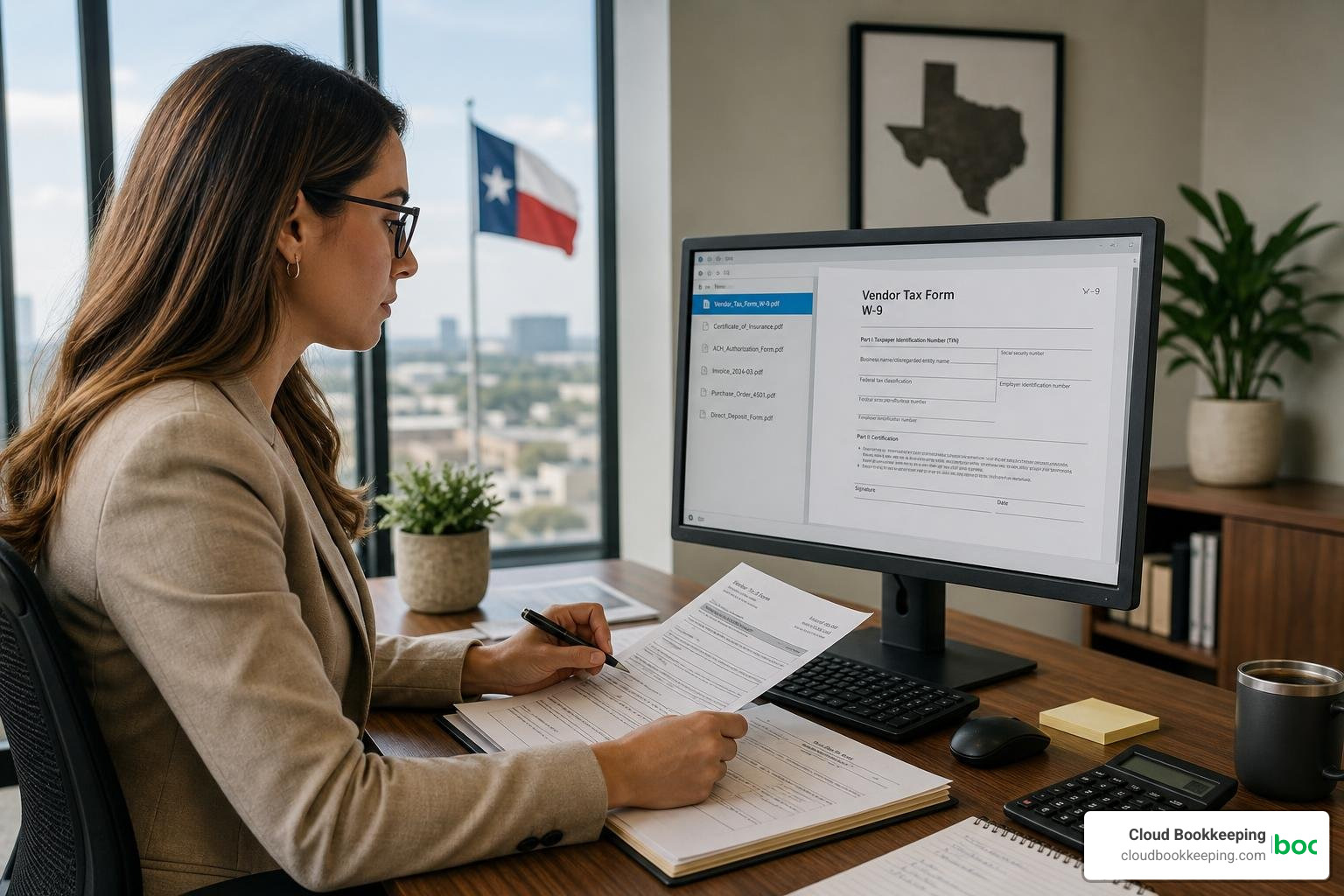
- Collect W-9s Immediately: Never write a check to a new vendor until they have handed you a completed and signed Form W-9. Trying to track down a contractor in January for their tax ID is a bookkeeping nightmare. Make W-9 collection a mandatory part of your onboarding process.
- Verify TINs with the IRS: Use the IRS TIN Matching service to verify that the vendor’s name and tax ID match official records. This prevents “B-Notices” (IRS notifications of mismatched information) later on.
- Track Payments Carefully: In your bookkeeping software (like QuickBooks), flag every 1099-eligible vendor. Ensure your system tracks payments by payment method so you can easily filter out credit card and third-party processor payments at year-end.
- Implement Backup Withholding If Needed: If a vendor refuses to provide a valid W-9 but you must pay them, federal law requires you to immediately withhold 24% of their payment as backup withholding and remit it to the IRS. If you fail to do this, your business can be held personally liable for that 24%.
- Issue and File Forms: Follow the steps in our guide on how to prepare and issue 1099 forms to distribute copies to your vendors by January 31 and file electronically with the IRS. Keep all signed W-9s, payment records, and filed 1099 copies in your records for at least four years in case of an audit. For more on managing state-specific rules, read up on State Tax Compliance.
Critical Deadlines and Penalties for Non-Compliance
The IRS does not accept “I was too busy running my business” as an excuse for late filings. The deadlines are absolute:
- January 31, 2026: Deadline to furnish copies of Form 1099-NEC to recipients and file them with the IRS (either paper or electronic). Because January 31 falls on a Saturday in 2026, the official postmark and filing deadline is extended to February 2, 2026.
- March 31, 2026: Deadline to electronically file Form 1099-MISC with the IRS.
If you miss these deadlines, the penalties accumulate quickly:
- Filed within 30 days of deadline: $60 per form
- Filed more than 30 days late but by August 1: $130 per form
- Filed after August 1 or not at all: $330 per form
- Intentional Disregard: If the IRS determines you deliberately ignored the filing rules, the penalty increases to a minimum of $660 per form (or 10% of the total reportable payments, whichever is greater) with no maximum cap.
Additionally, if you file 10 or more information returns (including W-2s and all 1099s combined) in 2026, you must file electronically. Paper filing when you meet this threshold will result in the forms being rejected, triggering late-filing penalties.
Frequently Asked Questions about Texas 1099 Compliance
Do I need to file 1099s with the State of Texas?
No. Because Texas has no state personal income tax, there is no state agency that requires you to file 1099 forms. You only need to file your 1099s with the federal IRS. However, you must still maintain accurate bookkeeping to support your federal deductions and align your business expenses with your Texas Franchise Tax filings.
What is the 1099-NEC threshold for the 2026 tax year?
Under the One Big Beautiful Bill Act (OBBBA) passed for 2026 and beyond, the federal reporting threshold for Form 1099-NEC has been raised to $2,000. You only need to issue a 1099-NEC to independent contractors who received $2,000 or more in nonemployee compensation via cash, check, ACH, or direct deposit during the calendar year.
What happens if a vendor refuses to provide a W-9?
If a vendor refuses to provide a completed W-9, you must immediately implement backup withholding at a flat rate of 24% on any future payments and remit those funds to the IRS. If you have already paid them, file the 1099 form with the IRS anyway and write “Refused” in the Taxpayer Identification Number box to show you made a good-faith effort to comply.
Conclusion
Managing 1099 vendor compliance Texas requirements doesn’t have to be a source of year-end panic. By building a proactive, year-round bookkeeping system that collects W-9s on day one and tracks payments accurately, you can completely eliminate the stress of tax season.
At Cloud Bookkeeping, we help San Antonio small businesses stay ahead of changing tax laws, clean up their books, and automate their vendor management. Led by Charlie Perrin, our team provides personalized QuickBooks expertise and reliable back-office support so you can focus on growing your business.
Don’t let the IRS mess with your stress. Reach out to us today at 1099 Vendor Management Services to get your books in order and ensure your business is fully compliant for 2026!