Why IRS Rules for 1099 Vendors Can Make or Break Your Tax Season
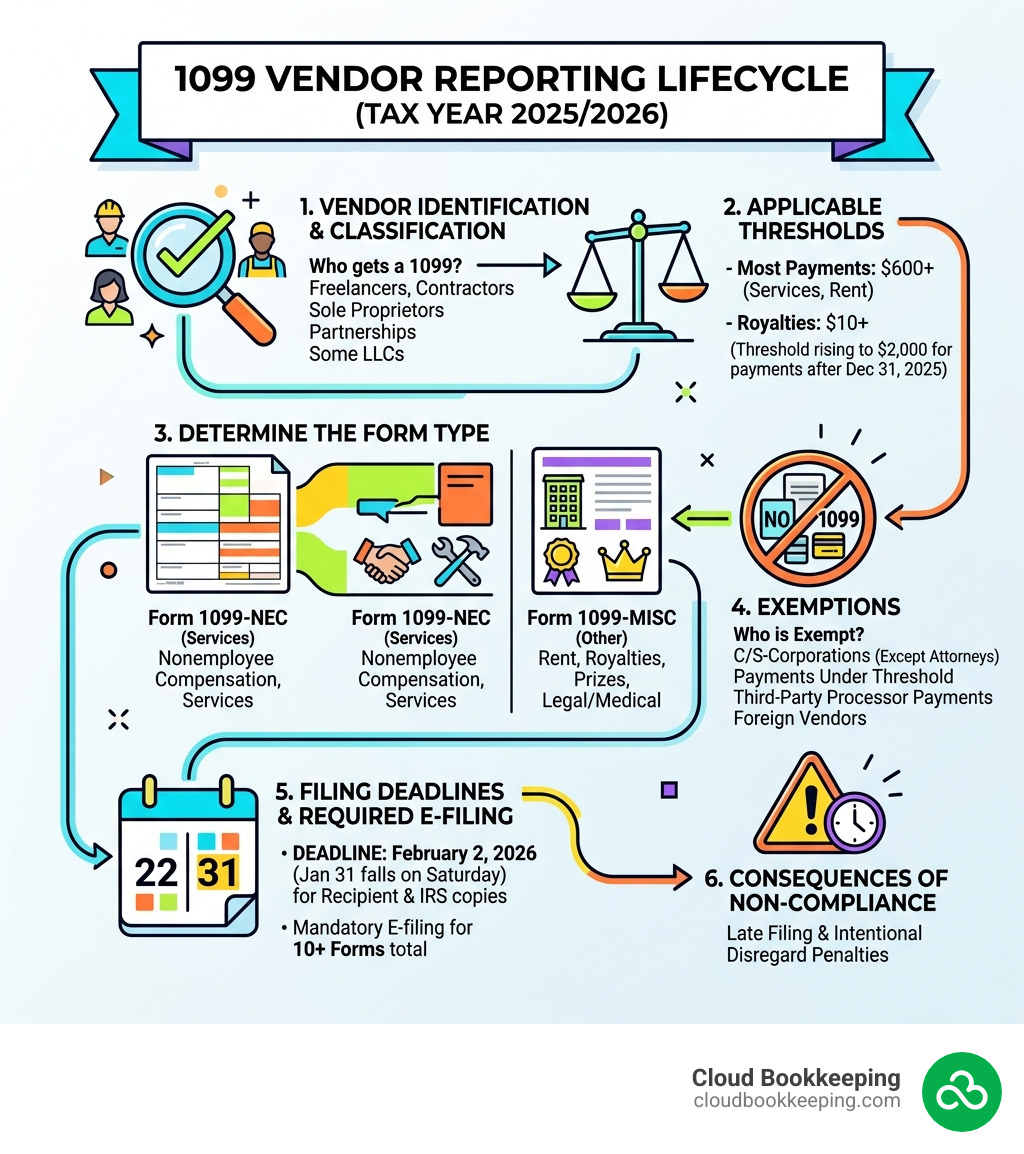
The IRS rules for 1099 vendors require businesses to report payments of $600 or more made to non-employee workers — like freelancers, independent contractors, and sole proprietors — using Form 1099-NEC or Form 1099-MISC, depending on the payment type.
Here’s a quick snapshot of what you need to know:
| Key Rule | Details |
|---|---|
| Who gets a 1099? | Freelancers, independent contractors, sole proprietors, partnerships, and some LLCs |
| Minimum threshold | $600+ for most payments (rising to $2,000 for payments after Dec 31, 2025); $10+ for royalties |
| Which form? | 1099-NEC for services; 1099-MISC for rent, royalties, prizes, and more |
| Deadline | January 31 (February 2, 2026, since Jan 31 falls on a Saturday) |
| Who is exempt? | C/S-corporations (except attorneys), payments under $600, foreign vendors, third-party processor payments |
| E-filing required? | Yes, if you file 10 or more information returns |
Miss these rules and you’re looking at penalties, back taxes, and unwanted IRS attention.
For small business owners, this stuff can feel overwhelming fast. You’re already juggling payroll, invoices, and cash flow — and now the IRS wants you to track every dollar you paid that freelancer last year? It adds up quickly, and the consequences of getting it wrong are real.
That’s exactly why understanding these rules before January rolls around is so important.
I’m Charlie Perrin, founder of Cloud Bookkeeping, and with over 24 years of experience helping small business owners navigate everything from bookkeeping to tax compliance, I’ve guided countless clients through the exact same questions about IRS rules for 1099 vendors. In the sections below, I’ll walk you through everything you need to know — step by step — so you can stay compliant and avoid costly surprises.
Understanding the IRS Rules for 1099 Vendors: Who and What to Report
When we talk about “vendors” in the eyes of the IRS, we aren’t just talking about the big companies that sell you office supplies. For tax purposes, a vendor is any entity or individual you pay to provide services or goods to your business. However, the IRS rules for 1099 vendors specifically target “non-corporate” entities.
This means if you hire a freelance graphic designer, a local plumbing partnership, or a sole proprietor consultant, you are likely on the hook for reporting those payments. The IRS uses these forms to cross-check the income reported by the vendor against the expenses claimed by your business. If you claim a deduction for “Contract Labor” but never file the corresponding 1099, it raises a red flag that can lead to an audit.
It is important to remember that these rules only apply to payments made in the course of your “trade or business.” If you hire a painter to refresh your home kitchen, you don’t need to worry about 1099s. But if that same painter touches up your San Antonio storefront, the IRS rules for 1099 vendors apply. Even nonprofit organizations and government agencies are considered to be engaged in a trade or business for these reporting purposes.
Key Thresholds Under IRS Rules for 1099 Vendors
The most famous number in the 1099s is $600. Generally, if you pay a vendor $600 or more during the calendar year for services, you must file a return. However, as we move through 2026, there are some critical updates to keep on your radar:
- The $600 Standard: This remains the baseline for most nonemployee compensation and rent payments.
- The $2,000 Shift: For payments made after December 31, 2025, the reporting threshold for certain nonemployee compensation is scheduled to increase to $2,000. Since we are currently in April 2026, you should be tracking your current year payments with this new higher limit in mind for the next filing season.
- The $10 Rule: If you are paying royalties (perhaps for a copyright or oil and gas rights), the threshold is a tiny $10.
- The $5,000 Direct Sales Rule: If you sell $5,000 or more of consumer products to a person on a buy-sell or deposit-commission basis for resale, you must report this.
According to the Instructions for Forms 1099-MISC and 1099-NEC (04/2025) – IRS, these thresholds apply to the cumulative total paid to a vendor throughout the year, not just individual invoices.
Distinguishing Form 1099-NEC from 1099-MISC
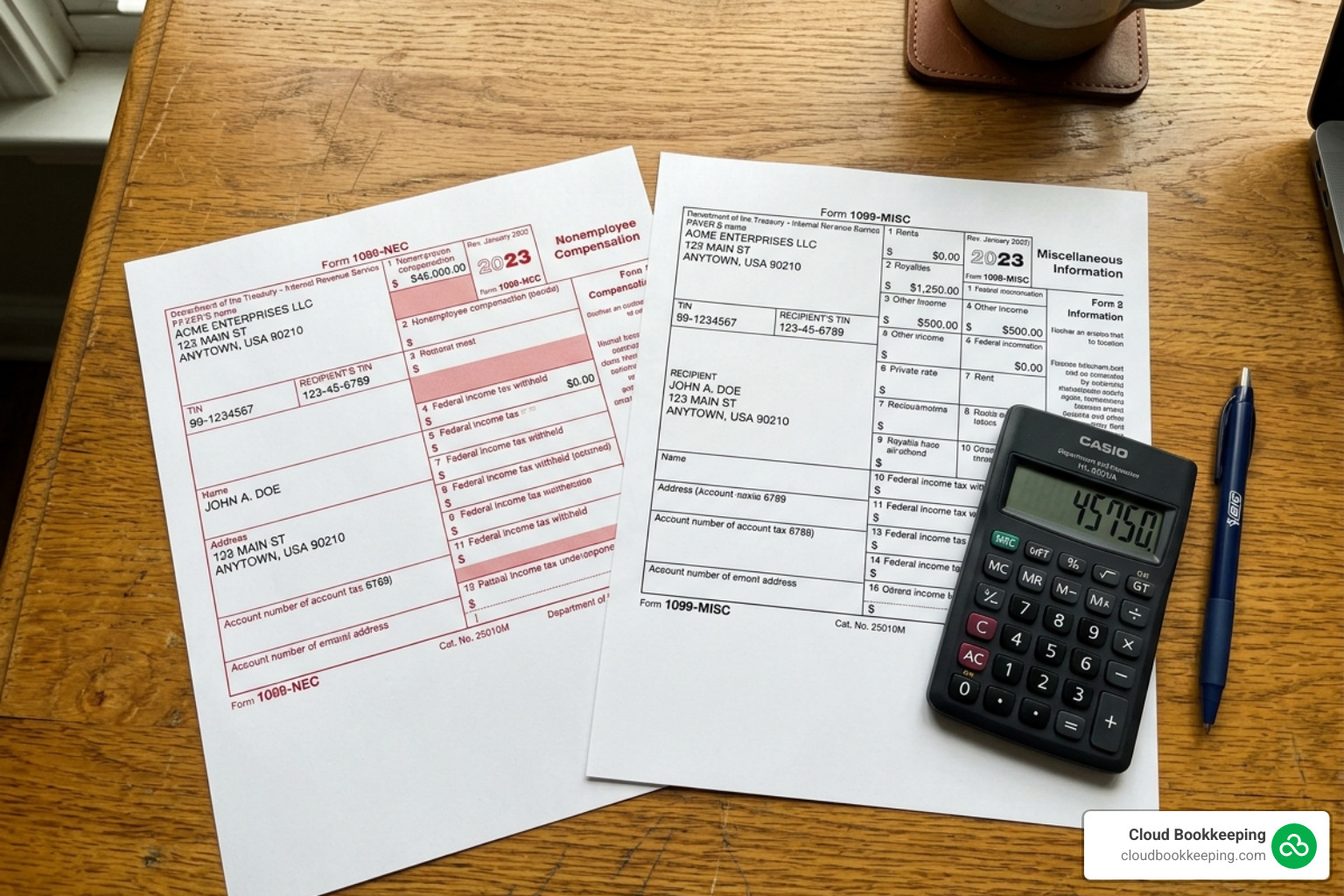
A few years ago, the IRS brought back Form 1099-NEC (Nonemployee Compensation) to separate contractor pay from other types of income. It can be confusing, but here is the breakdown:
- Form 1099-NEC: This is used almost exclusively for services. If you paid a human (or a partnership) to do work for your business—whether they are a web developer, a lawyer, or a janitor—their pay goes in Box 1 of the 1099-NEC.
- Form 1099-MISC: This is the “catch-all” form. You use this for:
- Rent: Paying a landlord for your office space (unless you pay a real estate agent).
- Royalties: Payments for the use of intellectual property.
- Prizes and Awards: Non-service-related winnings.
- Medical and Health Care Payments: Payments to doctors or hospitals for business-related health services.
- Attorney Gross Proceeds: This is a tricky one. If you pay a legal settlement where the check is made out to the attorney, it goes on 1099-MISC Box 10, even if the attorney is incorporated.
Classifying Your Workforce: 1099 Vendor vs. W-2 Employee
One of the biggest risks in following IRS rules for 1099 vendors is misclassifying someone who should actually be an employee. The IRS is very protective of W-2 status because it ensures they collect Social Security, Medicare, and unemployment taxes upfront.
To help you decide, the IRS looks at three main categories of control:
| Factor | 1099 Contractor (Vendor) | W-2 Employee |
|---|---|---|
| Behavioral Control | The vendor decides when, where, and how the work is done. | The business provides training and specific instructions on methods. |
| Financial Control | The vendor has a significant investment in their own tools and can realize a profit or loss. | The business reimburses expenses and provides all necessary equipment. |
| Type of Relationship | Usually a project-based or temporary arrangement with no benefits. | Expectation of a permanent relationship; often receives benefits like 401k or insurance. |
As the IRS explains in its reporting guides, there is no “magic number” of factors that make someone a contractor. You have to look at the entire relationship. Even remote workers can be employees if you control the details of their workday.
The Consequences of Misclassification
If you treat a worker as a 1099 vendor but the IRS later determines they were an employee, the financial hit can be devastating. You may be held liable for:
- Unpaid employer shares of Social Security and Medicare.
- Unpaid workers’ compensation premiums.
- Unpaid unemployment taxes.
- Massive penalties for failing to file W-2s.
If you are ever unsure, you can file Form SS-8 with the IRS to ask for an official determination, though be warned—this process can take six months or longer. For those who realize they’ve made a mistake, programs like the Voluntary Classification Settlement Program (VCSP) allow you to reclassify workers prospectively with partial tax relief. You can learn more about these nuances in our guide on 1099 requirements for vendors, what employers need to know.
Step-by-Step: How to Comply with IRS Rules for 1099 Vendors
Compliance isn’t just about filing a form in January; it’s a year-round process. Here is our recommended workflow to stay on the right side of the IRS rules for 1099 vendors:
- Request a W-9 Immediately: Never pay a vendor until you have a signed Form W-9 in your hand. This form provides their legal name, address, and Taxpayer Identification Number (TIN) or Social Security Number.
- Verify the TIN: Use the IRS TIN Matching service to ensure the name and number match. This prevents “B-Notices” (mismatch notices) later.
- Track Payments by Method: Keep your books clean! You need to know exactly how much you paid each vendor via check, cash, or direct deposit.
- Implement Backup Withholding: If a vendor refuses to provide a TIN, the IRS requires you to withhold 24% of their payment and send it to the IRS. If you don’t, you might have to pay that 24% out of your own pocket!
- Choose Your Filing Method: For most modern businesses, electronic filing is the only way to go.
According to the IRS FAQ on filing requirements, businesses can use the IRIS (Information Returns Intake System) portal. It’s a free, web-based platform that allows you to upload CSV files or manually enter data to file your 1099s without needing expensive software.
Deadlines and E-filing IRS Rules for 1099 Vendors
Timing is everything. For the 2025 tax year (which you’ll be wrapping up in early 2026), keep these dates in your calendar:
- January 31: This is the traditional deadline to furnish copies to your vendors and file Form 1099-NEC with the IRS.
- February 2, 2026: Because January 31, 2026, falls on a Saturday, the deadline is pushed to the next business day.
- March 31, 2026: This is the deadline for filing Form 1099-MISC electronically.
The 10-Return Threshold: One of the most important updates in recent years is the e-filing mandate. If you are filing 10 or more information returns (this includes W-2s and all types of 1099s combined), you must file electronically. Paper filing is essentially a thing of the past for all but the smallest “mom and pop” shops. If you do file on paper, you must include Form 1096, which acts as a cover sheet for your 1099 stack.
Common Exceptions and the Impact of Third-Party Payments
Not every check you write requires a 1099. Understanding the exceptions is just as important as knowing the rules.
- The Corporate Exception: Generally, you do not need to send a 1099 to a C-Corporation or an S-Corporation. This is why many freelancers incorporate—to simplify their clients’ lives.
- Merchandise and Freight: Payments for physical goods, storage, or shipping do not require a 1099.
- Tax-Exempt Organizations: Payments to 501(c)(3) nonprofits are exempt.
The 1099-K Transition: This is a huge area of confusion. If you pay a vendor via credit card, PayPal, Stripe, or other third-party processors, you do not issue a 1099-NEC. Why? Because the payment processor is responsible for issuing a Form 1099-K.
The IRS has been in a “transition period” for 1099-K thresholds. For 2025, the threshold for 1099-K reporting is $2,500, but it is scheduled to drop to $600 for 2026 and beyond. Regardless of the threshold, the rule for you remains the same: if you paid via a third-party network, it’s their job to report it, not yours.
Handling Foreign Vendors and Special Cases
If you hire a developer in another country, the IRS rules for 1099 vendors change. You generally do not issue a 1099-NEC to a foreign person performing work outside the United States. Instead, you should:
- Collect a Form W-8BEN (for individuals) or W-8BEN-E (for entities) to certify their foreign status.
- If the work is performed within the U.S., you may need to file Form 1042-S and potentially withhold 30% of the payment for taxes.
As mentioned earlier, attorneys are the exception to the corporate rule. Even if your lawyer is “Law Firm, P.C.” (a corporation), you must still issue them a 1099-NEC for their fees or a 1099-MISC for gross proceeds from a settlement.
Frequently Asked Questions about IRS Rules for 1099 Vendors
Do I need to send a 1099 to an LLC?
This is the most common question we get in San Antonio! The answer is: it depends. An LLC can be taxed as a sole proprietorship, a partnership, or a corporation.
- If the LLC is a Single-Member LLC (disregarded entity) or a Partnership, you must send a 1099.
- If the LLC has elected to be treated as a C-Corp or S-Corp, you usually do not need to send one. Check Box 3 on their W-9 to be sure. If they haven’t checked the “Limited Liability Company” box and specified their tax classification, ask them to clarify.
What happens if a vendor refuses to provide a W-9?
If a vendor is being difficult, you have the law on your side. You should inform them that under IRS rules, you are required to begin backup withholding at a rate of 24% immediately. Most vendors will find their W-9 very quickly once they realize they’ll only be receiving 76% of their check! If you’ve already paid them and they won’t provide the info, file the 1099 anyway with “Refused” in the TIN box—this protects you, though it will likely trigger an IRS notice for the vendor.
Are personal payments subject to 1099 reporting?
No. The IRS rules for 1099 vendors apply only to payments made in the course of your trade or business. Personal expenses—like paying a babysitter, a personal trainer, or a house cleaner—are not reported on Form 1099-NEC. However, if you run a home-based business and hire someone to clean your dedicated home office, that portion could be considered a business expense subject to reporting.
Conclusion
Staying on top of the irs rules for 1099 vendors doesn’t have to be a nightmare. By collecting W-9s early, tracking your payments accurately, and embracing the new e-filing requirements, you can breeze through tax season without the “Taxman” catching you napping.
At Cloud Bookkeeping, we know that as a small business owner in San Antonio, your time is better spent growing your company than squinting at IRS instructions. Whether you need help with QuickBooks expertise, clear financial reporting, or a dedicated partner to handle your services 1099 vendor management, we’re here to help. Our local leadership, led by Charlie Perrin, is committed to providing the unparalleled customer service you need to keep your books—and your compliance—in perfect order.
Don’t wait until January to find out you’re missing a dozen W-9s. Reach out to us today, and let’s get your vendor management streamlined for 2026!