What Is 1099 NEC Filing Assistance and Who Needs It?
1099 NEC filing assistance helps businesses correctly report payments made to independent contractors, freelancers, and vendors — and stay on the right side of IRS rules.
Here’s a quick overview of what you need to know:
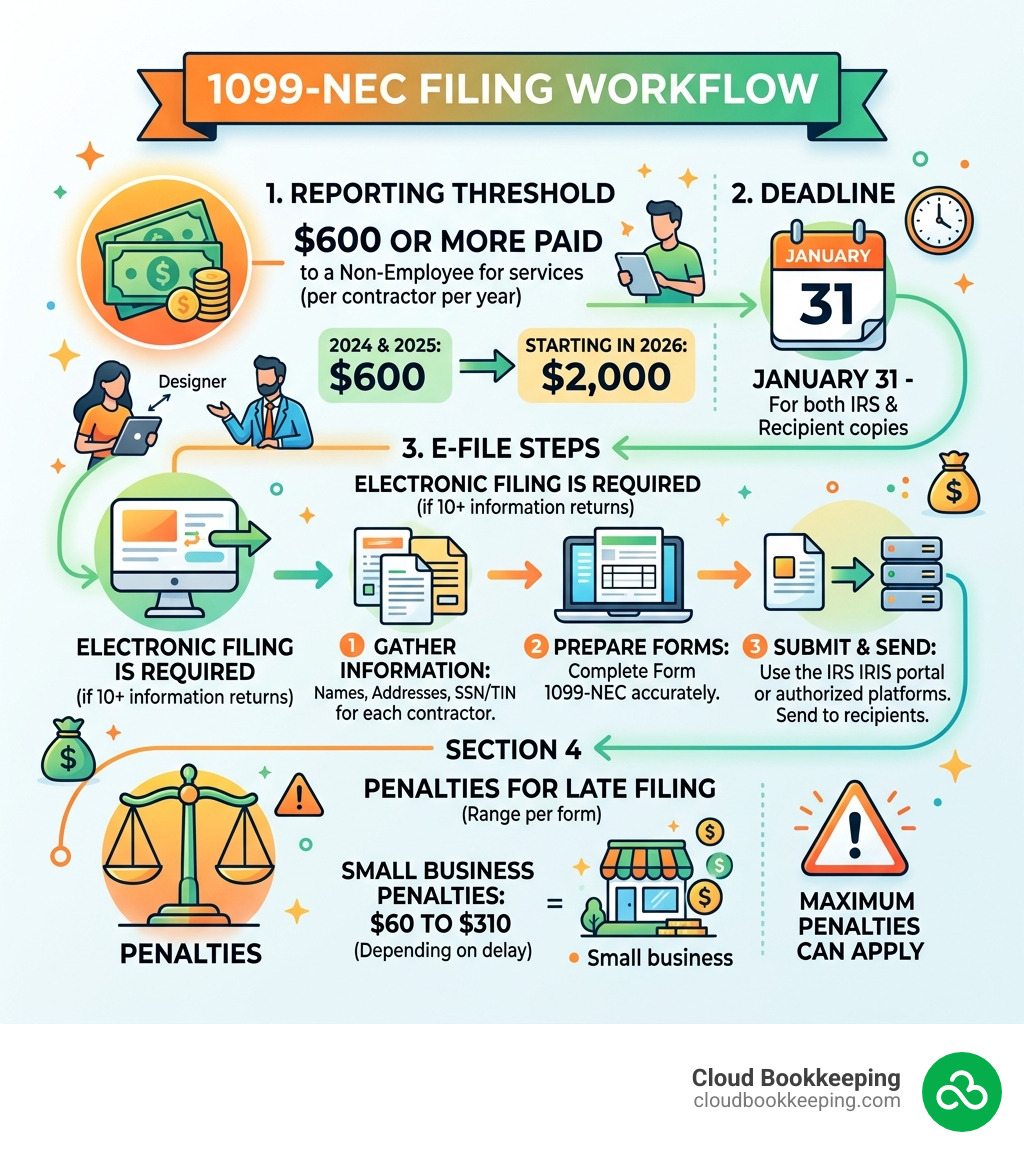
- Who must file: Any business that paid $600 or more to a non-employee for services during the 2024 or 2025 tax year
- Deadline: January 31 — for both the IRS copy and the recipient’s copy
- How to file: Paper or electronically (e-filing is required if you have 10 or more information returns)
- Where to file electronically: The IRS IRIS portal (free for any business size) or IRS-authorized third-party platforms
- Threshold change ahead: Starting in 2026, the reporting threshold rises from $600 to $2,000
- Penalties: Range from $60 to $310 per form, depending on how late you file
If you’re a small business owner juggling contractors, invoices, and a hundred other things — getting this wrong is easier than you think.
The rules around who gets a 1099-NEC, which payments qualify, and how to file correctly can trip up even experienced business owners. Miss a deadline or report the wrong amount, and the IRS notices.
That’s exactly why so many San Antonio business owners look for help before January rolls around.
I’m Charlie Perrin, founder of Cloud Bookkeeping, and with over 24 years of experience helping small business owners clean up their financials and reduce tax stress, I’ve guided countless clients through the full 1099 NEC filing assistance process — from tracking contractor payments to submitting accurate forms on time. Let’s walk through everything you need to know.
Understanding Form 1099-NEC, Thresholds, and Deductions
To master 1099 NEC filing assistance, we first have to understand what this form actually does. The “NEC” stands for Nonemployee Compensation. Since its reintroduction in 2020, it has been the primary way the IRS tracks money paid to people who aren’t on your payroll but did work for your business.
Think of your favorite freelance graphic designer, the independent contractor who fixed the office plumbing, or the consultant who helped with your marketing strategy. If they aren’t employees and you paid them for their services, they likely fall into the 1099-NEC category.
The $600 Rule and the 2026 Shift
For the 2024 and 2025 tax years, the magic number is $600. If you pay a non-employee $600 or more in a calendar year, you are legally required to file Form 1099-NEC. However, as we sit here in April 2026, we are entering a new era of reporting.
Starting with the 2026 tax year, the reporting threshold is increasing to $2,000. This change is designed to reduce the paperwork burden on small businesses, but it also means you need to be extra vigilant about tracking which year’s rules you are following. After 2026, this $2,000 limit will be adjusted for inflation, so staying updated on 1099 requirements for vendors is more important than ever.
Schedule C and Deductions
From the recipient’s perspective, receiving a 1099-NEC isn’t just about reporting income; it’s about the opportunity to offset that income with business expenses. Contractors report this income on Schedule C of their Form 1040.
As experts in bookkeeping, we always remind our clients that “ordinary and necessary” expenses are deductible. This includes things like:
- Home office expenses
- Necessary software subscriptions
- Mileage for business travel
- Equipment used specifically for the job
If you are the one issuing the 1099, ensure your records are clean so your contractors get accurate forms, allowing them to calculate their net profit correctly and pay their self-employment taxes (which cover Social Security and Medicare) without a headache.
Reporting Payments to Attorneys and Corporations
One of the most common points of confusion in 1099 NEC filing assistance involves payments to corporations and lawyers. Generally, you don’t need to send a 1099 to a corporation (like a C-Corp or S-Corp). However, the IRS makes a big exception for legal services.
Regardless of whether a law firm is incorporated, if you paid them $600 or more for legal services in the course of your business, you must issue a 1099-NEC. These fees are typically reported in Box 1. If you are paying “gross proceeds” to an attorney (such as a settlement payment where the lawyer takes a cut), that usually moves over to Form 1099-MISC, Box 10.
To stay compliant, always collect a Form W-9 from every vendor before you pay them. This ensures you have their correct Taxpayer Identification Number (TIN) and know their business structure upfront.
Critical Deadlines and the 1099 NEC Filing Assistance You Need
Mark your calendars in bright red ink: January 31 is the ultimate deadline for Form 1099-NEC. Unlike Form 1099-MISC, which sometimes allows for later electronic filing, the 1099-NEC must be furnished to the recipient and filed with the IRS by the last day of January.

Whether you are filing on paper or electronically, the clock stops on the 31st. If that day falls on a weekend or holiday, the deadline moves to the next business day. For more official details on these timelines, you can always check the About Form 1099-NEC, Nonemployee Compensation – IRS page.
Penalties for Late or Incorrect Filing
The IRS doesn’t just send a polite “oops” letter if you miss the deadline. Penalties for failing to file or providing incorrect information are calculated per form and can add up fast. For small businesses (defined by the IRS as having average annual gross receipts of $5 million or less for the three most recent tax years), the tiers usually look like this:
- Filed within 30 days of the deadline: $60 per form.
- Filed after 30 days but by August 1: $120 per form.
- Filed after August 1 or not at all: $310 per form.
- Intentional disregard: If the IRS thinks you ignored the rules on purpose, the penalty jumps to at least $630 per form, with no maximum cap.
Waiting until February or March to handle your 1099s is an expensive mistake. Seeking 1099 NEC filing assistance early in January—or better yet, keeping your books clean year-round—is the best way to keep your money in your pocket rather than the government’s.
E-filing Procedures, IRIS, and TIN Validation
In recent years, the IRS has moved aggressively toward a digital-first approach. As of 2024, if you are filing 10 or more information returns in total (including 1099s, W-2s, etc.), you must e-file. Gone are the days of mailing stacks of paper for most businesses.
The IRS IRIS Portal
The IRS recently launched the Information Returns Intake System (IRIS), a free portal designed for businesses of any size. It’s a great tool, but it does require some setup. You’ll need a Transmitter Control Code (TCC), which can take up to 45 days to process. If you’re looking for a free way to file, IRIS is your best bet, but don’t wait until January 30 to apply for your TCC!
| Feature | IRS IRIS Portal | Paper Filing (Form 1096) |
|---|---|---|
| Cost | Free | Cost of forms + Postage |
| Speed | Confirmation in ~48 hours | Weeks to process |
| Mandatory? | Required for 10+ returns | Only for < 10 returns |
| Errors | Real-time validation alerts | High risk of manual errors |
For many of our San Antonio clients, using an IRS-Authorized 1099-NEC E-Filing service is the preferred route. These platforms often provide a more user-friendly interface than the government portals and offer additional features like TIN matching.
Leveraging Technology for 1099 NEC Filing Assistance
If you have more than a handful of contractors, manual data entry is a recipe for disaster. Professional 1099 NEC filing assistance often involves using software that allows for bulk uploads via CSV or Excel templates.
These tools can integrate directly with your accounting software (like QuickBooks) to pull vendor data and payment totals automatically. One of the most valuable features is “TIN Matching.” This service checks the name and Taxpayer Identification Number you provided against the IRS database in real-time. If there’s a mismatch, you can fix it before you file, saving you from “B-Notices” and potential backup withholding penalties later.
Handling Corrections and Avoiding Common Filing Mistakes
Even with the best 1099 NEC filing assistance, mistakes happen. Maybe a contractor moved and didn’t tell you, or you accidentally swapped two digits in a payment amount.
One of the most common mistakes is confusing the 1099-NEC with the 1099-MISC. Remember:
- 1099-NEC: Services performed by non-employees (Box 1), and now, excess golden parachute payments (Box 3).
- 1099-MISC: Rents, royalties, prizes, awards, and other miscellaneous income.
Another common error involves TIN truncation. While you are allowed to truncate a recipient’s TIN (showing only the last four digits, like XXX-XX-1234) on the copy you send to the recipient, you must never truncate it on the copy you send to the IRS.
Correcting Errors with 1099 NEC Filing Assistance
If you realize you’ve made a mistake after hitting “submit,” don’t panic. There are two main types of corrections:
- Type 1 Errors: These involve incorrect money amounts or checking the wrong box. To fix this, you generally file a new form with the “Corrected” box checked, showing the right numbers.
- Type 2 Errors: These are more complex and involve a wrong TIN or a wrong name. This usually requires a two-step process: first, “voiding” the old return by filing a corrected form with $0.00, and then filing a brand-new return with the correct information.
Managing these nuances is why many businesses outsource their 1099 vendor management services. Having a professional eye on your data ensures that “void” doesn’t become a “penalty.”
Frequently Asked Questions about 1099-NEC
What is the new reporting threshold for 2026?
Starting with the 2026 tax year (returns filed in early 2027), the threshold for issuing a 1099-NEC increases from $600 to $2,000. This is a significant jump and is part of a legislative effort to simplify reporting for small businesses.
Do I need to file a 1099-NEC if I paid via credit card?
No. Payments made by credit card, debit card, or third-party networks (like PayPal or Venmo for Business) are actually reported by the payment processor on Form 1099-K. To avoid “double reporting” the same income to the IRS, you should exclude any credit card payments from your 1099-NEC totals.
How do I validate a contractor’s Taxpayer Identification Number?
The best way is to use the IRS TIN Matching system. Many third-party e-filing platforms offer this as a built-in service. Alternatively, you can register for the service directly through the IRS e-services portal. Always ensure you have a signed Form W-9 on file for every contractor to provide a paper trail of the information they gave you.
Conclusion
Filing 1099s doesn’t have to be the bane of your existence every January. By understanding the thresholds, keeping a close eye on deadlines, and utilizing modern e-filing tools, you can stay compliant without the stress.
At Cloud Bookkeeping, we specialize in taking this weight off your shoulders. Whether you need QuickBooks expertise to get your vendor data in order or comprehensive 1099 vendor management, our team is here to help. Led by Charlie Perrin right here in San Antonio, we provide the clear reporting and unparalleled customer service that small businesses need to thrive.
Don’t let the IRS mess with your stress. Reach out to us for professional 1099 NEC filing assistance and get back to doing what you love—running your business.