
What the 2026 Federal Withholding Tax Table Means for Your Business
The 2026 federal withholding tax table has been significantly updated this year — and if you run payroll for your small business, you need to know what changed.
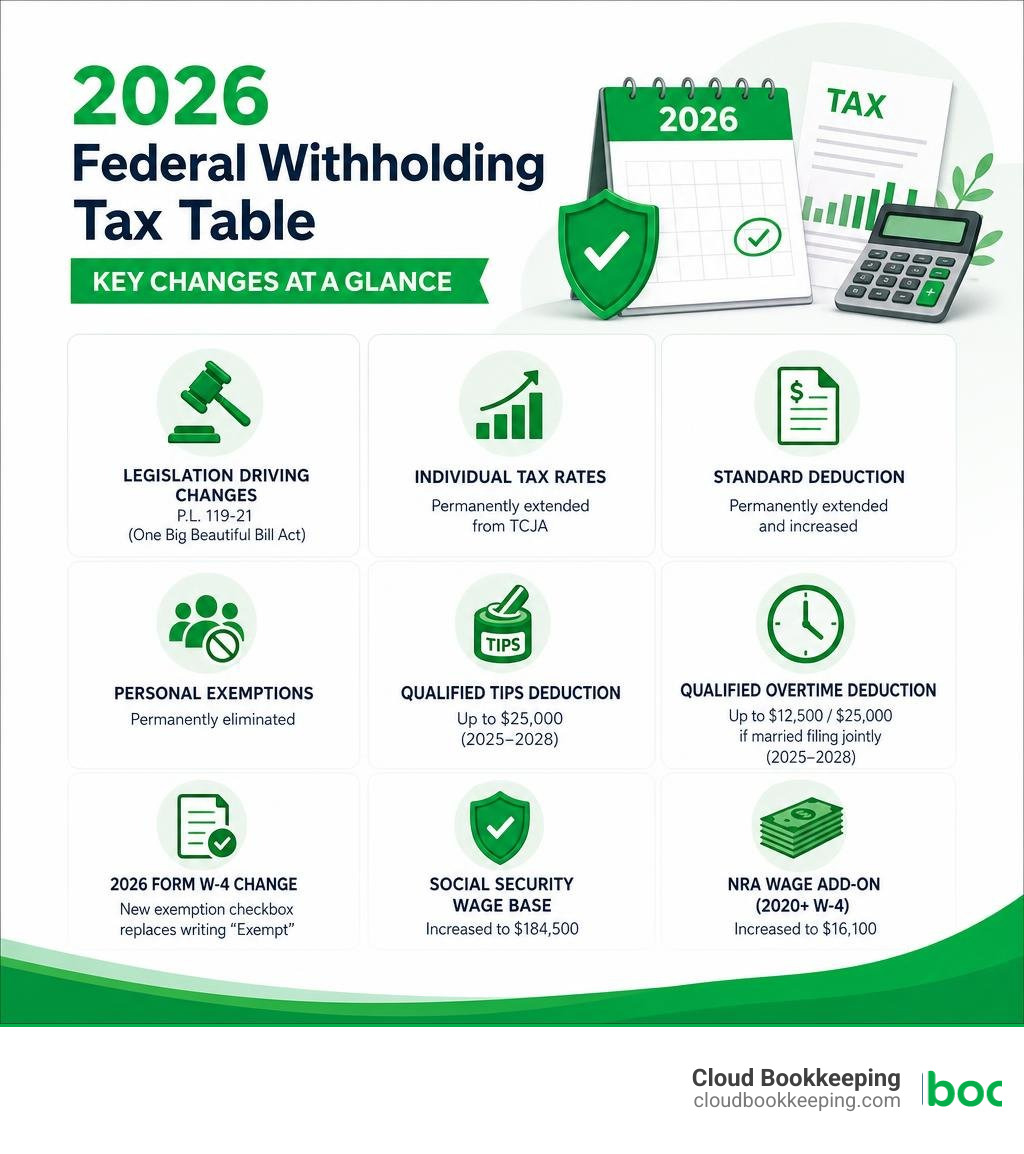
Here’s a quick summary of the most important updates:
| What Changed | Key Detail |
|---|---|
| Legislation driving changes | P.L. 119-21 (One Big Beautiful Bill Act) |
| Individual tax rates | Permanently extended from TCJA |
| Standard deduction | Permanently extended and increased |
| Personal exemptions | Permanently eliminated |
| Qualified tips deduction | Up to $25,000 (2025–2028) |
| Qualified overtime deduction | Up to $12,500 / $25,000 if married filing jointly (2025–2028) |
| 2026 Form W-4 change | New exemption checkbox replaces writing “Exempt” |
| Social Security wage base | Increased to $184,500 |
| NRA wage add-on (2020+ W-4) | Increased to $16,100 |
These changes affect how much you withhold from every paycheck you issue. Getting it wrong can mean penalties, surprised employees, and messy year-end corrections.
I’m Charlie Perrin, founder of Cloud Bookkeeping, and with over 24 years of experience helping small business owners navigate payroll and tax compliance, I’ve seen how updates to the 2026 federal withholding tax table can catch business owners off guard. This guide will walk you through everything you need to know to stay compliant and confident.
Understanding the 2026 Federal Withholding Tax Table and Legislative Updates
As we navigate the middle of 2026, payroll administrators and business owners must adapt to a overhauled landscape of federal tax tables. The primary driver of these updates is Public Law 119-21, officially known as the One Big Beautiful Bill Act (OBBBA). This sweeping legislation permanently settled several tax provisions that were previously scheduled to sunset, bringing much-needed predictability to long-term payroll planning.
Under the OBBBA, the individual income tax rates originally introduced by the Tax Cuts and Jobs Act (TCJA) have been permanently extended. This means we are keeping the seven progressive tax brackets (10%, 12%, 22%, 24%, 32%, 35%, and 37%), preventing a sudden jump back to older, higher rates. To help keep pace with inflation, the IRS applied standard annual cost-of-living adjustments, which were released in late 2025.
For a complete breakdown of how these brackets fall across different filing statuses, you can review this 2026 tax bracket overview.
Navigating these legislative shifts requires vigilance. As an employer, you cannot simply copy and paste last year’s formulas into your payroll software. Staying on top of these adjustments is a core part of maintaining your business’s financial health. For tips on building a structured approach to these changes, read our guide on staying ahead of payroll compliance.
Key Changes to the 2026 Federal Withholding Tax Table
The permanent extension of the increased standard deduction is one of the most critical structural updates in the 2026 federal withholding tax table. For the 2026 tax year, the standard deduction amounts have risen to:
- Single filers: $16,100
- Married Filing Jointly: $32,200
- Head of Household: $24,150
Seniors aged 65 and older can also claim an additional standard deduction of $2,050 for single filers or $1,650 if married filing jointly. Alongside this, the personal exemption remains permanently terminated at $0.
Because these figures directly dictate how much of an employee’s income is shielded from withholding, the IRS updated its primary employer resource, which you can download directly in Publication 15-T. This document contains the exact percentage and wage bracket tables that your automated systems or manual spreadsheets must use to compute withholding.
New Deductions for Qualified Tips and Overtime Compensation
Perhaps the most unique and highly talked-about feature of the OBBBA is the introduction of brand-new deductions designed to support hourly and service-industry workers. For tax years beginning after 2024 and ending before 2029, eligible employees can take advantage of two temporary deductions:
- Qualified Tips Deduction: Employees in occupations that customarily and regularly received tips on or before December 31, 2024, can deduct up to $25,000 of qualified tips from their federal income tax. Mandatory service charges imposed by employers do not qualify.
- Qualified Overtime Compensation Deduction: Individuals can deduct up to $12,500 ($25,000 if married filing jointly) of qualified overtime pay. This deduction specifically targets the “half” portion of time-and-a-half pay mandated under the Fair Labor Standards Act (FLSA) for hours worked over 40 in a workweek.
While these deductions are ultimately claimed by employees on their individual tax returns, employers have a direct role in adjusting withholding. If an employee submits an updated 2026 Form W-4 reflecting these expected deductions, employers must use the updated procedures in Publication 15-T to reduce their federal income tax withholding accordingly.
That these new rules only apply to federal income tax withholding. Tips of $20 or more per month and overtime pay remain fully subject to both the employer and employee shares of Social Security and Medicare taxes. For a deeper look at how these adjustments look on an individual paycheck, see our article on semi-monthly payroll deductions.
How to Calculate Withholding Using the 2026 Methods
When it comes to calculating the exact amount of federal income tax to pull from an employee’s paycheck, the IRS provides two primary paths: the Percentage Method and the Wage Bracket Method.

Choosing the right method depends largely on your payroll workflow. No matter which route you take, staying organized is essential for avoiding penalties and IRS notices. To learn more about setting up a reliable system, check out our guide to managing payroll taxes on time.
Percentage Method vs. Wage Bracket Method
While both methods yield highly accurate results, they are designed for different administrative environments:
| Feature | Percentage Method | Wage Bracket Method |
|---|---|---|
| Best Suited For | Automated payroll systems and computerized calculations | Manual payroll processing and quick paper references |
| Wage Limits | No limit; handles any amount of compensation | Limited to wages under a certain threshold (typically $100,000) |
| Form W-4 Support | Supports all W-4 versions (pre-2020 and 2020 or later) | Supports all W-4 versions, but requires separate lookup tables |
| Calculation Style | Formula-based mathematical steps | Grid-based lookups by pay frequency and filing status |
Generally, if you use a modern software platform, it will automatically employ the Percentage Method. If you are calculating payroll by hand for a small team here in San Antonio, the Wage Bracket Method is often easier to read, provided your employees’ wages fit within the table limits.
Step-by-Step Calculations with the 2026 Federal Withholding Tax Table
To calculate federal withholding manually using the 2026 tables, you must follow a structured, multi-step process:
- Calculate Adjusted Gross Wages: Start with gross wages earned during the pay period. Subtract any pre-tax deductions (such as health insurance premiums or traditional 401(k) contributions) and add any taxable fringe benefits.
- Account for Form W-4 Step 2: Determine if the employee checked the box in Step 2 of their 2020 or later Form W-4 (indicating multiple jobs or a working spouse). If checked, you must use the “Higher” withholding rate schedules. If unchecked, use the “Standard” schedules.
- Apply the Standard Deduction Adjustment: If the employee has a 2020 or later Form W-4, apply the standard withholding allowance adjustments ($12,900 for Married Filing Jointly, or $8,600 for Single/Head of Household) to determine their annualized taxable wage.
- Locate the Correct Table: Open Publication 15-T and find the table matching the employee’s pay frequency (e.g., biweekly, semi-monthly, monthly) and their chosen calculation method.
- Compute and Divide: Apply the percentage formula to calculate the annual withholding amount. Finally, divide this annual total by the number of pay periods in your fiscal year to find the exact per-paycheck withholding.
For a helpful tool to cross-reference your manual calculations or help your employees project their annual liability, you can direct them to this interactive federal tax calculator.
Managing Form W-4, Form W-4P, and Legacy Withholding Forms
A critical part of managing payroll is ensuring you have a valid, up-to-date Form W-4 (Employee’s Withholding Certificate) on file for every worker. The same applies to Form W-4P for payers managing periodic pension or annuity distributions.
Mishandling these forms is a frequent source of compliance headaches. To see how this fits into the bigger picture of business administration, read about common payroll mistakes.
Revisions to 2026 Forms W-4 and W-4P
The 2026 revisions to Forms W-4 and W-4P introduced a small but highly important administrative change. In previous years, if an employee wanted to claim complete exemption from federal income tax withholding, they had to write the word “Exempt” in the blank space below Step 4(c).
For 2026, the IRS has replaced this manual entry with a dedicated exemption checkbox located directly below Step 4(c). This change makes the form cleaner and easier for automated optical character recognition (OCR) systems to read.
Similarly, the 2026 Form W-4P features a new checkbox below Step 4(c) for payees of periodic pension or annuity payments to request “no withholding,” replacing the old practice of writing “No withholding” on the form. Nonperiodic distributions and eligible rollover distributions must still be managed using Form W-4R.
Handling Legacy Forms and the Computational Bridge
One of the most common questions we get from local business owners is: “Do I have to force all my long-term employees to fill out a new Form W-4?”
The answer is no. You are not required to demand new forms from employees who submitted a valid Form W-4 in 2019 or earlier. However, because the calculation methods changed drastically in 2020 (when personal exemptions were first suspended), calculating withholding for these legacy forms can be incredibly tedious.
To solve this, the IRS provides an optional computational bridge. This bridge allows employers to treat 2019 and earlier Forms W-4 as if they were 2020 or later forms by applying up to four specific mathematical adjustments:
- Filing Status Mapping: Map “Single” or “Married filing separately” directly to the corresponding 2020+ status.
- Step 4(a) Adjustment: Add an annualized amount of $8,600 (for Single/MFS) or $12,900 (for MFJ) to the employee’s taxable wages.
- Step 4(b) Allowance Conversion: Multiply the number of withholding allowances claimed on the legacy form by $4,300, and treat this total as a deduction in Step 4(b).
Using this bridge simplifies your internal payroll calculations by standardizing all records into a single computational flow. Keeping up with these detailed requirements is highly important for staying compliant. For more strategies on keeping your business aligned with IRS rules, see our guide to payroll compliance requirements.
Special Withholding Procedures and Compliance Requirements
For businesses employing nonresident aliens (NRAs), standard withholding tables do not accurately reflect their actual tax liabilities. Because NRAs are generally not eligible for the standard deduction, employers must apply specific NRA wage add-on procedures.
Under these rules, you must add a predetermined mathematical amount to the employee’s wages solely for the purpose of calculating their federal income tax withholding. For 2026, these annual wage add-on amounts are:
- Pre-2020 Form W-4: $11,800
- 2020 or later Form W-4: $16,100
These amounts are scaled down to match your specific pay frequency (for example, adding $309.60 to a weekly pay period or $1,341.70 to a monthly pay period). The actual tax is calculated on this inflated amount, but the add-on is never actually paid to the employee or reported as taxable wages on their Form W-2. Nonresident alien employees should always be instructed to consult IRS Notice 1392 before filling out their Form W-4.
Furthermore, if your business uses electronic substitute systems for collecting Forms W-4 or W-4P, your system must strictly comply with IRS guidelines. The electronic portal must replicate all text, instructions, and worksheets exactly as they appear on the official paper forms.
Additionally, the system must force the user to visit and scroll through every page of instructions before they are permitted to apply their electronic signature. If you use paper substitute forms, you must provide the full, unabridged IRS worksheets and instructions directly to the employee rather than simply linking to the IRS website.
To ensure you never miss a deadline or an update to these special procedures, it is highly helpful to establish a structured calendar. Take a look at our 2026 semi-monthly payroll calendar to align your administrative schedule.
Frequently Asked Questions about 2026 Federal Withholding
What is the Social Security wage base for 2026?
For 2026, the Social Security wage base has increased to $184,500 (up from $176,100). Wages paid up to this amount are subject to the 6.2% Social Security tax for both the employer and the employee. Any earnings above $184,500 are exempt from further Social Security tax for the remainder of the calendar year.
Medicare tax, however, remains uncapped. Both employers and employees must pay the 1.45% Medicare tax on all wages. Additionally, employers must withhold the 0.9% Additional Medicare Tax on any individual employee’s wages that exceed $200,000 in a single calendar year.
How do employees claim total exemption from withholding in 2026?
To claim total exemption from federal income tax withholding in 2026, an employee must meet two specific IRS criteria:
- They had no federal income tax liability in the prior tax year (2025).
- They expect to have no federal income tax liability in the current tax year (2026).
If eligible, the employee must submit a new Form W-4 and check the new exemption box located directly below Step 4(c). It is important to note that a claim of exemption is only valid for a single calendar year. To maintain their exempt status, employees must submit a fresh Form W-4 by February 18, 2026. If they fail to do so, you must begin withholding tax based on their last valid non-exempt W-4 or default them to standard single withholding.
What happens if an employee fails to submit a Form W-4?
If a newly hired employee fails to submit a completed Form W-4, or if an employee claiming exemption fails to renew their form by the February 18 deadline, you must apply the default withholding rules. Under the current IRS guidelines, you must treat the employee as a Single filer with zero adjustments. This means you will apply the standard single rates with no additional standard deduction adjustments, child tax credits, or other deductions, resulting in a higher default withholding rate.
Conclusion
Managing the 2026 federal withholding tax table updates, interpreting new legislative changes like P.L. 119-21, and tracking complex rules for tips and overtime can feel like a full-time job. As a small business owner in San Antonio, your time is best spent serving your customers and growing your business — not getting buried in IRS publications.
At Cloud Bookkeeping, we provide professional bookkeeping, QuickBooks expertise, and reliable payroll administration tailored to your business’s unique needs. Led by Charlie Perrin, our team delivers unparalleled customer service and clear, actionable reporting to keep your business running smoothly and fully compliant.
Let us handle the numbers so you can focus on what you do best. Contact us today to learn more about our full-service payroll support and find out how we can simplify your operations.