Why Knowing the Difference Between a Bookkeeper and an Accountant Can Save Your Business
What is the difference between a bookkeeper and an accountant comes down to this: bookkeepers record your daily financial transactions, while accountants analyze that data to provide strategy, tax guidance, and big-picture financial insights.
Here’s a quick breakdown:
| Bookkeeper | Accountant | |
|---|---|---|
| Primary focus | Recording daily transactions | Analyzing and interpreting financial data |
| Typical tasks | Data entry, payroll, bank reconciliation, invoicing | Tax preparation, audits, forecasting, financial statements |
| Education | High school diploma or associate’s degree; optional certification | Bachelor’s degree; often a CPA license |
| When you need them | Ongoing, day-to-day financial management | Tax season, growth planning, complex financial decisions |
| Avg. annual salary (2023) | $47,440 | $79,880 |
Many business owners use the terms interchangeably — but they represent two very different roles. As accounting professor D’Arcy Becker put it: “Bookkeeping is designed to generate data about the activities of an organization. Accounting is designed to turn data into information.”
That distinction matters more than most people realize, especially when your business is growing and the financial stakes are higher.
I’m Charlie Perrin, founder of Cloud Bookkeeping, and with over 24 years of experience helping small business owners untangle their finances, I’ve seen how confusion about what is the difference between a bookkeeper and an accountant leads to costly gaps in financial oversight. In this guide, I’ll walk you through everything you need to know to make the right call for your business.
What is the difference between a bookkeeper and an accountant?
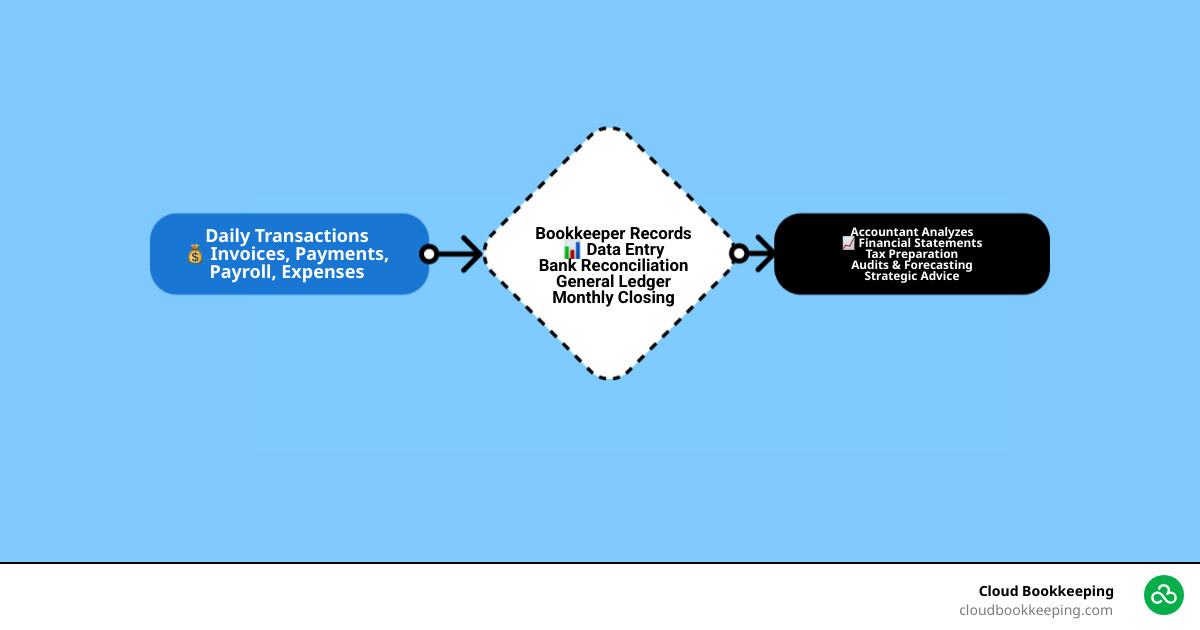
At its core, the distinction lies in the stage of the financial cycle they handle. If you think of your business finances as a story, the bookkeeper is the one writing down the daily events as they happen. They ensure every character (dollar) is accounted for and every plot point (transaction) is recorded accurately. The accountant, on the other hand, is the literary critic. They read the story, interpret what it means for the future, and tell you how to change the ending to make it more successful.
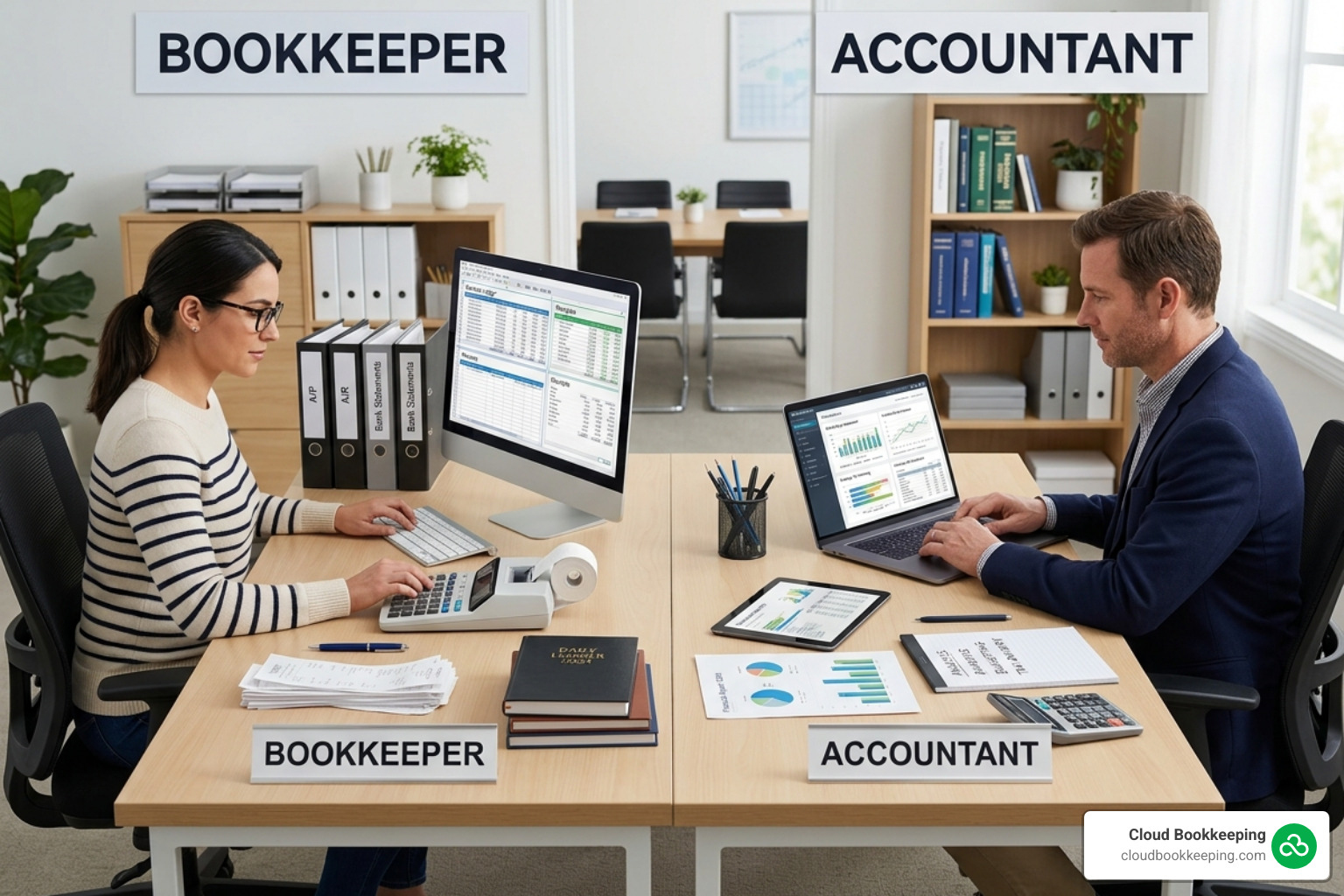
A bookkeeper’s work is transactional and administrative. They focus on the “now.” Their goal is to ensure that the data entering your system is categorized correctly and that your accounts match your bank statements. This provides short-term financial insights—like knowing exactly how much cash you have on hand today.
An accountant’s work is more analytical than transactional. Using the accurate records a bookkeeper maintains, they turn the numbers into insight. That means spotting patterns, flagging potential issues, and helping your business stay compliant with financial rules and reporting requirements. In simple terms, the bookkeeper records what happened, and the accountant explains what it means. For a deeper look, see this overview of the differences.
Roles and Responsibilities: From Daily Tasks to Strategic Analysis
To truly understand how these roles function within your San Antonio business, we need to look at what they actually do when they sit down at their desks in April 2026.
The primary role and focus of a bookkeeper
The bookkeeper is the guardian of your data accuracy. Without them, the financial information you see would be a chaotic mess of uncategorized receipts and missed invoices. Their primary focus is maintaining the “General Ledger,” which is the master document where all financial transactions are recorded.
Key responsibilities include:
- Recording Transactions: Every sale made and every bill paid must be entered into the system.
- Bank Reconciliation: Comparing your internal records against your bank statements to ensure they match perfectly.
- Accounts Payable (AP): Making sure your vendors get paid on time so your lights stay on.
- Accounts Receivable (AR): Chasing down payments from customers so you actually have money in the bank.
- Payroll Processing: Ensuring your team is paid accurately and that payroll taxes are withheld.
For a closer look at what this work includes day to day, read our guide on what a bookkeeper does for a small business. In short, bookkeepers create the accurate financial base that everything else depends on.
The main responsibilities of an accountant
Once the bookkeeper has finished their work, the accountant steps in to perform higher-level tasks. In 2026, this involves much more than just “doing taxes.” Accountants are strategic partners who ensure your business stays compliant and profitable.
Their main responsibilities include:
- Preparing financial reports: Turning your numbers into balance sheets, profit and loss statements, and cash flow reports so you can see how the business is really doing.
- Handling tax work and planning: Not just filing returns, but helping you plan ahead so there are fewer surprises at tax time.
- Reviewing and checking records: Looking over the books for accuracy, reducing risk, and making sure everything lines up with sound practices discussed in this guide to smarter business accounting.
- Advising on bigger decisions: Helping you think through moves like hiring, expanding, or investing in equipment.
- Supporting compliance: Making sure your financial reporting follows Generally Accepted Accounting Principles, which can matter if you want financing, outside investors, or cleaner reporting overall.
How daily tasks differ for bookkeepers and accountants
The frequency and nature of their work are quite different. A bookkeeper is often involved in your business daily or weekly. An accountant might only look at your books once a month, once a quarter, or even once a year during tax season.
| Task | Bookkeeper Frequency | Accountant Frequency |
|---|---|---|
| Recording Receipts | Daily/Weekly | Rarely (only for adjustments) |
| Reconciling Bank Accounts | Monthly | Reviewing the reconciliation |
| Processing Payroll | Every Pay Period | Annual tax reporting |
| Financial Analysis | Basic (Cash on hand) | Deep (Ratios, trends, forecasts) |
| Tax Filing | Data collection | Filing and Representation |
A helpful way to think about it is this: a bookkeeper handles the recording, while an accountant handles the adjusting and interpreting. For example, a bookkeeper logs the purchase of a truck. An accountant then decides how that truck should be depreciated over time and what that means for taxes. For a deeper look, see this QuickBooks comparison.
Qualifications, Salaries, and Career Outlook in 2026
The path to becoming a bookkeeper or an accountant involves different levels of formal education and licensing.
Education and certifications required for each role
In the United States, and specifically here in Texas, the requirements are distinct:
Bookkeepers: There is no legal requirement for a bookkeeper to have a specific degree. Many start with a high school diploma or an associate’s degree and learn through on-the-job training. However, professional certifications like the Certified Bookkeeper (CB) from the American Institute of Professional Bookkeepers (AIPB) or the Certified Public Bookkeeper (CPB) from the National Association of Certified Public Bookkeepers (NACPB) are highly recommended. These require thousands of hours of experience and passing rigorous exams. At Cloud Bookkeeping, we emphasize these Bookkeeping Services as a mark of quality.
Accountants: Accountants almost always require a bachelor’s degree in accounting or finance. To become a Certified Public Accountant (CPA), they must complete 150 credit hours of postsecondary education (which usually means a fifth year of school), pass a notoriously difficult four-part exam, and meet strict experience requirements. CPAs are also required to complete continuing education every year to keep their license active.
Salary ranges and job growth for bookkeepers vs. accountants
The difference in education is reflected in the paychecks. According to 2023 BLS data, the national average salary for bookkeepers was $47,440 ($22.81 per hour). In contrast, the median salary for accountants was $79,880 ($38.41 per hour)—a significant jump that reflects the complexity of their advisory and tax roles.
The outlook for these careers is also shifting due to technology. The BLS projects a 4% job growth for accountants through 2032, driven by the increasing complexity of global tax laws and corporate governance. However, they project a 6% decline for bookkeeping and accounting clerk roles.
Why the decline? Mostly because of automation. Today’s software can scan receipts, sort transactions, and handle a lot of routine data entry. But that doesn’t mean bookkeepers are going away. It means the job is changing. Many bookkeepers now spend less time typing in numbers and more time reviewing systems, catching errors, and keeping financial data accurate.
When to Hire: Choosing the Right Professional for Your Business Stage
Deciding who to hire—and when—is one of the most important decisions a San Antonio business owner can make.
When should a business hire a bookkeeper vs. an accountant?
Hire a Bookkeeper if:
- You are spending more than 4-5 hours a week chasing invoices, sorting receipts, and reconciling bank accounts.
- Your “filing system” is basically a shoebox full of paper receipts.
- You are not sure which customers still have unpaid balances.
- You are worried about missing a payroll tax deadline.
- You need help getting your chart of accounts set up properly from the start. If that sounds familiar, this guide on why to bring in a bookkeeper before you launch is a smart next step.
Hire an Accountant if:
- It’s tax season and you want to ensure you aren’t overpaying the IRS.
- You are applying for a business loan and need certified financial statements.
- You are considering a major change, like changing your business structure from a Sole Proprietorship to an S-Corp.
- You need someone to represent you during an IRS audit (only CPAs, Enrolled Agents, or attorneys can do this).
Most businesses start with a bookkeeper to handle the daily grind and then bring in an accountant for year-end taxes or strategic planning.
The impact of technology and cloud-based tools
The year 2026 has seen a massive shift toward cloud-based financial management. Tools like QuickBooks Online have bridged the gap between these two roles.
With cloud-based accounting tools, your bookkeeper and accountant can work from the same up-to-date numbers at the same time. That means less chasing files, fewer handoffs, and no need to pass around paper records. In practice, that leads to:
- Better security: Encrypted systems can protect financial data far more effectively than a desk drawer or filing cabinet.
- More automation: Features like receipt capture and bank feeds cut down on repetitive manual entry.
- Stronger backup protection: Automatic backups help safeguard your records if a computer fails or a local disruption hits.
Frequently Asked Questions
Do most businesses need both a bookkeeper and an accountant?
In short: Yes. Think of it like a construction project. The bookkeeper is the carpenter and mason doing the heavy lifting and building the structure every day. The accountant is the architect and inspector who designed the blueprints and ensures the building won’t fall down.
Using both gives your business a practical system of checks and balances. A bookkeeper keeps the records clean and current, while an accountant uses that information to make sure everything makes sense and meets reporting requirements. Together, they help you keep your accounting running smoothly all year instead of scrambling at tax time. It is also usually more cost-effective to have a bookkeeper manage routine monthly work and bring in an accountant for higher-level planning and review.
Can a bookkeeper perform accounting tasks, or vice versa?
There is some overlap, but there are hard boundaries. An accountant can do bookkeeping, but it’s usually a waste of your money to pay CPA rates for data entry.
A bookkeeper cannot perform certain tasks. In many states, including Texas, only a CPA can perform an “attest” function (like a formal audit) or sign off on certain certified financial statements. Furthermore, a bookkeeper who is not an Enrolled Agent or CPA cannot represent you in front of the IRS. If your business is growing to the point where you need high-level oversight, you might look into Controller Services to bridge that gap.
What are the different types of bookkeeping services for my business?
Not every business needs a full-time, in-house staff member. In fact, most small businesses in San Antonio thrive using outsourced or virtual models.
- Full-Charge Bookkeeper: Handles everything from entry to basic financial statements.
- Virtual/Cloud Bookkeeping: Uses software to manage your books remotely, offering maximum flexibility.
- Specialized Industry Reporting: For example, a restaurant needs very different reporting than a construction firm.
You can explore the different bookkeeping service options to see which one best fits your budget and goals.
Conclusion
Understanding what is the difference between a bookkeeper and an accountant is the first step toward building a business that lasts. By leveraging the daily accuracy of a bookkeeper and the strategic vision of an accountant, you protect your cash flow and prepare for long-term growth.
At Cloud Bookkeeping, we specialize in providing that essential foundation. Under the local leadership of Charlie Perrin in San Antonio, we offer unparalleled customer service and clear, actionable reporting. Whether you need QuickBooks expertise or a partner to help you navigate the complexities of 2026 business trends, we are here to help.
Don’t let your finances become a source of stress. Contact us today and let us handle the details so you can focus on what you do best—running your business. Ready to see how the right financial team can transform your operations? Learn more about the Bookkeeper vs Accountant dynamic and how we can support your journey today.