Why Corporate Tax Prep Is One of the Biggest Financial Risks Small Businesses Face
Corporate tax prep is the process of organizing your financial records, calculating what your business owes, and filing the correct forms with the IRS — accurately and on time.
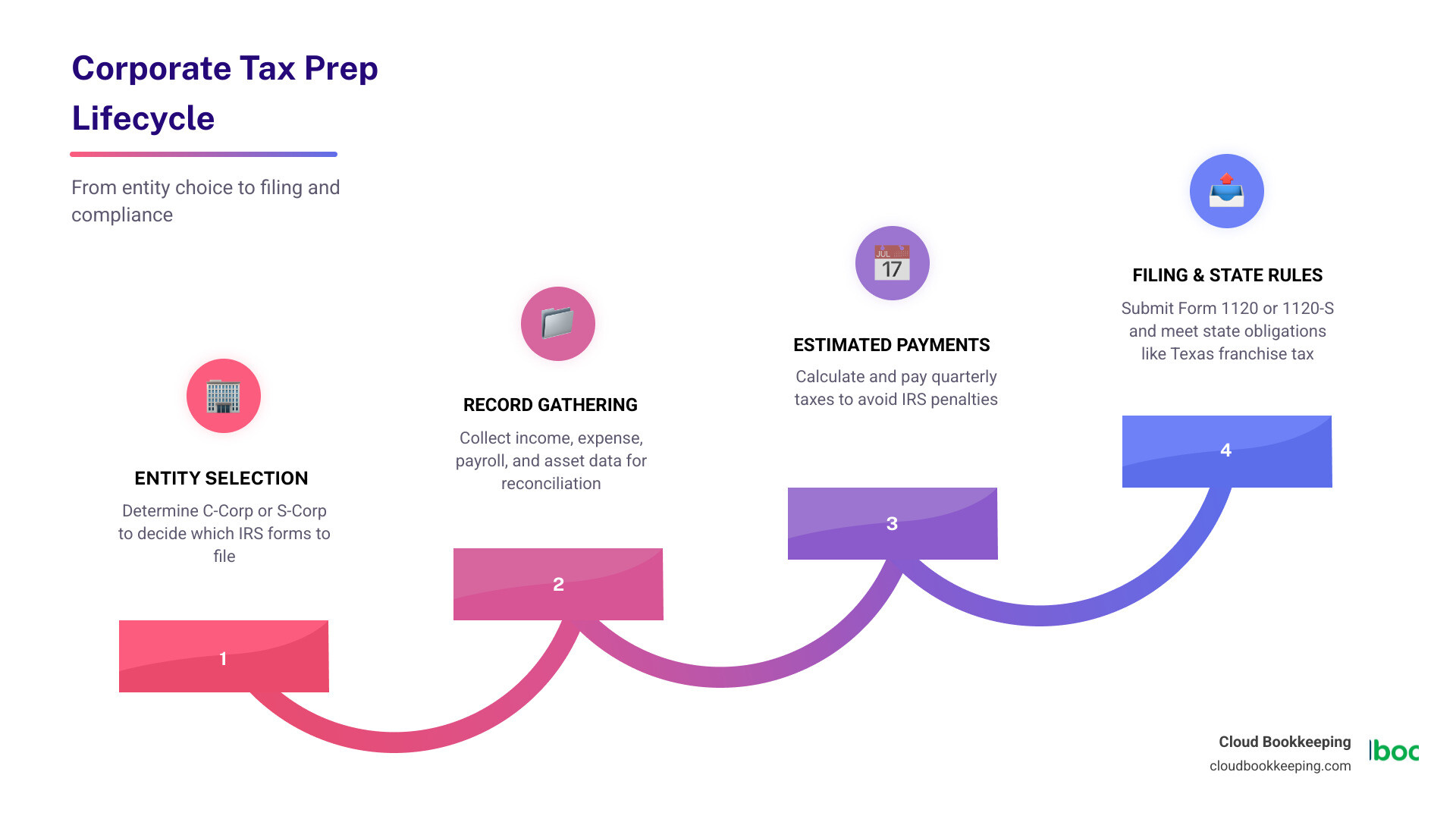
Here’s a quick overview of what corporate tax prep involves:
| Step | What It Means |
|---|---|
| Identify your entity type | C-Corp or S-Corp determines which forms you file |
| Gather financial records | Income, expenses, payroll, and asset data |
| Reconcile books to tax return | Explain differences between accounting and tax income |
| Calculate and pay estimated taxes | Quarterly payments to avoid IRS penalties |
| File the correct IRS forms | Form 1120 (C-Corp) or Form 1120-S (S-Corp) |
| Meet state and local obligations | Texas franchise tax, nexus rules, and more |
Most small business owners know taxes are complicated. But corporate taxes are a different level of complexity altogether. A single filing error can trigger IRS correspondence — and according to industry data, roughly 25% of corporate returns get flagged for book-tax reconciliation errors. That’s one in four businesses dealing with unnecessary headaches, penalties, and lost time.
The stakes are high. C-corporations face a flat 21% federal tax rate on profits. Complex returns can take 8 to 12 hours to prepare and cost between $2,000 and $5,000 per filing. For a small business owner in San Antonio already juggling cash flow, payroll, and daily operations, that pressure adds up fast.
Getting corporate taxes right isn’t just about compliance — it’s about protecting your business from surprises that hurt your bottom line.
I’m Charlie Perrin, founder of Cloud Bookkeeping, and with over 24 years of experience helping small business owners navigate corporate tax prep and financial strategy, I’ve seen how the right preparation makes the difference between a stressful filing season and a confident one. Let’s walk through exactly what you need to know.
Understanding Corporate Tax Prep and Why It Matters

Many business owners treat corporate tax prep as a once-a-year chore—something to scramble through in March or April and quickly forget. However, approaching your taxes this way exposes your business to massive financial and operational risks. True corporate tax preparation is an ongoing, strategic process that relies heavily on clean, year-round bookkeeping.
When your daily transactions, payroll, and accounts receivable are messy, your tax return will be messy too. Accurate, real-time bookkeeping ensures that you are not missing out on crucial deductions or making errors that invite IRS scrutiny. By evaluating business tax preparation services and aligning them with your bookkeeping, you gain a clear, continuous view of your company’s financial health.
Furthermore, proactive planning unlocks the true benefits of tax consulting services. Instead of simply reporting what happened in the past, we can help you make strategic decisions in real time—such as timing equipment purchases or adjusting owner compensation—to minimize your liability. Utilizing regular tax preparation services as part of your broader business model transforms taxes from an unpredictable annual hurdle into a manageable, structured business process.
Key Differences Between C-Corp and S-Corp Filing Requirements
One of the first steps in establishing a robust tax strategy is understanding how your business structure dictates your relationship with the IRS. C-corporations (C-Corps) and S-corporations (S-Corps) have fundamentally different tax structures, filing requirements, and operational rules.
- C-Corporations (Form 1120): A C-Corp is treated as a completely separate legal and financial entity from its owners. This structure is subject to what is known as double taxation. First, the corporation pays federal income tax on its net profits at the flat 21% corporate rate. Then, when those profits are distributed to shareholders as dividends, the individual shareholders must report and pay taxes on those dividends on their personal tax returns. There are no shareholder limits for C-Corps, making them ideal for businesses seeking venture capital or plan to go public.
- S-Corporations (Form 1120-S): An S-Corp is a special tax status elected through the IRS. It operates as a pass-through entity. This means the corporation itself generally does not pay a federal corporate income tax. Instead, the business’s profits, losses, deductions, and credits “pass through” to the individual shareholders’ tax returns, where they are taxed at individual income rates. This avoids double taxation entirely. However, S-Corps face strict regulatory limits, including a maximum of 100 shareholders, who must all be U.S. citizens or residents.
Essential IRS Forms for Corporate Tax Prep
Navigating the sea of IRS forms is a central challenge of corporate tax prep. To keep your business compliant, you must understand which documents are required for your specific entity type:
- Form 1120 (U.S. Corporation Income Tax Return): This is the standard tax return filed by C-corps. It reports the company’s income, gains, losses, deductions, and credits, and calculates the final corporate tax liability.
- Form 1120-S (U.S. Income Tax Return for an S Corporation): S-corps use this form to report their financial activity. While it resembles Form 1120, it does not calculate a corporate-level tax; instead, it reports the figures that will pass through to the owners.
- Schedule K-1 (Form 1120-S): Prepared alongside Form 1120-S, a separate Schedule K-1 is generated for each individual shareholder. It outlines their specific share of the S-corp’s income, deductions, and credits, which they must then report on their personal Form 1040.
- Form 1099-NEC (Nonemployee Compensation): Used to report payments of $600 or more made to independent contractors or sole proprietors. This is a critical record-keeping document for corporate write-offs.
- Form 1099-K (Payment Card and Third Party Network Transactions): If your business accepts credit cards or third-party payments (like PayPal or Stripe), you will receive this form detailing those merchant transactions, which must reconcile perfectly with your reported gross receipts.
Step-by-Step Guide to Preparing Your Corporate Return

Filing an accurate corporate return requires a systematic approach. Scrambling at the last minute leads to missed deductions, math errors, and filing delays. To establish an efficient workflow, we recommend following structured tips to stay ahead on business tax prep.
If you are transitioning between tax years, it is also highly beneficial to leverage professional resources to get help with 2024 business tax deadline preparation and carry those clean practices forward into 2026. Let’s break down the two most critical steps in this preparation lifecycle.
Step 1: Reconciling Books and Managing Estimated Payments
Before you fill out a single line of your tax return, your books must be completely reconciled. This means checking your general ledger against bank statements, credit card accounts, and loan balances to ensure every single penny is accounted for. Reconciling your books is the only way to establish your true net income.
Once your books are accurate, you must manage your estimated tax payments. The IRS requires C-corporations to pay estimated taxes if they expect their estimated tax liability to be $500 or more. These payments are due four times a year (generally April 15, June 15, September 15, and December 15).
To calculate these payments without hurting your cash flow, corporations often rely on two primary methods:
- Safe Harbor Method: Paying 100% of the tax shown on the corporation’s return for the preceding tax year (provided the prior year was a full 12-month period and showed a tax liability).
- Annualized Income Installment Method: Useful for seasonal businesses, this method allows you to pay estimated taxes based on your actual income earned during the months leading up to each payment installment.
Failing to make these quarterly payments, or underpaying them, can result in steep interest charges and penalties. Working closely with professionals and using tax consulting services avoid penalties ensures your payments are calculated accurately based on real-time data.
Step 2: Maximizing Deductions and Credits
Once your income is clearly defined, the next step is identifying every legitimate deduction and tax credit available to your business. Under Section 162 of the Internal Revenue Code, corporations are allowed to deduct all “ordinary and necessary” expenses paid or incurred during the taxable year in carrying on their trade or business.
Common corporate write-offs and deductions include:
- Operating Expenses: Rent, utilities, office supplies, insurance, and marketing costs.
- Salaries and Benefits: W-2 wages paid to employees, officer compensation, and employee benefit programs (like health insurance or retirement plans).
- Depreciation: Writing off the cost of physical assets (machinery, vehicles, computers) over their useful lives using methods like Section 179 or bonus depreciation.
- Research & Development (R&D) Tax Credit: A highly valuable dollar-for-dollar credit for businesses developing new or improved products, processes, or software.
To make sure you do not leave money on the table, it is crucial to proactively prepare business end of year tax returns well before December 31. This gives you the runway needed to execute year-end tax strategies, such as accelerating deductions or deferring income, to legally minimize your taxable liability.
Navigating Complexities in Corporate Tax Compliance
As a business grows, its tax landscape becomes exponentially more complex. For larger corporations, simple bookkeeping is no longer enough to satisfy regulatory requirements. One of the most common friction points during corporate tax prep is reconciling the differences between “book income” (the profit shown on your financial statements) and “taxable income” (the profit you are actually taxed on).
These differences must be reported on IRS Schedules M-1 or M-3. The M-3 is a highly detailed version required for corporations with total assets of $10 million or more.
| Feature | Schedule M-1 | Schedule M-3 |
|---|---|---|
| Asset Threshold | Corporations with assets under $10 million | Corporations with assets of $10 million or more |
| Level of Detail | Basic, high-level summary of differences | Highly granular, column-by-column breakdown |
| Purpose | Reconciles book net income to tax return income | Reconciles book net income to taxable income with extensive transparency |
| Audit Risk | Moderate | High (errors easily trigger IRS correspondence) |
These reconciliations exist because accounting rules (GAAP) and tax laws (IRC) treat certain financial transactions differently. These differences fall into two categories:
- Temporary Differences: Differences that will eventually reverse over time. For example, using straight-line depreciation for your books but accelerated depreciation for your tax return.
- Permanent Differences: Differences that will never reverse. For example, meals and entertainment expenses that are fully recorded on your books but are only 50% deductible (or entirely non-deductible) under tax law, or municipal bond interest that is book income but tax-exempt.
Additionally, businesses operating multiple entities must navigate multi-entity consolidation. Filing a consolidated return (Form 1120 for an affiliated group) requires eliminating intercompany transactions, adjusting asset bases, and combining financial statements. Because of these moving parts, taking steps toward avoiding tax return errors is critical to keeping your corporate entity in good standing.
State, Local, and International Tax Obligations
Your tax obligations do not end at the federal level. In today’s interconnected economy, corporations must carefully track where they do business to avoid local and state penalties.
- Nexus and Apportionment: Historically, physical presence determined whether you owed taxes in a state. Today, economic nexus rules mean that simply reaching a certain sales threshold or transaction volume in another state can trigger tax obligations there. If your corporation has nexus in multiple states, you must use apportionment formulas (based on payroll, property, and sales) to distribute your taxable income across those jurisdictions.
- Texas Franchise Tax: For businesses located here in San Antonio, the Texas Franchise Tax is a primary local obligation. It is a privilege tax imposed on each taxable entity formed or doing business in Texas. Managing this requires calculating your margin and filing the appropriate report with the Texas Comptroller of Public Accounts.
- International Tax Compliance: If your business has international operations, foreign bank accounts, or foreign shareholders, you must navigate complex international tax frameworks. This includes complying with the Foreign Account Tax Compliance Act (FATCA) and filing the Report of Foreign Bank and Financial Accounts (FBAR) if your foreign accounts exceed specific financial thresholds.
Leveraging Technology and Professional Services
In 2026, relying on manual data entry and disconnected spreadsheets for corporate tax prep is a recipe for disaster. The sheer volume of data required to file a corporate return makes manual processes incredibly risky.
Embracing modern technology allows you to transform business tax preparation into an automated, highly accurate workflow.
How Modern Software Streamlines Corporate Tax Prep
Enterprise-level corporations and accounting firms utilize advanced tax software to manage the complex lifecycle of tax compliance, provision, and planning. These digital tools replace manual calculations with automated data flows, ensuring numbers move seamlessly from your trial balance directly into your tax forms.
Many businesses use enterprise tax platforms to make corporate tax prep faster, more accurate, and easier to manage across multiple filings.
Popular solutions in the market include ONESOURCE, Corporate Taxprep, and CSC Corptax. In general, these platforms are designed to help tax teams handle tasks like:
- preparing complex corporate returns
- importing and organizing trial balance data
- running diagnostic checks to catch errors before filing
- managing federal, state, and international compliance
- automating parts of the tax workflow for better consistency
The right software can be especially helpful for businesses with multi-entity structures, high filing volume, or more complex compliance needs. That said, technology works best when it supports a clear process, clean books, and a thoughtful tax strategy.
By integrating these types of advanced software tools with your everyday bookkeeping system (such as QuickBooks), you eliminate double-entry errors and ensure your tax preparer is always working with clean, validated data.
Career and Professional Development in Corporate Taxation
Because corporate tax compliance is so complex, there is a constant demand for highly skilled professionals who understand the nuances of the tax code. If you are looking to build a career in this field, several professional pathways exist:
- Enrolled Agent (EA): Licensed by the federal government, Enrolled Agents have unlimited rights to represent taxpayers before the IRS. Earning this designation requires passing a rigorous three-part exam covering individual and business tax laws.
- Continuing Education: Tax laws change constantly. Professionals must commit to regular continuing education to stay updated on new legislation, tax court rulings, and international compliance standards.
- Tax Consultant & Accounting Specialist: These roles focus on helping corporations design long-term tax strategies, structure business entities, and optimize their financial operations to legally minimize tax liability.
Frequently Asked Questions about Corporate Tax Prep
What is the flat federal corporate tax rate for C-corporations?
C-corporations are subject to a flat 21 percent federal income tax rate on all taxable business profits. This flat rate was established to simplify corporate tax calculations, though C-corps remain subject to double taxation when profits are distributed to shareholders as dividends.
Why do book-tax reconciliation errors trigger IRS audits?
The IRS pay close attention to Schedule M-1 and M-3 reconciliations because discrepancies between your financial statements (book income) and your tax return (taxable income) can point to unreported income or overstated deductions. If these permanent or temporary differences are calculated incorrectly, it will likely trigger automated IRS correspondence or a formal audit.
How can businesses handle emergency tax filing situations?
If your business is facing a sudden disruption, missing financial records, or simply needs more time to compile accurate data, you can file Form 7004 to request an automatic 6-month filing extension. However, it is vital to remember that an extension to file is not an extension to pay—you must still estimate your tax liability and pay any owed taxes by the original deadline to avoid penalties. For step-by-step guidance, read our advice on handling emergency tax filing situations.
Conclusion
At the end of the day, successful corporate tax prep is not a sprint—it’s a marathon that requires clean financial records, proactive planning, and a deep understanding of tax regulations. Scrambling to pull together your receipts at the end of the year only leads to missed deductions, costly errors, and unnecessary stress.
At Cloud Bookkeeping, led by Charlie Perrin right here in San Antonio, Texas, we provide the professional bookkeeping services, QuickBooks expertise, and clear reporting you need to keep your business running smoothly all year long. We don’t just organize your numbers; we help you understand them, giving you the peace of mind that your business is fully prepared for tax season.
Ready to take the stress out of your corporate tax preparation? Get Started with Cloud Bookkeeping today, and let us help you build a stronger, more profitable financial foundation.