Why So Many Small Business Owners Struggle at Tax Time
Keeping track of business expenses for taxes is one of the most important habits you can build as a small business owner — and one of the most commonly neglected.
Here’s a quick answer to get you started:
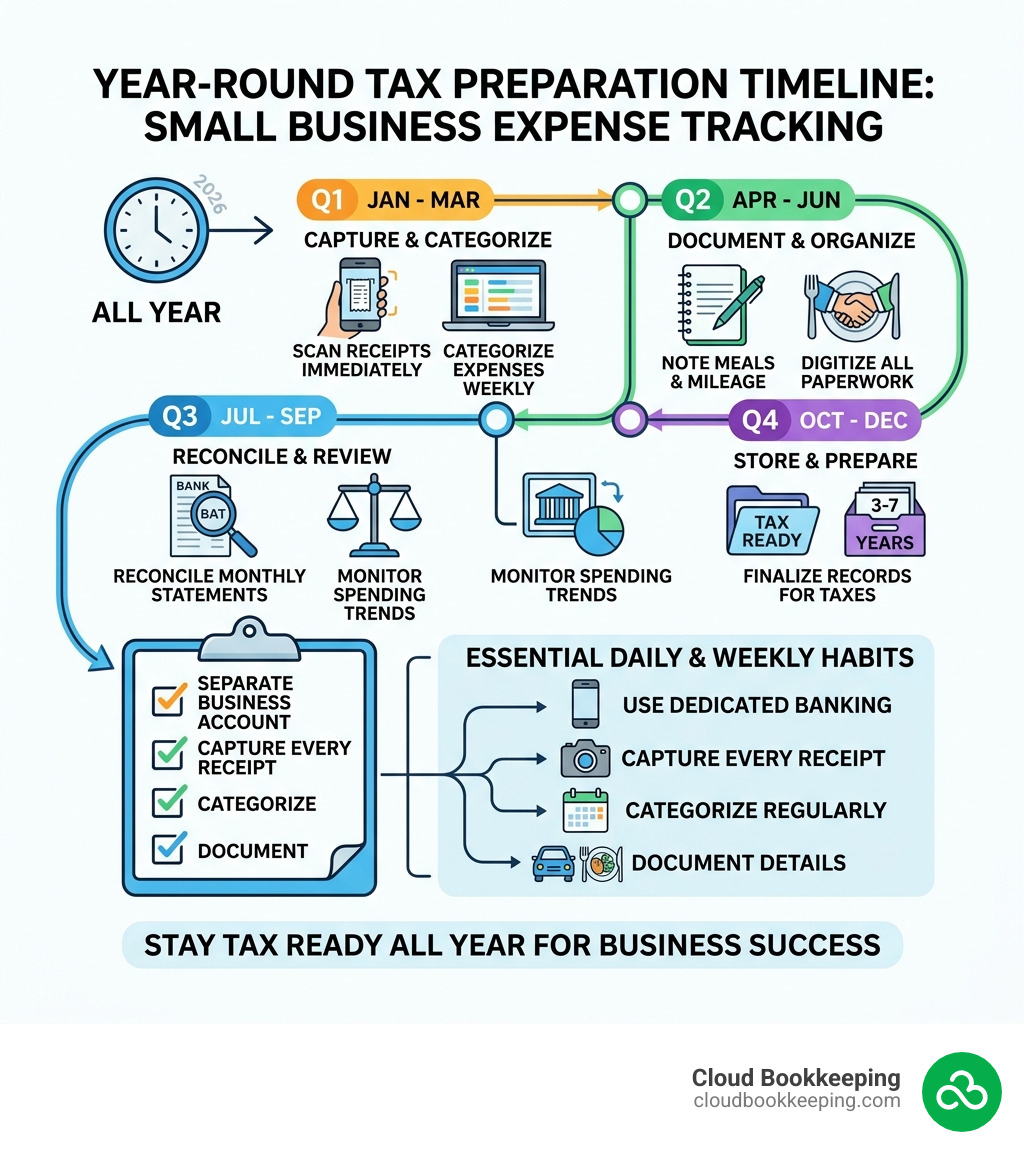
How to Keep Track of Business Expenses for Taxes
| Step | What to Do |
|---|---|
| 1. Separate your finances | Open a dedicated business bank account |
| 2. Capture receipts immediately | Use a mobile app or scan and save on the spot |
| 3. Categorize as you go | Use accounting software to sort expenses weekly |
| 4. Document high-scrutiny expenses | Note the who, what, and why for meals, mileage, and travel |
| 5. Reconcile monthly | Match your records against bank and credit card statements |
| 6. Store records securely | Keep digital or paper records for at least 3-7 years (4 years minimum for employment taxes) |
Most small business owners know they should be tracking expenses. But in practice, tax time often looks like digging through shoeboxes, scrolling through months of bank statements, and guessing what that $47 charge from eight months ago was actually for.
That scramble costs real money — in missed deductions, avoidable penalties, and hours of stress.
The good news? With the right system in place, expense tracking doesn’t have to be complicated or time-consuming. It just has to be consistent.
I’m Charlie Perrin, founder of Cloud Bookkeeping, and with over 24 years of experience helping small business owners build smarter financial systems, I’ve seen how keeping track of business expenses for taxes year-round — not just in April — can save thousands of dollars and eliminate financial surprises. In this guide, I’ll walk you through exactly how to set that system up.
Why Keeping Track of Business Expenses for Taxes is Essential for Growth
Many entrepreneurs view bookkeeping as a “tax season chore,” but that mindset is expensive. When we prioritize keeping track of business expenses for taxes, we aren’t just pleasing the IRS; we are building a roadmap for business scaling.
Real-Time Financial Health
Without accurate expense tracking, you’re essentially flying blind. You might think your San Antonio-based bakery is profitable, but without seeing your rising ingredient costs reflected in a real-time Profit & Loss statement, you could be losing money on every cupcake sold. Proper tracking provides the financial clarity needed to spot runaway costs and negotiate better terms with vendors.
Cash Flow and Decision-Making
A 2023 survey revealed that a majority of small businesses worldwide experience cash flow problems. With a few practical cash flow management habits, you can predict lean months and plan for growth. Should you hire a new employee? Can you afford that new piece of equipment? These decisions shouldn’t be “gut feelings.” They should be backed by data.
Audit Protection and Strategic Budgeting
The IRS requires “adequate records” to substantiate any deduction you claim. If you’re audited, a shoebox of faded receipts won’t cut it. Consistent tracking builds a “fortress” around your deductions. Furthermore, learning how to manage key financial metrics allows you to set realistic budgets. When you know exactly what you spent last year on marketing, you can more effectively allocate funds for the coming year to ensure a higher return on investment.

IRS Requirements: What Records Must You Retain?
To stay compliant, you must understand what the IRS expects. According to the IRS guide to deducting business expenses, you may choose any recordkeeping system suited to your business that clearly shows your income and expenses. However, the burden of proof is on you.
Core Categories of Records
The IRS generally requires you to keep records for:
- Gross Receipts: Cash register tapes, deposit slips, receipt books, invoices, and 1099-MISC/NEC forms.
- Purchases: Canceled checks, credit card sales slips, and invoices that show the amount paid and that the item was for resale or raw materials.
- Expenses: These are the costs you incur to carry on your business. You must have documents showing the payee, the amount, the date, and a description of the business purpose.
- Assets: Records for property like machinery or vehicles must show when and how you acquired the asset, the purchase price, and any depreciation claimed.
- Employment Taxes: You must keep all records of employment for at least four years after the tax becomes due or is paid.
Digital vs. Paper
The IRS is surprisingly modern: electronic records meet the same standards as paper records. In fact, we highly recommend digitizing everything. A “mediocre photo” taken immediately at the gas station is infinitely more valuable than a perfect paper receipt that gets lost under the car seat. For more on the timing of these entries, see our guide to tracking when a business expense occurs.
For a deeper look at starting out, refer to IRS Publication 583 on starting a business and keeping records.
Mastering High-Scrutiny Deductions and 2026 Tax Rates
The IRS pays closer attention to certain “mixed-use” expenses — things that could easily be personal rather than business. In 2026, the stakes are high, especially with updated deduction rates.
2026 Mileage and Home Office Rates
| Deduction Type | 2026 Rate/Rule | Requirement |
|---|---|---|
| Standard Mileage | 72.5 cents per mile | Written mileage log (Date, Destination, Purpose) |
| Home Office (Simplified) | $5 per sq. ft. (Max 300 sq. ft.) | Exclusive and regular use of the space |
| Business Meals | 50% Deductible | Must document who, what, and the business purpose |
Keeping track of business expenses for taxes: Mileage and Travel
If you drive 20,000 business miles a year in San Antonio, that’s a $14,500 deduction. To claim it, you need a log. Simply saying “I drive a lot for work” won’t pass an audit. For travel, keep every receipt for hotels, airfare, and even Uber rides. Always note the business relationship of the people you meet. These small business bookkeeping tips can help you stay on top of those moving parts.
Keeping track of business expenses for taxes: Digital Tools and Automation
Automation is the “secret sauce” of modern bookkeeping. Tools like QuickBooks Online allow you to sync your bank accounts directly. This means every time you swipe your business card at an office supply store, the transaction appears in your software automatically.
Features like Intuit Assist and AI-powered categorization can even suggest where to book the expense based on your history. Automated invoice reminders can help you get paid up to 45% faster (or about 5 days earlier on average). For many owners, managed bookkeeping support is the best way to leverage these tools without getting overwhelmed by the technology itself.
Avoiding Common Bookkeeping Pitfalls and Audit Triggers
Even with the best software, human error can lead to “audit triggers.” We want to help you avoid the magnifying glass of the IRS.
The “Miscellaneous” Trap
One of the biggest red flags is a giant “Miscellaneous” or “Other” category on your tax return. When everything is miscellaneous, nothing is analyzable — and auditors notice catch-all categories immediately. Categorize your expenses specifically: “Software Subscriptions,” “Office Supplies,” or “Professional Fees.”
Mixing Personal and Business Finances
This is the fastest way to lose deductions. If you use your personal account to buy a business laptop, you’ve created a reconciliation headache. Always use a separate business bank account. If you accidentally mix funds, document it immediately and reimburse the correct account with a clear paper trail.
1099-NEC Requirements
If you pay an independent contractor $600 or more in a year, you are required to issue a Form 1099-NEC. Failing to do this is a common mistake that can lead to penalties. Learn how to spot bookkeeping mistakes early and avoid the costly consequences of messy books before they create tax problems.
Frequently Asked Questions about Business Expense Tracking
How long should I keep my business tax records?
As a general rule, keep most records for three years from the date you filed your original return. However, there are exceptions. Employment tax records must be kept for at least four years. If you are depreciating an asset (like a delivery truck), keep those records for as long as you own the asset plus three years. Digital storage is the best way to manage this long-term requirement without filling up a storage unit.
Should I use a separate bank account for my home-based business?
Absolutely. Even if you are a “cottage food” business or a solo freelancer, commingling funds is a recipe for disaster. A separate account provides a clean audit trail and legally protects you by maintaining the “corporate veil” (if you’re an LLC or Corporation). It also makes keeping track of business expenses for taxes significantly easier because you don’t have to filter out your grocery bills from your business expenses every month.
What is the easiest way to organize receipts for a small business?
The “easiest” way is the one you will actually do. For most, this means using a mobile app to “snap and save” receipts the moment they are received. Many apps integrate directly with QuickBooks, matching the photo to the bank transaction automatically. If you prefer a lower-tech version, use the “Ziploc bag” method: one bag for each month, with notes written directly on the receipts. However, we always recommend moving toward digital storage to avoid “fading thermal paper” syndrome.
Conclusion
At Cloud Bookkeeping, we believe that your books should be a tool for growth, not a source of stress. Under the local San Antonio leadership of Charlie Perrin, we provide the QuickBooks expertise and professional oversight you need to ensure you’re keeping track of business expenses for taxes with 100% accuracy.
Don’t wait until April to find out you’ve missed thousands in deductions. Let us help you achieve financial peace of mind with clear reporting and unparalleled customer service.
Learn more about our professional bookkeeping services.