The Real Difference Between Bookkeeping and Accounting (And Why It Matters for Your Business)
Understanding what is bookkeeping vs accounting comes down to one simple distinction: bookkeeping records the numbers, accounting interprets them.
Here’s a quick breakdown:
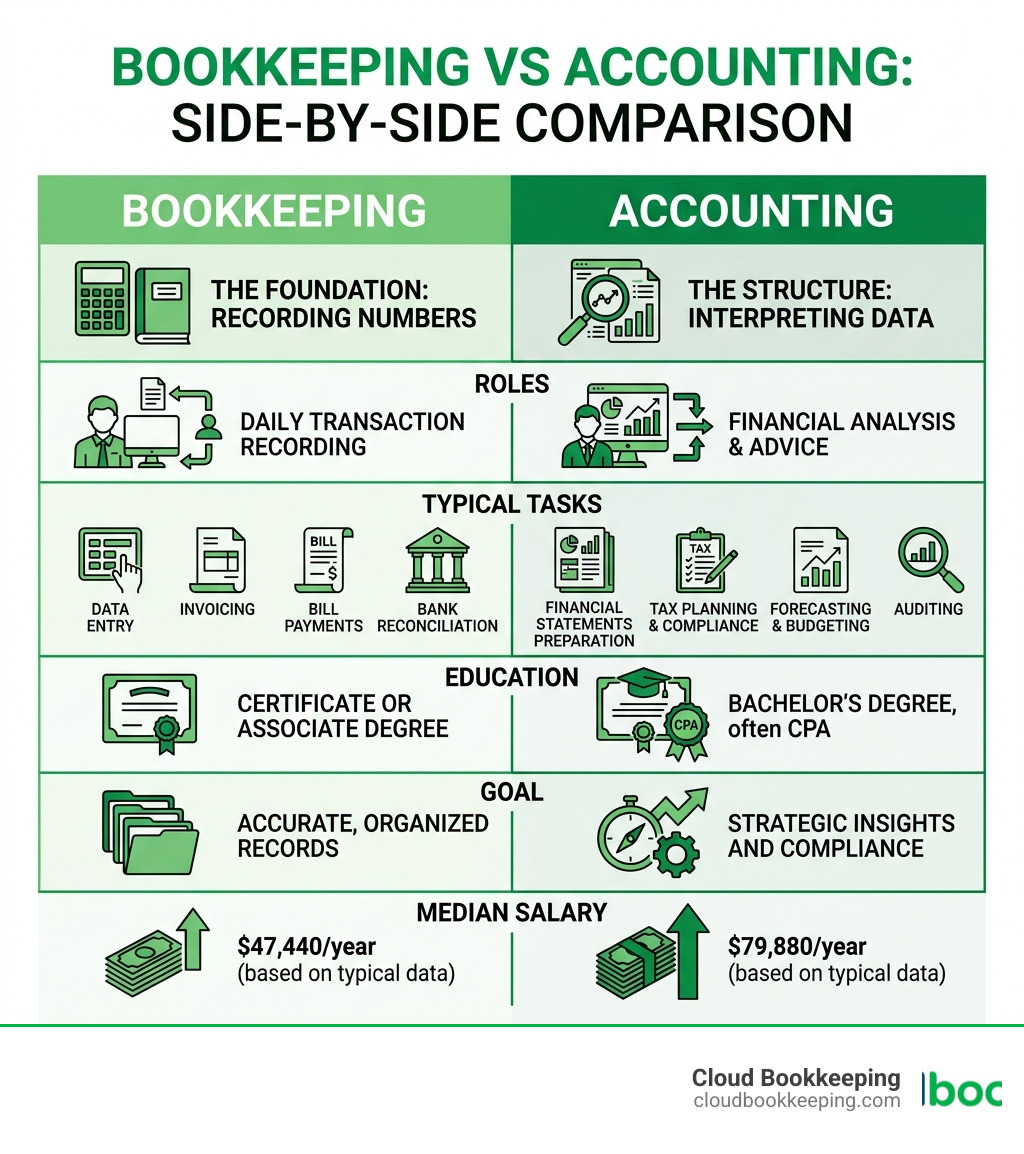
| Bookkeeping | Accounting | |
|---|---|---|
| Focus | Recording daily transactions | Analyzing and interpreting data |
| Goal | Accurate, organized records | Strategic insights and compliance |
| Typical tasks | Data entry, reconciliation, invoicing | Tax prep, forecasting, financial reporting |
| Education | Certificate or associate degree | Bachelor’s degree, often CPA |
| Median salary | $47,440/year | $79,880/year |
Think of it this way: bookkeeping is the foundation, and accounting is the structure built on top of it. Without clean books, accounting is just guesswork.
These two roles are constantly used interchangeably — even by people who should know better. But for a small business owner in San Antonio trying to make sense of cash flow, payroll, and tax season, knowing the difference isn’t just academic. It directly affects who you hire, what you pay, and how well your business runs.
I’m Charlie Perrin, founder of Cloud Bookkeeping, and with over 24 years of experience helping small business owners untangle exactly what is bookkeeping vs accounting and which one they actually need, I’ve seen how this confusion leads to costly mistakes — and how clearing it up changes everything. Let’s break it all down so you can stop guessing and start making confident financial decisions.
Defining the Roles: What is Bookkeeping vs Accounting?
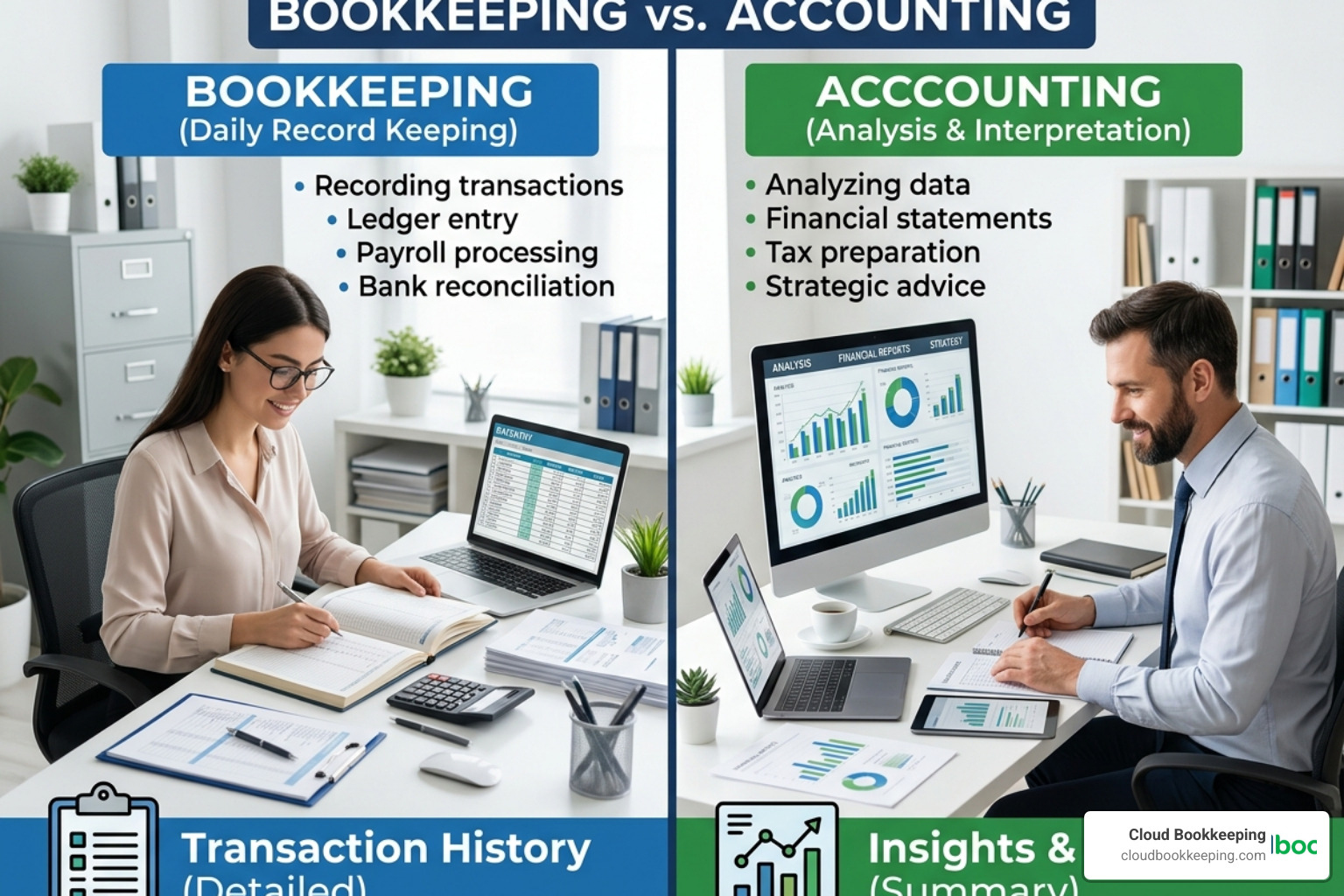
To get to the heart of the matter, we have to look at the “how” versus the “why.” Bookkeeping is the systematic, chronological recording of daily financial transactions. It is the administrative engine of your business. When we talk about bookkeeping, we are talking about the “how” of your money: how much came in, how much went out, and where it was categorized.
Accounting, on the other hand, is the “why.” It involves taking the data organized by the bookkeeper and turning it into actionable information. Accountants use that data to perform high-level analysis, prepare official financial statements, and offer strategic business advice. While bookkeeping is transactional, accounting is analytical and subjective.
Bookkeeping typically handles the first four steps—identifying transactions, recording journal entries, posting to the general ledger, and preparing an unadjusted trial balance. Accounting takes over for steps five through eight, which include adjusting entries and preparing the final financial statements.
If you want a deeper breakdown of how these roles overlap, we cover that in our guide to bookkeeping versus accounting.

Common Misconceptions About Financial Roles
One of the funniest (and most persistent) myths we hear in San Antonio is that you need to be a math genius to work in these fields. In reality, modern bookkeeping and accounting are more about logic, organization, and attention to detail than solving complex calculus equations. Software handles the arithmetic; the human provides the integrity.
Another misconception is that bookkeeping is “just” data entry. While data entry is a part of it, the real value lies in data integrity. If a bookkeeper miscategorizes a large purchase, it can throw off your entire tax strategy. Conversely, some believe an accountant is just a “glorified bookkeeper.” This ignores the subjective analysis accountants provide—like determining if your profit margins are healthy compared to industry benchmarks or helping you navigate complex regulatory compliance.
Key Differences in Scope, Focus, and Daily Tasks
The scope of these roles varies significantly. A bookkeeper’s world is the present—managing the day-to-day cash flow. An accountant’s world is the past and the future—reviewing what happened over the last year to plan for the next five.
| Task | Bookkeeper | Accountant |
|---|---|---|
| Daily Activity | Recording sales and expenses | Reviewing financial trends |
| Invoicing | Sending and tracking invoices | Analyzing accounts receivable aging |
| Payroll | Processing wages and taxes | Evaluating labor cost efficiency |
| Compliance | Reconciling bank statements | Preparing tax returns and audits |
| Strategy | Maintaining the general ledger | Creating financial models/forecasts |
Essential Skills for Success in Each Field
For bookkeepers, the superpower is “preternatural” attention to detail. Because a small error at the recording stage can snowball into a massive problem during an audit, bookkeepers must be meticulous. They also need strong organizational skills to manage a “funnel” of receipts, invoices, and bank statements.
Accountants need a different toolkit. They must possess strong communication skills to explain complex financial narratives to business owners. They need a deep understanding of regulatory knowledge, such as GAAP (Generally Accepted Accounting Principles), and the ability to think strategically about things like business valuation or R&D tax credits.
Deciding what is bookkeeping vs accounting for your business needs
When should a San Antonio business owner move beyond DIY and hire a professional? We suggest two main “triggers”:
- The 5-Hour Rule: If you are spending more than five hours a week on financial record-keeping, your time is likely better spent growing your business.
- The $500,000 Threshold: Once your annual revenue exceeds $500,000, the complexity of your taxes and financial reporting usually requires the oversight of an accountant.
Many small businesses start with a bookkeeper to handle daily management and then add an accountant for annual tax filing and strategic planning. If you’re wondering what that support looks like day to day, start with our guide on what a small-business bookkeeper does.
Education, Certifications, and Career Paths
The barrier to entry for these roles is quite different. Bookkeeping is often a “test the waters” entry point into the financial world. It doesn’t legally require a degree, though many professionals hold an associate degree or certificate. Accountants, however, almost always need at least a bachelor’s degree in accounting or finance.
Understanding what is bookkeeping vs accounting education requirements
If you’re looking at the career path, here is what the landscape looks like in May 2026:
- Bookkeepers: Can obtain certifications from the American Institute of Professional Bookkeepers (AIPB) or the National Association of Certified Public Bookkeepers (NACPB). These aren’t always mandatory but they certainly boost credibility.
- Accountants: Most states, including Texas, require 150 college credit hours to sit for the CPA (Certified Public Accountant) exam. This is often referred to as the “150-hour rule.”
- Specialized Roles: Beyond general practice, you’ll find Forensic Accountants (the “detectives” of the financial world) and Environmental Accountants who focus on sustainability reporting.
Salaries reflect these educational requirements. While a bookkeeper’s median wage is around $47,440, an accountant’s median is closer to $79,880, with CPAs often earning well into the six figures. We compare those career paths in more detail in our bookkeeper vs. accountant guide.
Can a bookkeeper transition into an accounting career?
Absolutely. Many accountants started their journey in bookkeeping. The transition usually involves returning to school to complete a bachelor’s degree and meeting the 150-hour requirement for the CPA exam. The on-the-job experience gained as a bookkeeper is invaluable, as it provides a deep understanding of the “foundational” data that accountants analyze.
The Impact of Technology: AI and Automation in 2026
As of May 2026, technology has blurred the lines between what is bookkeeping vs accounting more than ever. 80% of business decision-makers now agree that AI is necessary to stay competitive.
Cloud-based platforms and AI have automated the most repetitive parts of bookkeeping, such as data entry and bank reconciliation. This hasn’t made bookkeepers obsolete; rather, it has transformed them into “tech-savvy” advisors who focus on data integrity and real-time reporting.
How Automation is Changing Bookkeeping Roles
While traditional bookkeeping jobs are projected to decline by about 6% due to automation, the demand for professionals who can manage these AI tools is rising. We see a shift toward “Continuous Accounting,” where data is reconciled in real-time rather than at the end of the month. This creates a data-driven culture where business owners can see their financial health at any moment, not just during tax season.
Frequently Asked Questions
Is it better to be an accountant or a bookkeeper?
It depends on your goals! If you enjoy organization, daily tasks, and a faster entry into the workforce, bookkeeping is a fantastic career. If you prefer high-level problem solving, strategic advising, and have a higher salary ceiling, accounting is the way to go.
What can an accountant do that a bookkeeper can’t?
An accountant can perform audits, prepare complex tax returns, and provide legal representation before the IRS (if they are a CPA or Enrolled Agent). They also handle SEC reporting for public companies and perform “subjective” tasks like financial modeling and business valuation.
When should a business hire both roles?
A combined approach is often the most cost-effective. A bookkeeper handles the daily “cleanliness” of your data at a lower hourly rate ($30–$70), while an accountant provides the high-level strategy and tax compliance at a higher rate ($100–$400). This ensures you aren’t paying “accountant prices” for “bookkeeping tasks.”
Conclusion
At the end of the day, the debate over what is bookkeeping vs accounting isn’t about which role is more important—it’s about how they work together to ensure your business’s financial health. Bookkeeping provides the data, and accounting provides the clarity.
At Cloud Bookkeeping, we specialize in bridging that gap for San Antonio small businesses. Led by Charlie Perrin, our team provides unparalleled customer service and QuickBooks expertise to turn your confusing pile of receipts into a clear roadmap for growth. Whether you need a team to handle your daily transactions or strategic advisory to scale your operations, we’re here to help you move beyond the “great debate” and into a more profitable future.
Ready to get your books in order? Reach out to see how our local San Antonio expertise can transform your back office.