Your Spreadsheet Can’t Do This Job Anymore
Outsourcing the payroll process means hiring a third-party provider to handle your payroll calculations, tax filings, direct deposits, and compliance reporting — so you don’t have to.
Here’s a quick look at what the outsource payroll process typically covers:
| What Gets Outsourced | What You Keep Control Of |
|---|---|
| Wage and tax calculations | Pay schedules |
| Direct deposit and paycheck distribution | Employee classifications |
| Federal, state, and local tax filings | Benefits decisions |
| Year-end W-2s and 1099s | Approval of each payroll run |
| Compliance monitoring and new hire reporting | Access to all reports and data |
Most providers can have you up and running within a few weeks. Costs typically range from $5 to $30+ per employee per month, depending on complexity.
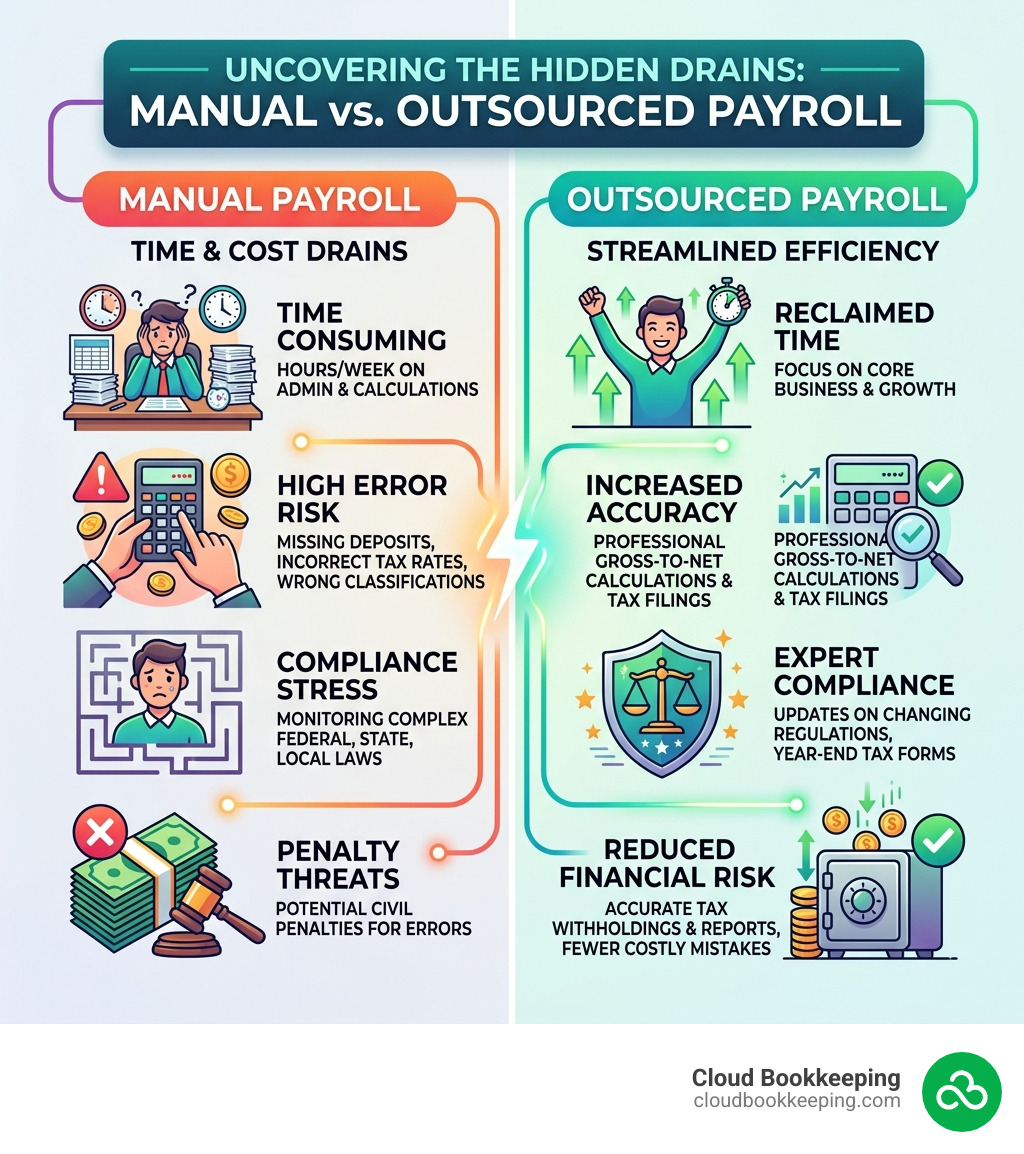
Payroll starts as a simple task. Then you hire more people, add a contractor, move into a new state — and suddenly you’re spending 11 hours a week just on HR admin. That’s more than a quarter of your entire workweek, according to a 2024 Paychex study. And 57% of HR professionals are already working beyond capacity before payroll even hits their desk.
The math gets worse when errors creep in. The IRS assessed $26.8 billion in civil penalties on employment tax returns in fiscal year 2024 alone, according to the IRS Data Book. One missed deposit, one outdated tax rate, one wrong classification — and you’re the one writing that check.
Meanwhile, your spreadsheet just sits there. Quietly. Waiting to let you down again.
I’m Charlie Perrin, founder of Cloud Bookkeeping, and over 24 years of working with small business owners I’ve seen how the outsource payroll process transforms what used to be a weekly stress point into a non-event. Let’s walk through exactly how it works and whether it’s the right move for your business.
What Does it Mean to Outsource Payroll Process?
When we talk about the outsource payroll process, we aren’t just talking about someone else printing checks. Modern payroll outsourcing is a comprehensive shift of responsibility. It involves hiring a specialized third-party provider to manage the entire lifecycle of employee compensation.
This includes the “heavy lifting” tasks that keep business owners up at night: calculating gross-to-net pay, managing tax withholdings, and ensuring all federal, state, and local tax reporting is accurate and submitted on time. A professional provider stays updated on the ever-shifting landscape of regulatory compliance, which is a full-time job in itself.
Beyond the numbers, these services often handle unemployment claims, wage garnishments, and new hire reporting. They provide a layer of data security that most small business servers simply can’t match, using encryption and redundant backups to protect sensitive employee information. Understanding the value of a full service payroll means recognizing that you aren’t just buying software; you’re buying expertise and a massive reduction in your company’s risk profile.
The Step-by-Step Outsource Payroll Process
Moving from a manual spreadsheet to a professional system doesn’t happen by magic, but it is much simpler than most owners fear. The goal is a stress-free payroll processing experience that runs like clockwork every two weeks.

Onboarding and System Integration
The first step is the “deep clean.” We look at your current employee records, tax IDs, and previous payroll history. This is where we identify any lingering errors from the “spreadsheet era” before they move into the new system.
A critical part of this phase is software sync. For our clients in San Antonio, this almost always involves QuickBooks. We ensure that your payroll data flows directly into your general ledger. This eliminates double-entry and ensures your financial reports actually reflect your real-time labor costs. Knowing how to choose payroll services for small teams often comes down to how well the provider integrates with your existing accounting tools.
Managing the Ongoing Outsource Payroll Process
Once you’re live, the day-to-day becomes remarkably simple. You provide the basic pay period data—hours worked, commissions, or any salary changes—through a secure portal. The provider then handles the complex math:
- Gross-to-Net Calculations: Subtracting taxes, 401(k) contributions, and health insurance premiums.
- Review Cycles: You get a chance to preview the run and click “approve.”
- Funding and Distribution: The provider pulls the total amount from your account and distributes it via direct deposit or paycards.
- Tax Remittance: The provider pays the IRS and state agencies on your behalf.
By standardizing this cycle, you avoid dealing with payroll processing delays that frustrate employees and damage morale.
Why Businesses Move Away from In-House Management
If you’re still doing payroll in-house, you’re likely spending nearly half your week on manual fixes and administrative data entry. In 2026, the complexity of payroll has only increased. Between flexible work schedules, multi-state remote workers, and shifting local tax laws, the margin for error is razor-thin.
The financial stakes are high. As mentioned, the IRS is increasingly aggressive with audits, assessing $26.8 billion in civil penalties recently. Many of these aren’t intentional fraud; they are simple math errors or missed deadlines from overwhelmed business owners.
Cost Comparison: In-House vs. Outsourced (Annual Estimates)
| Feature | In-House (Manual/DIY) | Outsourced (Full-Service) |
|---|---|---|
| Labor Cost | 11+ hours/week of owner/admin time | ~1 hour/week for review/approval |
| Software Fees | $500 – $1,200 (Basic apps) | $1,500 – $4,500 (All-in) |
| Error/Penalty Risk | High (Average penalty: $800+) | Low (Often includes tax guarantee) |
| Direct Savings | $0 | Up to 18% in operating costs |
While the “invoice” for outsourcing looks higher than a free spreadsheet, the top benefits of outsourcing payroll for small businesses include reclaiming hundreds of hours of your time—time that should be spent growing your San Antonio business, not calculating FICA withholdings.
Compliance Risks in the Outsource Payroll Process
The biggest myth in payroll is that if you hire a company, you are 100% shielded from all liability. The IRS is very clear: the employer is ultimately responsible for federal tax liabilities. If a provider disappears or fails to pay, the government still comes to you for the money.
This is why we advocate for using the Electronic Federal Tax Payment System (EFTPS). You should always maintain your own PIN to verify that your provider is actually making the deposits they claim to be making. Recognizing the most common payroll mistakes allows you to vet providers more effectively. The advantages outsourcing payroll tax services are immense, but only if you partner with a reputable provider that offers transparency and real-time reporting.
Choosing the Right Provider and Pricing Model
Not all payroll providers are created equal. In San Antonio, we see businesses choose between three main flavors:
- Full-Service Payroll Providers: These are the most common. They handle the processing, tax filing, and direct deposits. You stay the legal employer.
- Professional Employer Organizations (PEO): This is a co-employment model. They handle payroll, but also HR, benefits, and workers’ comp. It’s a deeper relationship that can lower insurance costs but offers less direct control.
- Employer of Record (EOR): Best for businesses hiring international workers. The EOR is the legal employer in that country, handling all local compliance.
When it comes to pricing, most providers use a Per Employee Per Month (PEPM) model or a flat fee per payroll run. Beware of “hidden” costs like year-end W-2 filing fees or fees for adding new employees. Look for scalability—your provider should be able to handle you whether you have 5 employees today or 50 next year. Checking for these 9 qualities to look for in outsourced payroll providers will save you a headache (and a migration) down the road.
Frequently Asked Questions about Payroll Outsourcing
Is my data secure when I outsource?
Yes, and usually much more secure than it is on an office laptop. Reputable providers use bank-level encryption, multi-factor authentication, and are often SOC 2 compliant. They undergo regular third-party audits to ensure their security protocols are impenetrable. While there are always challenges in payroll management, data breaches at major payroll firms are extremely rare compared to small business identity theft.
Do I lose control over my pay schedule?
Not at all. You still decide if you want to pay weekly, bi-weekly, or semi-monthly. You retain the right to approve every single payroll run before a dime leaves your account. You are simply delegating the execution of the task. Deciding who should be responsible for your company’s payroll is about choosing who does the work, not who makes the decisions.
How does it handle global or multi-state teams?
This is where outsourcing shines. If you have an employee living in Austin and another in San Antonio, or perhaps a remote worker in another country, the tax rules change instantly. A professional provider automates these calculations, ensuring you’re paying the right state unemployment insurance and local taxes for every jurisdiction. This is the ultimate key to small business payroll efficiency.
Conclusion
At the end of the day, your spreadsheet isn’t just a tool—if it’s taking up 11 hours of your week and exposing you to IRS penalties, it’s a liability. Switching to a professional outsource payroll process isn’t about giving up; it’s about leveling up. It allows you to move from reactive “firefighting” to strategic growth.
At Cloud Bookkeeping, we believe that your books should be a roadmap for your business, not a source of stress. Led by Charlie Perrin here in San Antonio, our team provides the QuickBooks expertise and operational bookkeeping systems that small businesses need to thrive. We don’t just “do the books”—we help you understand your numbers so you can make confident decisions.
Ready to stop “holding your breath” every payroll Friday? More info about payroll services is just a click away. Let’s get your payroll off your desk and into a system that actually works for you.