Is Your San Antonio Monthly Payroll Working Against You?
San Antonio monthly payroll can feel like a moving target — pay dates shift, deductions get complicated, and one missed deadline can cost your business real money. Here’s a quick snapshot of what you need to know:
Monthly Payroll Quick Facts for San Antonio (2026)
| Topic | Key Detail |
|---|---|
| Typical pay date | First business day of the month following the pay period |
| Average payroll salary | $61,360/year ($31.05/hour) |
| State income tax | None — Texas saves workers ~4.5% vs. other states |
| Social Security wage base | $176,100 cap for 2025/2026 |
| Outsourcing savings | Up to 78% reduction in back-office costs |
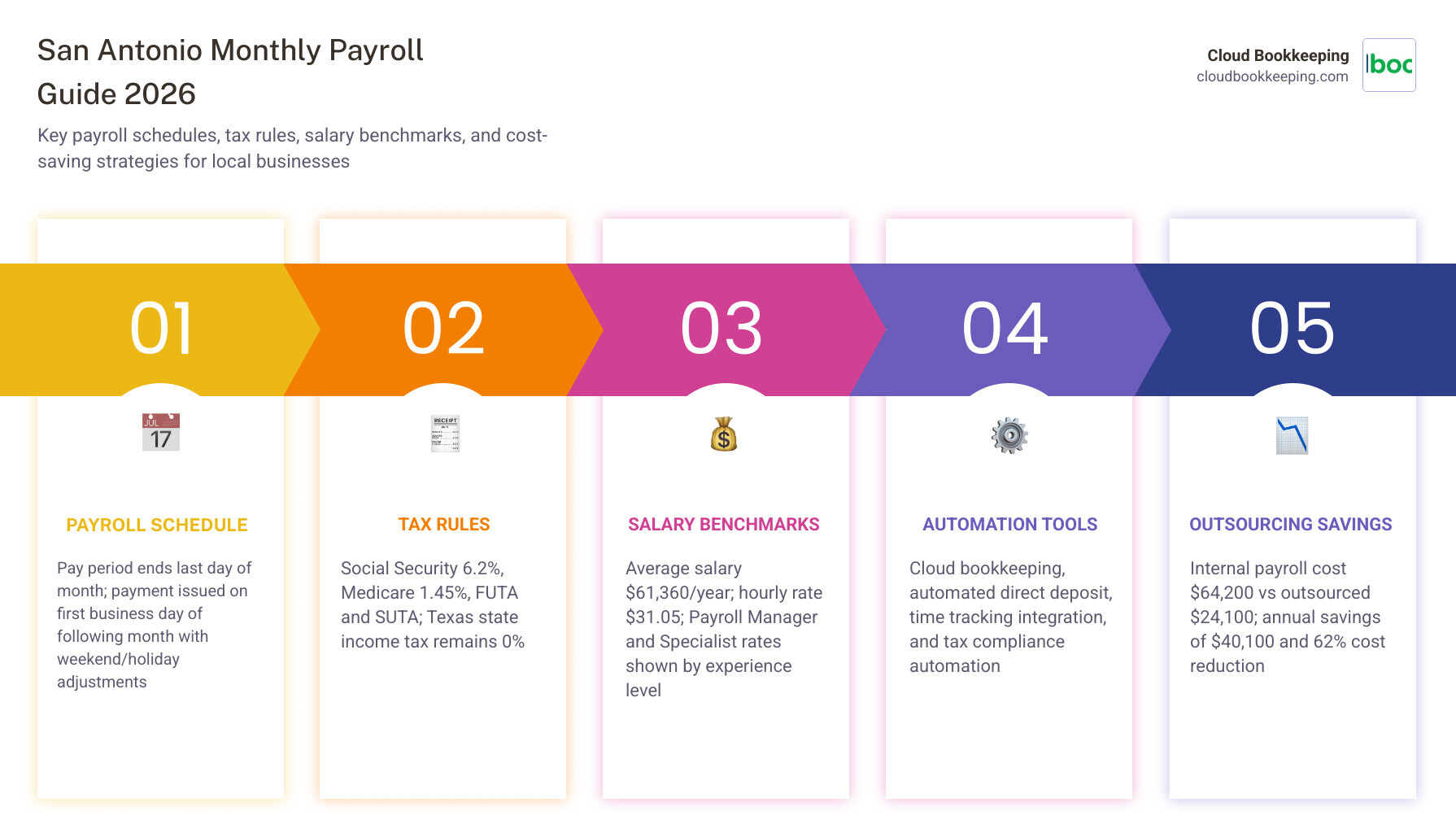
Pay dates follow a simple rule: if the 1st falls on a weekend or holiday, the pay date moves to the next business day. For example, the pay period covering August 1–31, 2025 was paid on September 2, 2025 — not September 1.
Running payroll in San Antonio isn’t just about cutting checks. It means staying current with federal tax brackets, FICA rules, benefit deductions, and shifting pay schedules — all while actually running your business.
I’m Charlie Perrin, founder of Cloud Bookkeeping, and over my 24 years of experience helping small business owners streamline their financial operations, San Antonio monthly payroll has been one of the most common pain points I see derail otherwise healthy businesses. Let’s break down exactly how to get it under control.
Understanding the San Antonio Monthly Payroll Landscape in 2026
As we navigate through May 2026, the economic landscape in San Antonio continues to show resilience and growth. For business owners and employees alike, understanding the local compensation standards is the first step toward effective financial management. Currently, the average payroll salary in San Antonio, TX stands at $61,360 per year, which breaks down to approximately $31.05 per hour.
When we look specifically at the combined “Payroll and Accounting” sector, the numbers are even more robust. The average salary for these roles in San Antonio is $71,699. This is particularly interesting because it sits 3% above the national average of $69,787. While San Antonio is often touted for its affordability, the demand for skilled financial professionals has kept local wages competitive.
Higher pay usually brings tighter standards. Handling payroll at this level means working through common payroll management challenges, including keeping up with federal rules and making sure every dollar is recorded correctly.

Economic Factors Influencing Local Pay
Several factors contribute to why San Antonio monthly payroll figures look the way they do in 2026. First and foremost is the cost of living in Bexar County. While San Antonio remains more affordable than coastal hubs, the local job market has seen significant tightening. Industries like healthcare, cybersecurity, and tourism are booming, driving up the need for administrative and financial support.
The talent gap is very real. San Antonio employers often pay more for payroll professionals who understand Texas labor rules and can handle more complex pay structures. Local salary data for payroll roles in San Antonio reflects that demand. And with Bexar County’s 1.8% property tax rate affecting household budgets, many businesses fine-tune gross pay to help employees keep up with living costs.
Comparing San Antonio to Other Texas Hubs
It is always helpful to see how we stack up against our neighbors. In the Texas “Texas Triangle,” San Antonio often holds a unique middle ground. While our salaries are 3% above the national average, they are frequently lower than the high-octane markets of Austin or Dallas.
| City | Cost Multiplier (vs. San Antonio) | Payroll Trend |
|---|---|---|
| San Antonio | 1.00x | Steady Growth |
| Austin | 1.16x | High Tech Premium |
| Dallas | 1.08x | Corporate Hub Pricing |
| Houston | 1.04x | Energy Sector Parity |
For example, a business operating in Austin might face costs 16% higher than those in San Antonio for the same level of administrative output. This makes San Antonio an incredibly attractive place for businesses to headquarter their back-office operations.
Navigating San Antonio Monthly Payroll Schedules and Compliance
Timing is everything. In San Antonio monthly payroll, the most common schedule for salaried employees is a monthly distribution. Per local standards and institutional practices (like those seen at major local universities and school districts), employees are typically paid on the first business day of the month following the pay period.
This is where monthly payroll can catch new business owners off guard. If the 1st lands on a Saturday, Sunday, or bank holiday, you usually cannot process pay until the next business day. That makes proactive communication important, so employees are not left wondering why their deposit has not arrived. It also helps to stay ahead of common cutoff issues by learning how to manage payroll deadlines, especially when supplemental pay like overtime, shift differentials, or bonuses needs to be rolled into one monthly paycheck.
If you want to confirm how often employees can legally be paid, Texas offers clear rules on pay frequency and twice-monthly payroll timing. Even so, monthly payroll is still common in many salaried and professional workplaces in San Antonio.

The Impact of Texas Tax Laws on San Antonio Monthly Payroll
One of the biggest “wins” for anyone on a San Antonio monthly payroll is the lack of a state income tax. In 2026, this continues to be a massive draw for the Texas workforce. Compared to states with high income taxes, San Antonio workers effectively see a 4.5% “raise” in their take-home pay simply by living here.
However, “no state tax” doesn’t mean “no taxes.” Employers must still rigorously manage:
- Federal Income Tax: Based on the 2025/2026 brackets (ranging from 10% to 37%).
- FICA Taxes: Social Security (6.2%) and Medicare (1.45%).
- Unemployment Taxes: Both FUTA (federal) and SUTA (state).
To get a precise estimate of what a check should look like after these bites are taken out, tools like the Texas Paycheck Calculator – SmartAsset are invaluable for both planning and transparency.
Managing Deductions and Take-Home Pay
For higher earners in San Antonio, the Social Security wage base cap is a critical number to watch. For the 2025-2026 period, this cap is set at $176,100. Once an employee’s year-to-date earnings hit this mark, the 6.2% Social Security tax stops, leading to a significant “bump” in take-home pay for the remainder of the year.
Beyond taxes, we must manage elective deductions. In San Antonio, about 75% of payroll professionals receive medical, dental, and vision benefits. Managing the pre-tax deductions for 401(k) contributions (and the corresponding employer match) is a vital part of the monthly cycle. We recommend using a San Antonio Paycheck Calculator | Texas Net Pay 2026 to help employees visualize how their HSA or 401(k) choices impact their actual monthly spendable income.
Salary Benchmarks for San Antonio Monthly Payroll Professionals
If you are looking to hire or are currently working in the field, knowing the 2026 benchmarks is essential. The role of a Payroll Specialist in San Antonio currently commands an average hourly rate of $23.01. Entry-level positions may start around $17.76, while highly experienced specialists can earn upwards of $30.41 per hour.
As you move into management, the compensation reflects the added responsibility of compliance and oversight. The average Payroll Manager Salary in San Antonio, Texas in 2026, according to PayScale is $75,940, with a total pay range (including bonuses) reaching up to $93,000. These managers are the gatekeepers who prevent The Most Common Payroll Mistakes that lead to IRS audits or disgruntled staff.
Career Growth and Compensation Factors
What moves the needle for salary in San Antonio? It’s a combination of three things:
- Experience: Early-career managers (1-4 years) average about $59,948, while those with 5-9 years of experience jump to $76,259.
- Education/Certification: Certified Payroll Professionals (CPP) often command a 10-15% premium.
- Software Proficiency: In 2026, being a “QuickBooks Pro” isn’t just a bonus; it’s often a requirement.
For those just starting out, moving from a general clerk position into a payroll specialist role is often one of the quickest ways to raise your hourly earning potential.
Benefits and Perks in the Local Market
In San Antonio’s competitive 2026 market, salary is only part of the story. Approximately 75% of payroll roles include a comprehensive benefits package. This typically includes:
- Healthcare: Medical, dental, and vision coverage.
- Retirement: 401(k) with employer matching (often 3-5%).
- Flexibility: With the rise of cloud-based systems, many San Antonio firms now offer hybrid or remote work options for payroll staff.
Strategies to Streamline Your San Antonio Monthly Payroll
If you’re a business owner, the “old way” of doing payroll—spreadsheets, manual data entry, and paper checks—is costing you more than you think. Research shows that back-office operations can consume up to 20-30% of a small business’s budget. However, San Antonio businesses that outsource these functions report operational cost reductions of up to 78% annually.
Efficiency is not only about cutting costs. It is also about getting your time back. When you use smarter payroll workflows, you can spend less energy on tax withholdings and more on serving customers and growing the business. We often see that the right payroll setup saves both time and money by reducing the manual errors that slow teams down.
Optimizing San Antonio Monthly Payroll with QuickBooks
At Cloud Bookkeeping, we are huge proponents of QuickBooks Online for managing San Antonio monthly payroll. Why? Because it integrates everything.
- Automated Tracking: Time tracking flows directly into the payroll module.
- Direct Deposit: No more printing checks or “lost in the mail” dramas.
- Compliance: The system automatically updates for 2026 tax table changes.
To keep payroll moving without last-minute scrambles, we encourage clients to stay ahead with a simple weekly payroll routine, like checking hours and updating new-hire details as they come in. If you’re weighing different payroll options for small businesses, QuickBooks is still a strong fit for many San Antonio companies.
Reducing Operational Costs Through Outsourcing
Let’s look at the math. For a typical San Antonio business with 10-25 employees, handling payroll in-house can add up fast once you include a bookkeeper, benefits, software, and training, often reaching about $64,200 a year. By comparison, outsourcing payroll support through a specialized provider may cost closer to $24,100.
That is an annual savings of $40,100—a 62% reduction in costs. Beyond the money, you gain the security of knowing a professional is handling your compliance, filings, and year-end reporting. This scalability is what allows San Antonio businesses to grow without the growing pains of administrative bloat.
Frequently Asked Questions about San Antonio Payroll
When are monthly employees typically paid in San Antonio?
In San Antonio, most monthly salaried employees are paid on the first business day of the month following the pay period. For example, work performed in June is typically paid on July 1st. If July 1st falls on a weekend, the pay date is moved to the next business day (usually Monday, July 2nd or 3rd).
What is the average salary for a payroll manager in San Antonio?
As of 2026, the average salary for a Payroll Manager in San Antonio is approximately $75,940. Depending on the size of the company and the complexity of the payroll, this can range from $51,000 to $93,000 when including bonuses and total compensation.
How does the lack of state income tax affect San Antonio payroll?
Texas’s zero state income tax is a major benefit for San Antonio workers. It effectively increases an employee’s take-home pay by about 4.5% compared to states with an income tax. For employers, it simplifies the payroll process as there is no state-level withholding to calculate or remit, though federal and FICA taxes still apply.
Conclusion
Mastering San Antonio monthly payroll doesn’t have to be a source of constant stress. By understanding the local benchmarks, staying ahead of the 2026 tax changes, and leveraging modern tools like QuickBooks, you can turn a complex administrative burden into a streamlined, automated process.
At Cloud Bookkeeping, we pride ourselves on providing unparalleled customer service and clear, actionable reporting. Led by Charlie Perrin, our San Antonio-based team understands the local market because we live and work here too. Whether you’re looking to fix a messy set of books or want to outsource your payroll entirely to save that $40,000 a year, we’re here to help.
Ready to stop worrying about deadlines and start focusing on your business? Master your business finances with professional San Antonio payroll services and let us take the weight off your shoulders.