Why Accounts Payable Services Can Make or Break Your Business
Accounts payable services are solutions — either software, outsourced teams, or a combination of both — that handle how your business receives, processes, approves, and pays vendor invoices.
Here’s a quick overview of what they typically include:
- Invoice capture — receiving and digitizing bills from vendors
- Data validation — checking invoice details for accuracy and matching to purchase orders
- Approval workflows — routing invoices to the right people for sign-off
- Payment execution — scheduling and sending payments on time
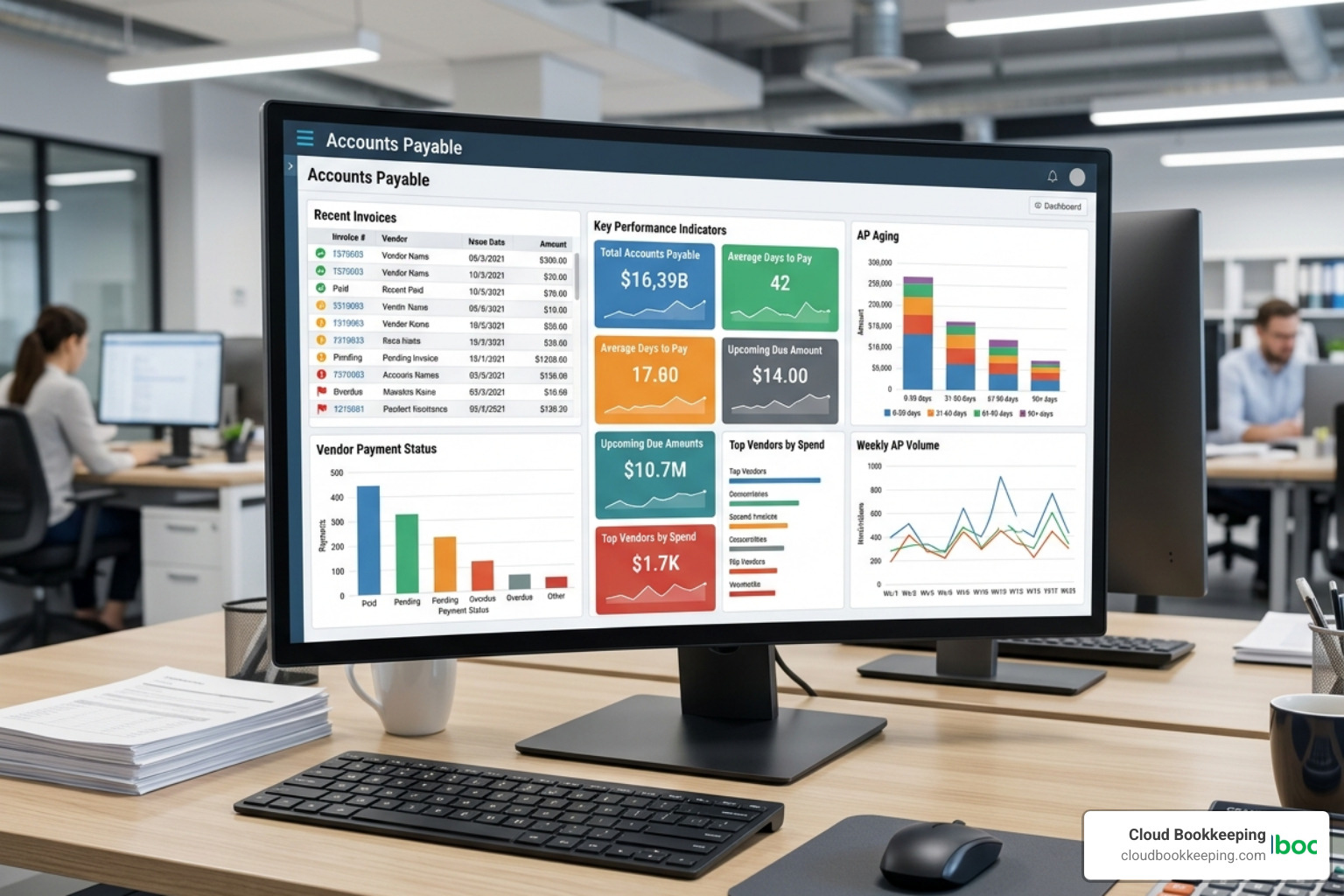
- Reporting — tracking what’s owed, what’s paid, and what’s overdue
If you’re a small business owner spending hours every week chasing paper invoices, manually entering data, or losing sleep over whether a vendor got paid — you’re not alone. Many businesses still rely on manual processes that are slow, error-prone, and expensive. In fact, processing a single paper invoice costs businesses an average of $22, and that number adds up fast.
I’m Charlie Perrin, founder of Cloud Bookkeeping, and with over 24 years of experience helping small business owners streamline their finances, I’ve seen how the right accounts payable services can eliminate chaos and free up real time and money. Let’s walk through exactly what your options are and how to choose the best fit for your business.
Understanding Accounts Payable Services and How They Work
To understand how accounts payable services work, we first have to look at the “old way” of doing things. In a traditional manual setup, an invoice arrives via mail or email. Someone has to open it, type the data into an accounting system, find the person who authorized the purchase, get a signature, and eventually cut a physical check. It’s a recipe for lost documents, duplicate payments, and late fees.
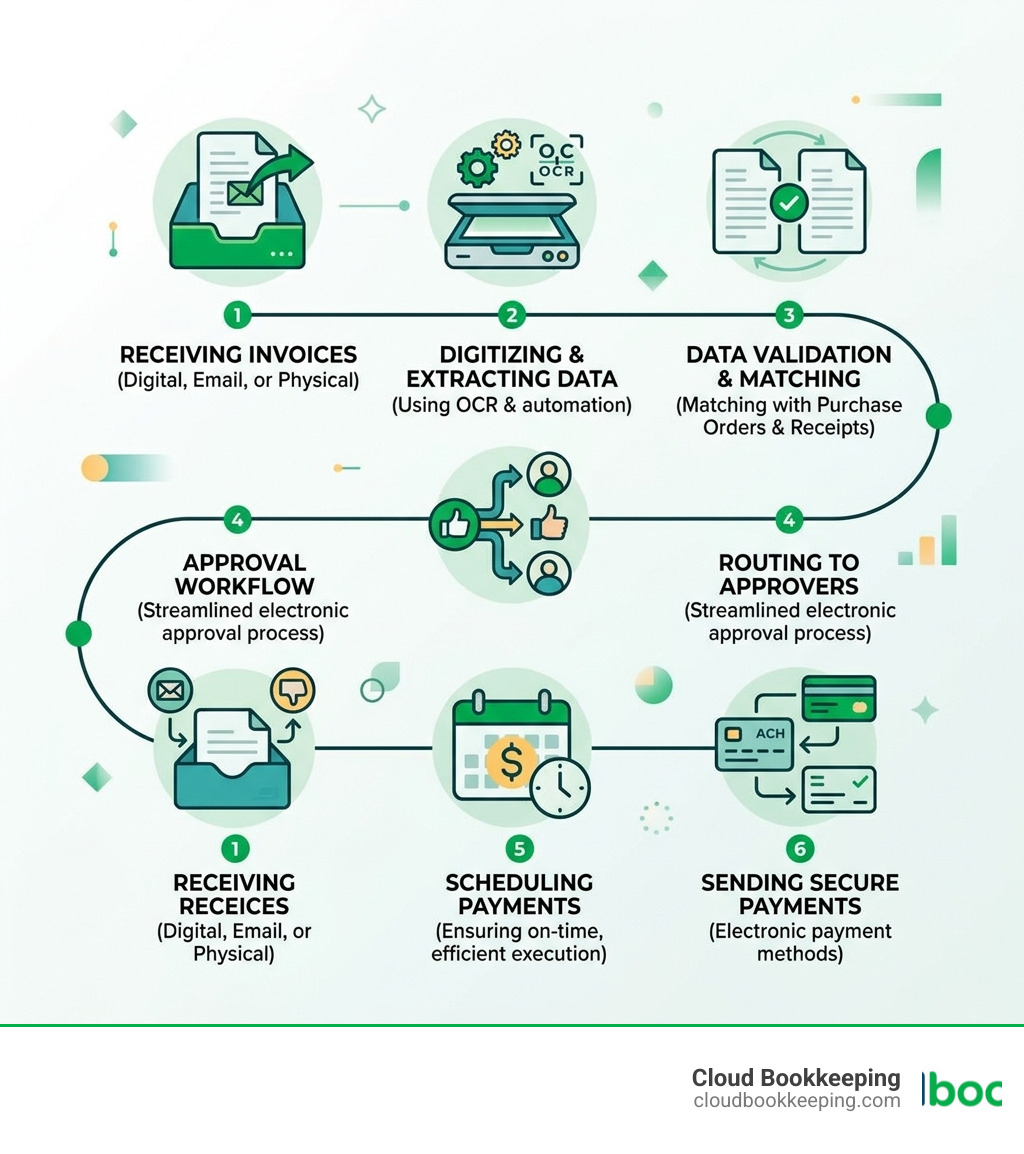
Modern accounts payable services transform this into a streamlined, digital workflow. It usually begins with invoice intake. Whether a bill comes in as a PDF or a piece of paper, it is funneled into a central system. Using OCR technology (Optical Character Recognition), the system “reads” the invoice, extracting the vendor name, date, amount, and due date automatically. This significantly reduces the risk of human error that comes with manual data entry.
A critical step in this process is 3-way matching. This is where the service compares the invoice against the original purchase order and the receiving report (the proof that you actually got the goods or services). If all three match, the invoice is cleared for payment. If there’s a discrepancy, the system flags it as an exception. This level of Accounts Payable Solutions ensures you never pay for something you didn’t receive or get overcharged by a vendor.
Once validated, the invoice enters an automated approval workflow. Instead of walking a piece of paper around the office, the system sends a digital notification to the manager who needs to sign off. After approval, payment execution happens via ACH, wire transfer, or virtual card, often integrated directly with your bank. This entire ecosystem provides a 30% cost reduction simply by automating data capture and can shorten processing times from 15 days down to just one. For more information on how this fits into your overall financial health, you can explore our bookkeeping services.
Outsourcing vs. Automation: Finding the Right Balance
When looking at accounts payable services, you’ll often hear two terms used interchangeably: outsourcing and automation. However, they aren’t quite the same thing, and choosing between them depends on how much control you want to keep in-house.
| Feature | AP Outsourcing (BPO) | AP Automation (SaaS) | Hybrid Model |
|---|---|---|---|
| Who does the work? | External vendor’s team | Your internal staff | Shared responsibilities |
| Data Control | Held by the vendor | Stays in-house | Shared access |
| Primary Tool | Service provider’s platform | Software (ERP integration) | Integrated software + experts |
| Cost Structure | Per-invoice or flat fee | Monthly subscription | Combined fee |
| Best For | Scaling without hiring | Maintaining total control | Maximum efficiency + oversight |
AP automation uses software, usually SaaS tools, to handle the repetitive parts while your team still owns the process. AP outsourcing means bringing in an outside firm to actually manage and complete those tasks for you. At Cloud Bookkeeping, we often recommend a hybrid approach: use strong tools, but add professional oversight so invoices, payments, and reconciliations stay accurate. If you are not sure what level of help fits, this guide to choosing the right bookkeeping support can help.
Comparing Costs and Efficiency in Accounts Payable Services
Cost is usually the biggest driver for change. If you stick with manual paper processing, you’re looking at that $22 per invoice figure mentioned earlier. In contrast, accounts payable services providers often set pricing at a much more manageable $1.50 to $2.00 per invoice.
The efficiency gains are even more staggering. Automation can provide up to 80% in substantial time savings. Imagine your finance team spending 80% less time on data entry and 80% more time on strategic planning or cash flow analysis. With touchless processing, where an invoice is received, matched, and scheduled for payment without a human ever touching it, the ROI becomes clear very quickly. You can see how global providers like APS leverage these models to serve businesses across the US, UK, and beyond.
Maintaining Control with Modern Accounts Payable Services
A common fear with outsourcing or automating is the “loss of control.” Business owners worry that bills will get paid without them knowing, or that they won’t have visibility into their cash flow.
Modern accounts payable services actually increase control. Every action taken—from the moment an invoice is scanned to the second the payment is sent—is recorded in a permanent audit trail. You can set specific user permissions so that only certain people can approve payments over a specific dollar amount. With real-time reporting and custom dashboards, you always know exactly how much money is leaving your account and when. This is especially vital when managing complex vendor relationships; learn more about our 1099 vendor management to see how we keep those details organized.
The Pros and Cons of External AP Management

Deciding to move your AP functions to an external provider is a big step. In April 2026, the trend is moving heavily toward specialized services because the benefits far outweigh the risks for most growing businesses.
The Pros:
- Cost Reduction: Achieve up to 30% savings through automated capture and up to 40% reduction in processing costs.
- Fraud Prevention: Systems include duplicate detection and 300-point verification to ensure you aren’t being scammed by “ghost” vendors.
- Early Payment Discounts: By processing invoices 40% faster, you can actually take advantage of vendor discounts for paying early, turning your AP department into a cost-saving center.
- Scalability: You can handle 10x more invoices without having to hire a single new employee.
The Cons:
- Dependency Risks: You rely on the provider’s uptime and accuracy.
- Communication Gaps: If the provider is in a different time zone or lacks local knowledge, resolving a specific vendor dispute might take longer.
- Initial Setup: It takes time to map your “as-is” processes and integrate the new system with your existing ERP or accounting software.
For a broader look at the benefits, this guide on outsourcing bookkeeping work explains why many San Antonio businesses move these tasks off their plate.
Signs Your Business Needs Scalable Accounts Payable Services
How do you know if you’re ready? If you’re experiencing high invoice volumes (usually 50+ per month), frequent late payment fees, or frustrated vendors calling to ask where their money is, it’s time. Rapid growth often creates manual bottlenecks that can paralyze a small team. When your bookkeeper is spending all their time on data entry rather than providing insights, you may need to look into controller services to bring a higher level of financial strategy to the table.
Security, Compliance, and Implementation Strategies
When you are dealing with your business’s bank accounts and vendor data, security is non-negotiable. Top accounts payable services utilize enterprise-level protections like SOC 2 Type 2 and ISO 27001 compliance. These are rigorous standards that ensure your data is encrypted and handled with the highest level of care.
Beyond digital security, these services help with segregation of duties. This is a fundamental accounting principle where the person who approves the invoice is not the same person who executes the payment. This prevents internal fraud and errors. Furthermore, these systems make tax compliance a breeze. Instead of scrambling at the end of the year, you have audit-ready controls and organized tax return work papers ready to go.
Implementing these services successfully requires a clear process mapping strategy. You need to document how an invoice moves through your office today so the service provider can mirror (and improve) that workflow. With 97% next-day processing accuracy being the industry standard for top providers, the transition usually pays for itself in peace of mind within the first three months.
Frequently Asked Questions About AP Outsourcing
How much do accounts payable services typically cost?
As we’ve noted, the most common pricing model is a per-invoice fee, typically ranging from $1.50 to $2.00. Some providers offer flat monthly rates for a set volume of invoices. When you compare this to the $22 cost of manual processing, the overhead reduction is massive. By moving from variable hourly labor costs to a fixed per-invoice cost, your budget becomes much more predictable.
What results can a company expect after switching from manual processes?
The most immediate result is speed. Many companies see their turnaround time drop from 15 days to just 1 day. You can also expect a 95% reduction in errors like typos or duplicate payments. Moving to 100% paperless operations improves vendor trust and allows your team to focus on growing the business rather than filing paperwork.
Is my financial data secure when using an outside provider?
Yes, provided you choose a reputable partner. Look for providers that offer 300-point verification and secure portals with role-based access. This means you can control exactly who sees what data. These platforms are designed to be “audit-ready,” meaning every transaction is documented and easy for an accountant to verify.
Conclusion
Managing your bills shouldn’t be a source of constant stress. By April 2026, the technology behind accounts payable services has become so accessible that even small businesses can enjoy the same efficiency as global corporations. Streamlining your AP isn’t just about paying bills; it’s a strategic move to optimize your working capital and improve your cash flow.
At Cloud Bookkeeping, we pride ourselves on our local San Antonio leadership and deep QuickBooks expertise. Under the guidance of Charlie Perrin, we help you move from the “shoe box of receipts” era into a future of clear reporting and dependable support. Don’t let manual tasks slow your growth, contact us today to talk about professional accounts payable services and take back your time.