What You Need to Know About Sales Tax in Texas (2026 Update)
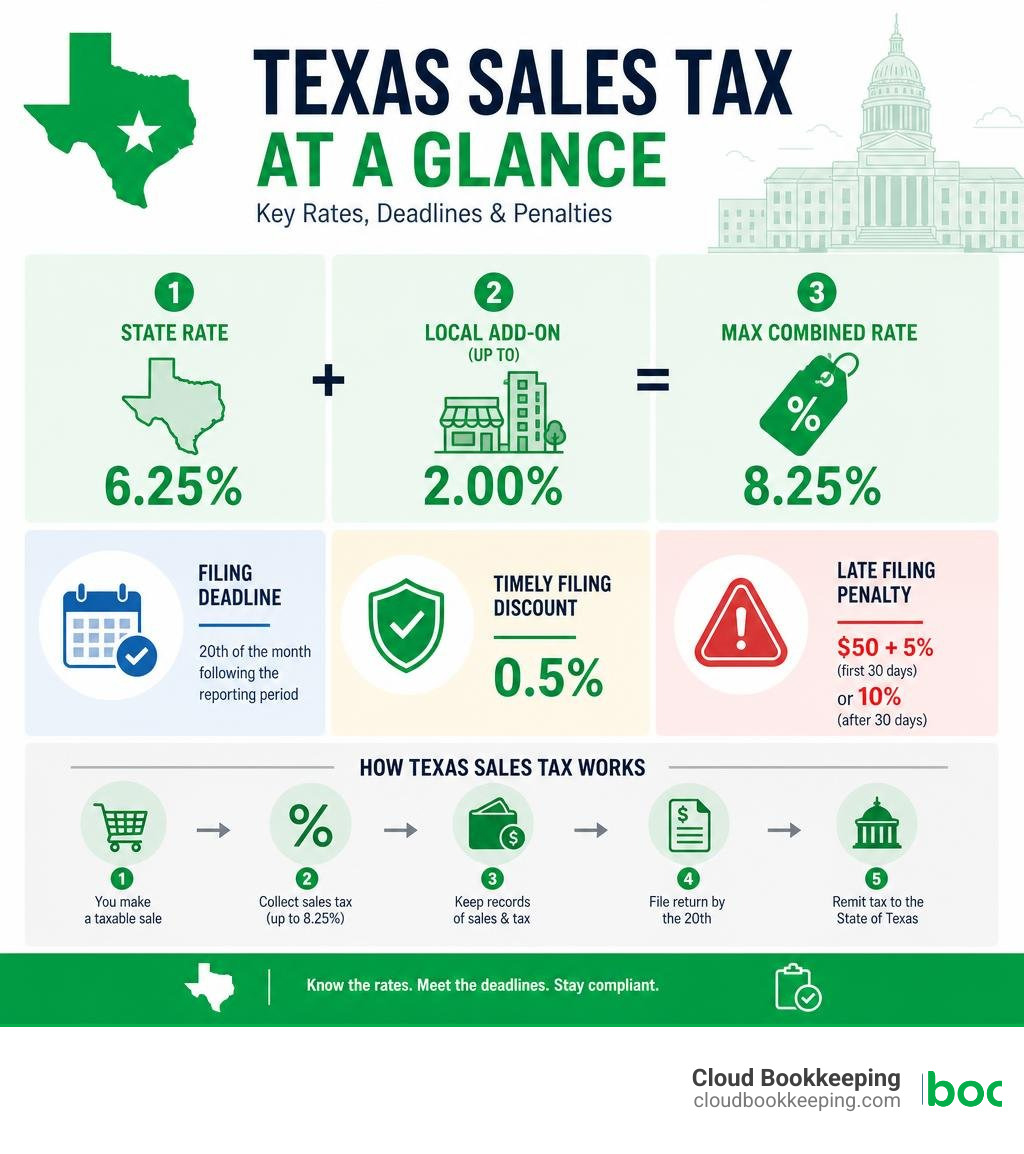
Sales tax in Texas is a consumption tax collected on most retail sales, leases, and rentals of goods — plus many services — within the state. Here’s a quick overview so you can get the key numbers fast:
| Detail | Rate / Info |
|---|---|
| State sales tax rate | 6.25% |
| Maximum local add-on | 2.00% |
| Maximum combined rate | 8.25% |
| Most major cities (Houston, Dallas, Austin, San Antonio) | 8.25% |
| Economic nexus threshold (remote sellers) | $500,000 in Texas sales in prior 12 months |
| Timely filing discount | 0.5% |
| Late filing penalty | $50 + 5% (first 30 days) or 10% (after 30 days) |
| Returns due | 20th of the month following the reporting period |
Texas relies heavily on sales tax — it made up 58.3% of all state tax revenue in fiscal 2025, totaling $49.06 billion. That means the state takes compliance seriously, and so should your business.
Getting this wrong — wrong rate, wrong filing date, wrong exemption — can cost you real money. This guide walks you through everything step by step.
I’m Charlie Perrin, founder of Cloud Bookkeeping, and over my 24 years working with small business owners on sales tax in Texas, I’ve seen how easily these details get overlooked when you’re focused on running your business. Let’s make sure you have the clarity you need to stay compliant and avoid costly surprises.
Understanding the Basics of Sales Tax Texas
To understand how sales tax texas works, you have to look at how the state structures its revenue. Unlike many other states, Texas does not levy a personal or corporate state income tax. Instead, the state funds its public services, schools, and infrastructure primarily through consumption taxes.
According to the Texas Comptroller’s field guide to state taxes, sales and use taxes are by far the largest single source of state tax collections. Texas sales tax collections have historically grown at a compound annual growth rate of 6.3% (measured from fiscal 2016 to 2025). This massive volume means the Texas Comptroller of Public Accounts keeps a close watch on businesses to ensure every dollar of tax is properly collected, reported, and remitted.
For any business operating in or selling to customers in the Lone Star State, the baseline starting point is the state-level sales tax rate of 6.25%. However, very few transactions in Texas are taxed at just 6.25%. Local jurisdictions are allowed to add their own local sales taxes on top of the state rate, up to a maximum cap of 2.00%. This brings the absolute maximum combined sales tax rate anywhere in Texas to 8.25%.
Managing these shifting rates across different jurisdictions is one of the most common administrative hurdles for business owners. If you want to dive deeper into how these reports function on a fundamental level, you can read our guide to sales tax report basics.

Local Jurisdictions and Address-Level Rates
The local portion of the sales tax is not just a single municipal add-on. Instead, it can be a combination of several different local taxing authorities layered on top of each other. These local jurisdictions include:
- Cities: Incorporated cities can impose a local sales tax (often 1.00% to 1.50%) to fund general municipal operations.
- Counties: Many of the 254 counties in Texas impose an additional sales tax (typically 0.50% to 1.00%) for county-wide services.
- Transit Authorities: Metropolitan transit authorities (like VIA in San Antonio, METRO in Houston, or DART in Dallas) often levy a sales tax (usually 1.00%) to fund public transportation.
- Special Purpose Districts (SPDs): These are specialized districts created to fund specific local projects, such as health services, library districts, crime control, or emergency services.
Because these districts can overlap in complex ways, two businesses located just across the street from one another might have entirely different combined sales tax rates. For example, if you look at San Antonio’s tax breakdown, you will see that the combined sales tax rate in San Antonio is the maximum 8.25%. This is composed of:
- Texas State Sales Tax: 6.25%
- City of San Antonio: 1.00%
- San Antonio Advanced Transportation District: 0.25%
- San Antonio MTA (Transit): 0.75%
- Bexar County: 0.25%
If you sell to a customer located in an unincorporated area of Bexar County outside the city limits and transit authority boundaries, the rate could drop significantly because fewer local jurisdictions apply.
To find the exact, legally required rate for any given address, businesses should use the official Sales Tax Rate Locator tool provided by the Texas Comptroller. Relying on zip codes alone is a dangerous practice because zip code boundaries do not align perfectly with municipal or special district tax borders.
Destination-Based Sourcing Rules
How do you know which local tax rate to charge? Texas uses a set of sourcing rules to determine which local jurisdictions get the tax revenue from a sale.
For local sales tax purposes, Texas generally operates under origin-based sourcing for in-state retailers who have a physical place of business in Texas. If you operate a physical retail shop in San Antonio and a customer walks in to buy an item, you charge the local sales tax rates applicable to your San Antonio store location, regardless of where the customer lives.
However, if you are a remote seller (an out-of-state business with no physical presence in Texas but with economic nexus), Texas applies destination-based sourcing. This means you must calculate and collect local sales tax based on the destination address where your customer takes possession of the goods.
Additionally, remote sellers have the option to simplify their bookkeeping by electing to use the Single Local Use Tax Rate of 1.75%. If you elect this option, you collect the flat 6.25% state rate plus a uniform 1.75% local rate (totaling 8.00%) on all sales shipped to Texas, rather than tracking hundreds of individual local jurisdictions.
Taxable vs. Exempt Goods and Services in Texas
In Texas, the sales tax applies to all retail sales, leases, and rentals of tangible personal property, as well as to specific, legally defined taxable services. “Tangible personal property” refers to physical items that can be seen, weighed, measured, felt, or touched. If you sell clothes, furniture, electronics, or office supplies, those items are taxable by default unless a specific statutory exemption applies.
Services, however, are a bit more complex. Unlike physical goods, services in Texas are only taxable if the state legislature has explicitly designated them as such. Some of the most common taxable services in Texas include:
- Amusement services (concerts, movie theaters, sporting events)
- Cable and satellite television services
- Credit reporting and debt collection
- Information services (newsletters, database access)
- Real property repair, remodeling, and restoration
- Security and detective services
- Data processing services
Businesses are often surprised to learn that data processing is taxable in Texas. According to the state’s data processing sales tax guidance, activities like word processing, payroll processing, accounts payable/receivable billing, data entry, and even SaaS (Software-as-a-Service) platforms fall under this category.
However, Texas does offer a unique benefit here: 20% of the value of data processing services is exempt from sales tax. This means you only charge sales tax on 80% of the total charge for taxable data processing services.

Common Exemptions and Exclusions
While many items are taxable, the Texas Legislature has carved out several major categories of goods and services that are exempt from sales tax to reduce the tax burden on essential needs and key industries.
- Groceries and Food: Most basic grocery items (like fresh produce, meat, milk, and bread) are exempt from sales tax. However, prepared meals, soft drinks, candy, and food sold ready-to-eat at restaurants remain fully taxable.
- Prescription Medicines: Prescription drugs, insulin, and certain medical devices are completely exempt. Over-the-counter medicines, however, are generally taxable.
- Professional Services: Professional services that require specialized, licensed knowledge — such as bookkeeping, accounting, legal services, medical care, and engineering — are exempt from sales tax.
- Manufacturing Equipment: Texas offers a sales tax exemption on machinery and equipment used directly in the manufacturing or processing of tangible personal property for sale.
It is also important to clear up a common misconception regarding veteran exemptions. According to the Texas Comptroller’s sales and use tax guidance, there is no sales tax exemption for 100% disabled veterans under Texas state law. While disabled veterans may qualify for significant property tax exemptions, they must still pay standard sales tax on retail purchases.
Texas Sales Tax Registration and Filing Requirements
Before your business can legally collect a single penny of sales tax in Texas, you must register for a sales tax permit with the Texas Comptroller’s office. Collecting sales tax without an active permit is a criminal offense.
| Step | Action Required |
|---|---|
| 1. Determine Nexus | Confirm if you have a physical presence or meet the $500,000 economic threshold. |
| 2. Gather Info | Have your EIN, SSN, business structure details, and NAICS code ready. |
| 3. Apply Online | Register through the Texas Comptroller’s eSystems portal. |
| 4. Receive Permit | Display your active permit at your place of business. |
| 5. File Returns | File on Webfile according to your assigned monthly, quarterly, or annual schedule. |
To keep your business running smoothly, you must align your internal accounting processes with the state’s reporting rules. For a comprehensive look at how to structure your internal processes, check out our guide on how to stay compliant with Texas sales tax returns.
Who Needs a Sales Tax Texas Permit?
Your business must obtain a Texas sales tax permit if you have nexus in the state. Nexus is the legal term for a business connection to a state that is strong enough to require you to collect and remit taxes. In Texas, nexus is established in two primary ways:
- Physical Nexus: This applies if your business has a physical presence in Texas. Physical presence includes having an office, warehouse, retail store, inventory stored in a fulfillment center, or employees/independent contractors working in the state.
- Economic Nexus: Following the landmark 2018 Supreme Court decision in South Dakota v. Wayfair, states can require out-of-state remote sellers to collect sales tax based purely on sales volume. In Texas, the economic nexus threshold is a $500,000 safe harbor.
Under this safe-harbor rule, remote sellers whose total gross revenue from sales into Texas is less than $500,000 during the preceding 12-month period are not required to register or collect Texas sales tax. If your out-of-state business exceeds this $500,000 threshold, you must register for a permit and begin collecting tax by the first day of the fourth month after the month in which you crossed the limit. You can read more about these specific rules directly from the state’s remote seller guidance.
Filing and Remitting Your Sales Tax Texas Returns
Once you have your permit, the Texas Comptroller will assign you a filing frequency based on the volume of tax you expect to collect:
- Monthly: Required if you collect and owe more than $1,500 in state sales tax per quarter.
- Quarterly: Allowed if you owe between $1,000 and $1,500 in state sales tax per quarter.
- Annually: Allowed if you owe less than $1,000 in state sales tax per year.
Regardless of your frequency, all Texas sales tax returns are due on the 20th day of the month following the end of the reporting period. If the 20th falls on a weekend or state holiday, the due date moves to the next business day. Missing these deadlines can lead to severe operational issues, which is why we always emphasize the importance of tracking sales tax return deadlines proactively.
To encourage compliance, Texas offers a 0.5% timely filing discount. If you file your return and pay the tax on or before the due date, you can keep 0.5% of the collected tax. If you prepay your taxes based on estimated liabilities, you can receive an additional 1.25% prepayment discount (for a total discount of up to 1.75%).
On the flip side, filing late is costly. There is an automatic $50 penalty assessed for any return filed after the due date, even if you owe $0 in tax for that period. If you owe tax and pay late, the state adds a 5% penalty if paid within 30 days of the due date, which increases to a 10% penalty if paid more than 30 days late. Interest also begins to accrue on unpaid balances starting on the 61st day after the due date.
For larger businesses, the state mandates electronic filing. If your business paid $50,000 or more in sales tax during the preceding fiscal year, you must file electronically via the Comptroller’s Webfile system or through approved EDI software. Failure to file electronically when required results in an additional 5% non-compliance penalty.
Use Tax and Marketplace Rules
Sales tax is only half of the equation; the other half is use tax. Use tax is a complementary tax designed to protect local Texas businesses from unfair out-of-state competition.
If a Texas resident or business purchases taxable goods or services from an out-of-state seller who does not collect Texas sales tax, the buyer is legally obligated to self-assess and remit use tax directly to the Texas Comptroller. The use tax rate is identical to the sales tax rate (6.25% state plus up to 2.00% local). For example, if a San Antonio business buys office furniture online from an out-of-state vendor that doesn’t charge sales tax, that business must report and pay the 8.25% use tax on its next tax return.
For e-commerce businesses, Texas has simplified much of this burden through marketplace facilitator laws. If you sell your products through a marketplace provider (like Amazon, eBay, or Etsy), the marketplace provider is legally considered the seller. They are responsible for calculating, collecting, and remitting the sales tax on your behalf.
However, as a marketplace seller, you are not entirely off the hook. You must still maintain accurate sales records, and if you have physical nexus in Texas, you must still maintain a sales tax permit and file regular returns, even if you report $0 in direct taxable sales. Ensuring you keep these records organized is a fundamental part of learning how to stay compliant with sales tax returns.
Frequently Asked Questions About Texas Sales Tax
What is the current maximum sales tax rate in Texas?
The current maximum combined sales tax rate in Texas is 8.25%. This is composed of the 6.25% state sales tax and up to 2.00% in local sales taxes imposed by cities, counties, transit systems, and special purpose districts.
Do 100% disabled veterans get a sales tax exemption in Texas?
No. Under current Texas state law, there is no sales tax exemption for 100% disabled veterans on everyday retail purchases. While veterans may qualify for property tax relief, they must still pay standard sales and use taxes at the register.
What is the penalty for filing a Texas sales tax return late?
Filing a return late triggers an immediate, automatic $50 late filing penalty, even if no tax is owed. If tax is owed, a 5% penalty is added if paid 1 to 30 days late, increasing to a 10% penalty if paid more than 30 days late. Interest begins accruing on the 61st day. If you find your books are out of sync, you should address why your sales tax numbers are not matching up before the state flag-marks your account for an audit.
Conclusion
Calculating and filing your sales tax in Texas does not have to be a source of constant stress. By understanding the state’s 6.25% baseline rate, tracking local municipal additions up to the 8.25% cap, and keeping up with monthly or quarterly deadlines, you can keep your business fully compliant and avoid painful state penalties.
However, as your business grows, managing these overlapping tax jurisdictions, tracking data processing exemptions, and reconciling your QuickBooks accounts can quickly become a full-time job.
At Cloud Bookkeeping, we specialize in taking the stress of sales tax off your plate. Led by Charlie Perrin in San Antonio, our team provides the QuickBooks expertise, clear financial reporting, and unparalleled customer service you need to focus on what you do best: running your business.
Let us handle the numbers so you can move forward with confidence. Explore our professional sales tax return services page today to learn how we can simplify your monthly and quarterly filings.