Why the Differences Between IFRS and US GAAP Still Matter in 2026
Understanding IFRS and US GAAP is essential for businesses working with international partners, investors, or cross-border transactions.
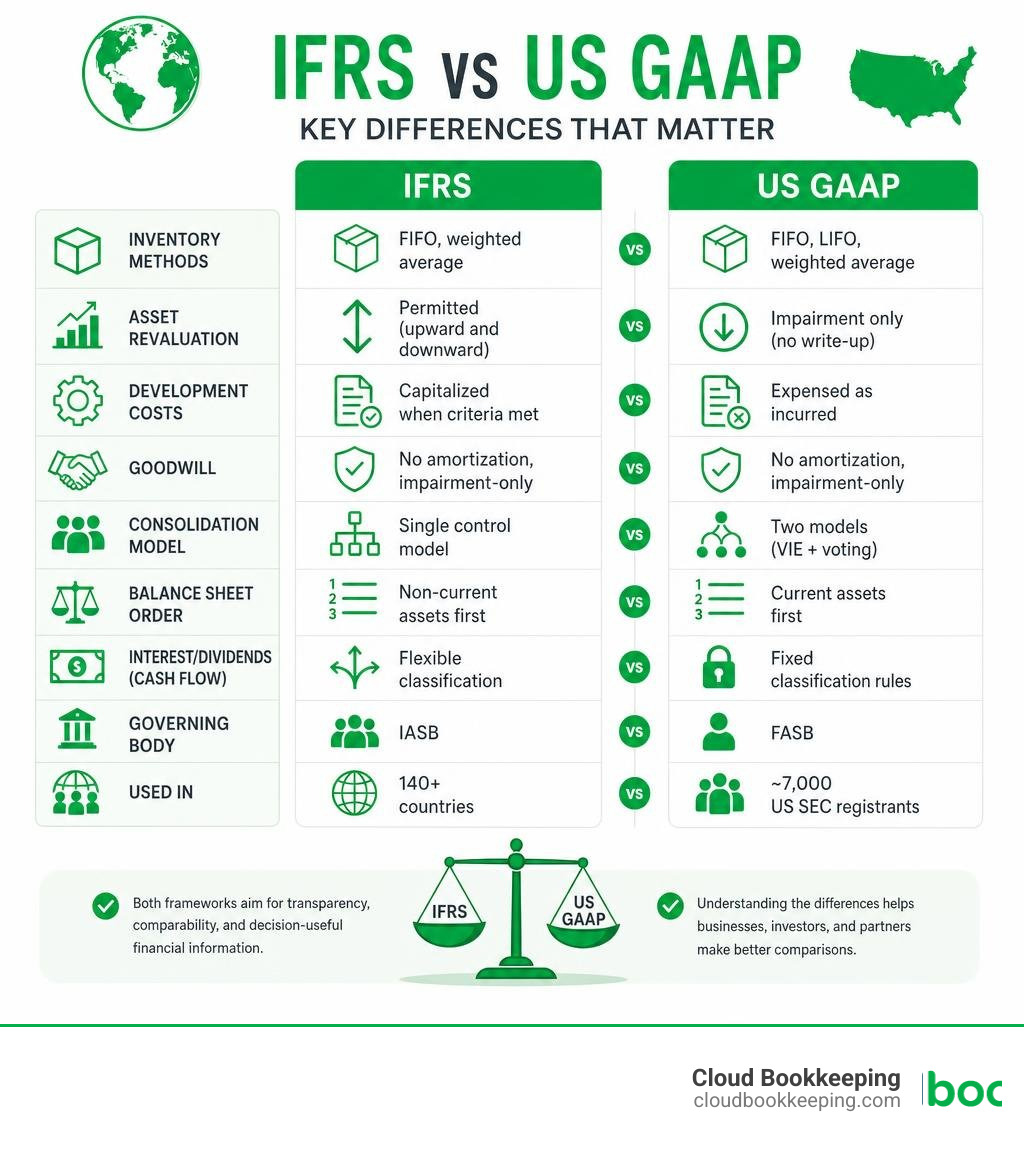
Here is a quick-reference breakdown of core differences:
| Topic | IFRS | US GAAP |
|---|---|---|
| Inventory methods | FIFO, weighted average | FIFO, LIFO, weighted average |
| Asset revaluation | Permitted in some cases | Impairment only, no write-up |
| Development costs | Capitalized when criteria are met | Usually expensed as incurred |
| Goodwill | No amortization, impairment-only | No amortization, impairment-only |
| Consolidation model | Single control model | VIE plus voting models |
| Balance sheet order | Often non-current assets first | Often current assets first |
| Interest/dividends in cash flow | Flexible classification | More fixed classification rules |
| Governing body | IASB | FASB |
| Used in | 140+ countries | About 7,000 US SEC registrants |
IFRS (International Financial Reporting Standards) is used in more than 140 jurisdictions, while US GAAP governs financial reporting for US public companies and many private companies. These differences affect asset values, reported profit, debt metrics, cash flow presentation, and investor comparisons.
The frameworks also continue to change. IFRS 18 takes effect in 2027 and will reshape income statement presentation, while the FASB continues to expand disclosure requirements for US reporters. Dual-reporting companies should prepare early.
I am Charlie Perrin, founder of Cloud Bookkeeping, with over 24 years of experience helping business owners build cleaner financial systems. While our firm focuses on small business clients, the principles behind IFRS and US GAAP are foundational to clear, reliable reporting at every level.
IFRS and US GAAP in 2026: Where the Frameworks Still Diverge
For calendar-year 2026 reporting, IFRS and US GAAP remain highly aligned in some areas but fundamentally different in others. IFRS is issued by the International Accounting Standards Board (IASB). US GAAP is maintained by the Financial Accounting Standards Board (FASB).
The FASB and IASB once pursued broad convergence, beginning with the Norwalk Agreement in 2002. That effort produced largely aligned standards for revenue recognition (IFRS 15 and ASC 606) and leases (IFRS 16 and ASC 842). Full convergence is no longer expected, and domestic US companies still cannot use IFRS for SEC reporting.
IFRS is required or permitted in more than 140 jurisdictions and is used by many global companies. US GAAP remains the required framework for US domestic SEC registrants. At a high level, IFRS is more principles-based and judgment-driven, while US GAAP is more rules-based, with detailed guidance and industry-specific requirements.
| Accounting Area | IFRS Accounting Standards | US GAAP |
|---|---|---|
| Basic Philosophy | Principles-based, relying on professional judgment. | Rules-based, with more detailed guidance. |
| Balance Sheet Layout | Often presented in reverse order of liquidity. | Often presented in order of liquidity. |
| Inventory Valuation | FIFO or Weighted Average; LIFO prohibited. | FIFO, LIFO, or Weighted Average permitted. |
| Development Costs | Capitalized once criteria are met. | Expensed as incurred, with limited software exceptions. |
| Asset Revaluation | Permitted for certain assets. | Generally prohibited; historical cost model used. |
| Impairment Reversals | Allowed for some assets if value recovers. | Generally prohibited for long-lived assets and goodwill. |
| Consolidation Model | Single control model. | Variable Interest Entity and Voting Interest models. |
| Cash Flow Statement | More flexibility for interest and dividends. | More prescriptive classification rules. |
IFRS and US GAAP adoption, scope, and regulatory use
Domestic US issuers must report under US GAAP. However, the SEC permits foreign private issuers to file financial statements prepared under IFRS as issued by the IASB without reconciling to US GAAP.
That flexibility makes financial literacy across both frameworks valuable for companies involved in foreign investment, acquisitions, or partnerships. If your San Antonio business works with an overseas parent, investor, or target company, you may need to read IFRS-compliant statements. The IFRS Foundation explains how these standards apply in the United States in its overview of IFRS use for US-related reporting.
Biggest 2026 differences at a glance
Key divergence points for 2026 include:
- Financial Instruments: IFRS 9 and US GAAP credit loss rules use different classification and impairment models.
- Consolidation: IFRS uses one control model, while US GAAP applies VIE and voting interest models.
- Business Combinations: Differences remain in NCI measurement, pushdown accounting, and the definition of a business.
- Intangible Assets: IFRS can require development cost capitalization; US GAAP generally expenses those costs.
- Inventory and Impairments: IFRS prohibits LIFO and permits some impairment reversals; US GAAP does not.
Financial Statement Presentation, Income Statement Transparency, and IFRS 18
Presentation affects how quickly investors, lenders, and managers can understand performance.

Historically, IAS 1 and US GAAP ASC 205 guided financial statement presentation. The IASB has now issued IFRS 18 Presentation and Disclosure in Financial Statements, effective for annual reporting periods beginning on or after January 1, 2027. IFRS 18 replaces IAS 1 and changes how profit or loss is structured.
The goal is to improve comparability, especially around operating profit and management-defined performance measures. The FASB is taking a different path by emphasizing more disaggregated expense disclosures rather than adopting the IFRS 18 category structure.
New income statement structure under IFRS 18
Under IFRS 18, the statement of profit or loss will use five categories:
- Operating: Income and expenses not classified elsewhere.
- Investing: Income and expenses from assets that generate returns largely independently.
- Financing: Income and expenses from financing transactions and certain interest effects.
- Income Taxes: Tax effects.
- Discontinued Operations: Results from discontinued components.
IFRS 18 also requires standardized subtotals, including operating profit and profit before financing and income taxes. Management-defined Performance Measures (MPMs), such as adjusted operating profit, must be disclosed in the notes and reconciled to the closest IFRS subtotal.
Recent US GAAP disclosure direction
US GAAP is not adopting the same income statement categories. Instead, FASB is focusing on disaggregation. Public companies must provide more detailed information about certain expenses, such as employee compensation, depreciation, amortization, and inventory costs.
The practical difference is clear: IFRS 18 standardizes the income statement structure, while US GAAP pushes more detail into disclosures.
Balance sheet, cash flow, liabilities, and equity presentation
Other presentation differences remain important:
- Balance Sheet Layout: IFRS statements often show non-current items first; US GAAP commonly presents current assets and liabilities first.
- Short-Term Debt Refinancing: US GAAP can allow non-current classification if refinancing is completed before the statements are issued. IFRS generally requires the right to defer settlement to exist at the reporting date.
- Third Balance Sheet: IFRS may require a third statement of financial position after certain retrospective changes; US GAAP does not.
- Cash Flow Statement: US GAAP has fixed classifications for interest and dividends. IFRS allows more classification choices if applied consistently.
- Liability-Equity Classification: Some redeemable instruments may be liabilities under IFRS but temporary equity or equity under US GAAP.
Recognition and Measurement Differences Across Core Accounting Areas
Presentation affects where numbers appear. Recognition and measurement affect the numbers themselves.
Financial instruments: classification, ECL, derivatives, and hedge accounting
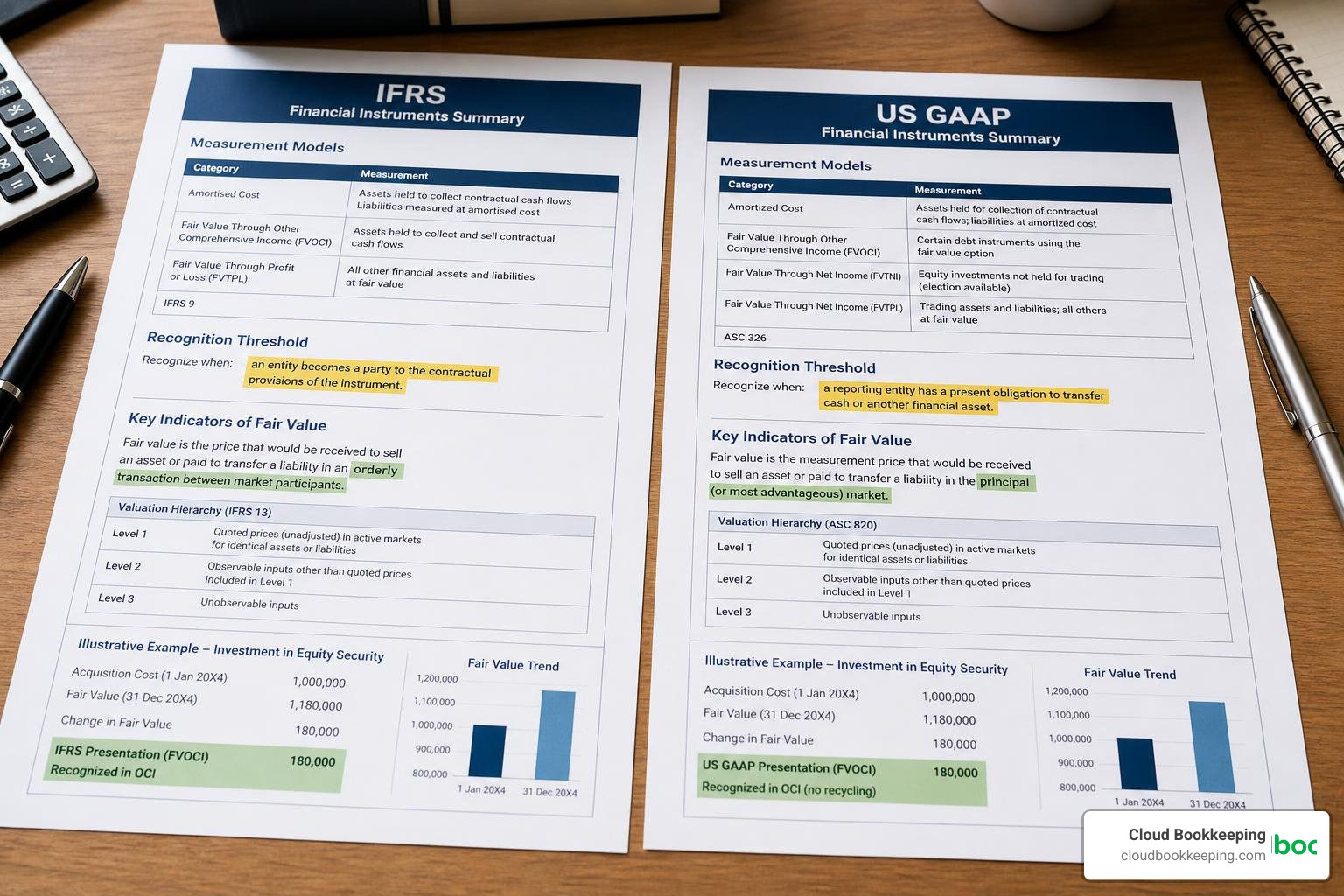
Under IFRS 9, financial assets are classified based on the business model and whether cash flows are solely payments of principal and interest. This leads to amortized cost, Fair Value through Other Comprehensive Income (FVOCI), or Fair Value through Profit or Loss (FVTPL). US GAAP also uses amortized cost and fair value, but its classification rules differ, especially for equity investments.
Credit impairment is a major difference:
- US GAAP (CECL): Lifetime expected credit losses are recognized when a financial asset is originated or acquired.
- IFRS 9 (ECL): A three-stage model applies. Stage 1 assets use 12-month expected credit losses. Stage 2 and Stage 3 assets use lifetime expected credit losses.
Other differences include embedded derivatives, loan modifications, and hedge accounting. For example, IFRS 9 generally treats hybrid financial assets as a whole, while US GAAP may require bifurcation of embedded derivatives.
Consolidation, joint ventures, associates, and investment entities
US GAAP uses two consolidation models: the Variable Interest Entity (VIE) model and the Voting Interest model. IFRS 10 uses one control model based on power, exposure to variable returns, and the ability to affect those returns.
Potential voting rights are considered under IFRS if they are substantive and currently exercisable. Under US GAAP, they are generally ignored until exercised. IFRS also requires uniform accounting policies across consolidated entities, while US GAAP permits some industry-specific differences.
Business combinations and noncontrolling interests
Both frameworks use the acquisition method, but differences remain:
- Definition of a Business: Both include a concentration test, but detailed application can differ.
- Noncontrolling Interests (NCI): US GAAP requires NCI at fair value. IFRS allows either fair value or the NCI’s proportionate share of identifiable net assets.
- Pushdown Accounting: US GAAP permits pushdown accounting in some acquired-entity financial statements. IFRS does not.
Intangible assets, development costs, and goodwill
Under US GAAP, most research and development costs are expensed as incurred, with limited software-related exceptions. Under IFRS, research costs are expensed, but development costs must be capitalized once IAS 38 criteria are met.
Goodwill is not amortized for public entities under either framework. However, impairment testing differs. US GAAP tests goodwill at the reporting unit level. IFRS tests goodwill at the cash-generating unit level and compares carrying amount to recoverable amount. Goodwill impairment reversals are prohibited under both frameworks.
Inventory, long-lived assets, and impairment
Key differences include:
- LIFO Prohibition: IFRS prohibits LIFO. US GAAP permits LIFO, and US tax rules can make it attractive for some companies.
- Impairment Reversals: IFRS allows reversals for some impaired assets when value recovers. US GAAP generally prohibits write-ups after impairment.
- Asset Componentization: IFRS requires significant components of property, plant, and equipment to be depreciated separately. US GAAP permits but does not generally require this approach.
Revenue, Leases, Taxes, Employee Benefits, and Other Recurring Differences
Even where the IASB and FASB created broadly converged standards, practical differences still affect bookkeeping, consolidation, and analysis.
Revenue recognition similarities and remaining differences
IFRS 15 and ASC 606 use the same five-step revenue model, but application details differ:
- Collectibility Threshold: Both use the word probable, but under IFRS this generally means more likely than not, while US GAAP applies a higher threshold.
- Noncash Consideration: US GAAP measures noncash consideration at contract inception. IFRS measurement can depend on when the consideration is received or promised.
- Licenses of Intellectual Property: US GAAP uses functional versus symbolic licenses. IFRS uses right to use versus right to access. Outcomes are often similar, but analysis may differ.
Lease accounting under IFRS 16 and US GAAP
Both IFRS 16 and ASC 842 bring most leases onto the balance sheet through right-of-use assets and lease liabilities. The expense pattern is different:
- US GAAP (Dual Model): Lessees classify leases as finance or operating. Operating leases generally produce a single straight-line lease expense.
- IFRS (Single Model): Most lessee leases are treated similarly to finance leases, with separate depreciation and interest expense.
- Exemptions: IFRS includes a low-value asset exemption. US GAAP does not have the same exemption, though both frameworks have short-term lease relief.
Income taxes, minimum taxes, and uncertain tax positions
Both frameworks classify deferred tax assets and liabilities as non-current. Differences remain in recognition and presentation:
- Deferred Tax Assets: US GAAP records the asset and then uses a valuation allowance if realization is not more likely than not. IFRS recognizes the asset only to the extent taxable profit is probable.
- Uncertain Tax Positions: US GAAP uses a two-step recognition and measurement model. IFRS reflects uncertainty using the most likely amount or expected value method, depending on which better predicts the outcome.
Employee benefits, share-based payments, and provisions
- Defined Benefit Plans: IFRS recognizes actuarial remeasurements immediately in OCI with no recycling to profit or loss. US GAAP has different presentation and amortization rules.
- Share-Based Payments: US GAAP allows straight-line or accelerated attribution for graded vesting awards. IFRS requires accelerated attribution.
- Provisions and Contingencies: IFRS generally uses a lower recognition threshold than US GAAP. If outcomes in a range are equally likely, US GAAP uses the low end, while IFRS uses the midpoint.
Preparing for Upcoming Changes and Managing Dual Reporting
Cross-border reporting requires strong systems, clear policies, and repeatable close procedures. Dual reporters should prepare before year-end, not during the audit.
IFRS and US GAAP transition checklist for dual reporters
- Conduct a Gap Assessment: Identify where policies diverge, such as development costs, inventory, leases, and impairments.
- Establish Policy Elections: Choose IFRS options, such as cost versus revaluation models, with an eye toward minimizing unnecessary differences.
- Configure Your ERP and Systems: Use dual ledgers or adjustment journals so IFRS and US GAAP entries can be tracked separately.
- Update Internal Controls: Cover areas requiring judgment, including IFRS impairment testing and US GAAP VIE analysis.
- Train Your Accounting Team: Make sure bookkeeping and finance staff know which framework applies to each report.
Monitoring new standard-setting developments
Dual reporters should also watch effective dates and disclosure changes. IFRS 18 takes effect in 2027, so companies should begin mapping income statement categories now.
The FASB has finalized new accounting and disclosure requirements for certain crypto assets, while the IASB continues work on topics such as intangible assets and environmental credit programs. Staying ahead of these changes helps businesses keep reporting clean, comparable, and audit-ready.
Frequently Asked Questions About IFRS and US GAAP
What are the most significant differences between IFRS and US GAAP for 2026 reporting?
The most significant differences for calendar year 2026 reporting center on financial instrument impairment (the lifetime CECL model under US GAAP vs. the staged ECL model under IFRS 9), development costs (which must be capitalized under IFRS once feasibility criteria are met but are expensed under US GAAP), inventory methods (LIFO is allowed under US GAAP but strictly prohibited under IFRS), and impairment reversals (permitted under IFRS for long-lived assets but prohibited under US GAAP).
How will IFRS 18 affect companies that also report under US GAAP?
IFRS 18, effective in 2027, will require dual-reporting companies to completely restructure their income statements into five categories and present new standardized subtotals for their IFRS reporting. Because US GAAP is not adopting the IFRS 18 structure, dual reporters will have to maintain two completely different income statement formats—one structured by category (IFRS) and one focused on disaggregated expense disclosures (US GAAP).
Which framework should a business use?
The framework you use is primarily determined by regulatory requirements. If you are a domestic US company or an SEC registrant, you must use US GAAP. If you operate in one of the 140+ countries that require IFRS, or if you are a foreign private issuer in the US, you will use IFRS. For many growing businesses, understanding both is crucial for international expansion, securing foreign investment, or preparing for cross-border mergers and acquisitions.
Conclusion
Navigating the complexities of IFRS and US GAAP requires a disciplined approach to financial policy, system configuration, and reporting transparency. While the two frameworks continue to share a common goal—providing high-quality, transparent financial information to capital markets—their technical differences can have a material impact on your balance sheet, profit margins, and cash flow presentation.
For dual-reporting entities, maintaining compliance is not just about checking boxes; it is about establishing a “financially bilingual” corporate culture that can seamlessly translate transactions between rules-based and principles-based worlds.
At Cloud Bookkeeping, under our local San Antonio, Texas leadership, we believe that sound financial reporting is the bedrock of any successful enterprise. Whether you need help streamlining your day-to-day bookkeeping, optimizing your QuickBooks setup, or preparing clear financial reports that align with best practices, we are here to support your business’s financial journey.
Ready to bring institutional-grade clarity to your business’s financial records? Improve financial reporting with expert bookkeeping support and let us help you build a stronger, more transparent financial foundation today.