Why Accounting for a New Small Business Can Make or Break You
Accounting for a new small business is one of the most important things you’ll set up — and one of the most overlooked.
Here’s a quick answer to get you started:
The essential steps to set up accounting for a new small business:
- Choose a legal structure (sole proprietorship, LLC, S-Corp, etc.)
- Get an EIN from the IRS
- Open a dedicated business bank account — keep personal and business money separate
- Choose an accounting method — cash basis or accrual
- Set up a chart of accounts — categories for income, expenses, assets, liabilities, and equity
- Pick accounting software — to track transactions and automate tasks
- Establish a bookkeeping routine — weekly, monthly, and quarterly tasks
- Know your tax obligations — quarterly estimated taxes, payroll, sales tax
- Review your financial statements regularly — profit & loss, balance sheet, cash flow
The numbers are hard to ignore. A staggering 78% of small businesses fail due to poor financial management — yet 65% still operate without a proper bookkeeping system in place. In 2026, with rising costs and a competitive economic landscape, flying blind with your finances is a risk no small business owner can afford.
The good news? You don’t need to be a numbers person to get this right. You just need the right foundation.
I’m Charlie Perrin, founder of Cloud Bookkeeping, and with over 24 years of experience helping small business owners untangle their finances and build profitable systems, I’ve seen what proper accounting for a new small business can do — and what disorganized books can cost you. This guide will walk you through everything, step by step.
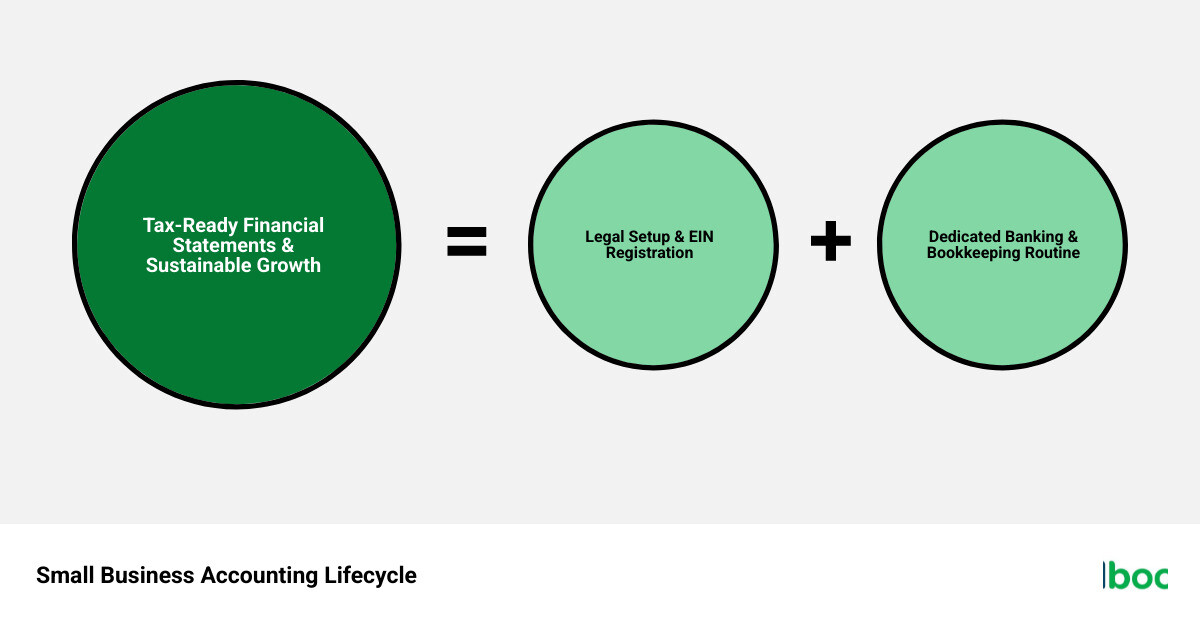
Setting the Foundation: First Steps in Accounting for New Small Business
When you first launch your dream, it’s easy to focus entirely on your product or service. However, the backend of your business is what keeps the lights on. Proper accounting for new small business starts with a few administrative hurdles that protect you legally and financially.
First, you must determine your legal structure. Whether you choose to be a sole proprietorship, a partnership, a Limited Liability Company (LLC), or a corporation, this decision dictates how you are taxed and your level of personal liability. For many in San Antonio, starting as an LLC provides a healthy balance of protection and flexibility.
Once your structure is set, you’ll need an Employer Identification Number (EIN) from the IRS. Think of this as a social security number for your business. It is essential for hiring employees, paying taxes, and, most importantly, opening a business bank account.

Before your first dollar comes in, set up a clear home for it: a dedicated business bank account. It is one of the simplest ways to make your business feel real from day one, and it helps keep your records clean. If you want a fuller walkthrough of the early setup steps, start with our guide to startup bookkeeping basics. For official details on registration, the IRS also explains how Employer Identification Numbers work.
Separating Personal and Business Finances
One of the most common-and dangerous-mistakes new owners make is “commingling” funds. This is a fancy way of saying you’re paying for your morning taco with the business card or using your personal savings to pay a vendor.
Why is this a problem?
- Audit Triggers: The IRS hates messy books. If they see personal expenses mixed with business ones, they may disqualify your legitimate business deductions.
- Liability Protection: If you are an LLC or Corporation, you have a “corporate veil” that protects your personal assets from business debts. If you mix your money, a court can “pierce the veil,” making you personally liable for business lawsuits.
- Tax Season Nightmares: Trying to remember if a $40 Amazon charge in July was for office supplies or a birthday gift is a waste of your valuable time.
Starting clean is much easier than cleaning up later. If you’re unsure how to draw these lines, it’s often worth learning why to hire a bookkeeper before starting your small business to ensure your accounts are partitioned correctly from day one.
Choosing Your Accounting Method: Cash vs. Accrual
One of the first questions your accounting software (or your accountant) will ask is: “Cash or Accrual?” This choice dictates when you record income and expenses.
| Feature | Cash Basis Accounting | Accrual Accounting |
|---|---|---|
| When is Income Recorded? | When money hits your bank account. | When you send the invoice. |
| When are Expenses Recorded? | When the money leaves your account. | When you receive the bill. |
| Complexity | Simple; easy to track actual cash. | More complex; requires tracking receivables/payables. |
| Best For | Solopreneurs and small service businesses. | Businesses with inventory or high volume. |
| Accuracy | Shows cash on hand, but not long-term health. | Provides a realistic picture of long-term profitability. |
In the United States, businesses averaging under $25 million-$29 million in annual gross receipts can typically choose either method. Most small startups start with the cash method because it’s intuitive. However, as you grow and begin dealing with inventory or large contracts, the accrual method becomes necessary to provide the most accurate financial advice.
Building Your System: Software and the Chart of Accounts
Gone are the days of the physical shoebox filled with faded thermal paper receipts. In 2026, automation is your best friend. Businesses that embrace digital bookkeeping report saving between 15 and 20 hours per month. That is nearly a part-time job’s worth of time you can spend growing your business instead of squinting at spreadsheets.

To get these hours back, you need to simplify your startup operations with bookkeeping software. Modern tools connect directly to your bank, “reading” your transactions and suggesting where they should go.
Designing a Scalable Chart of Accounts
The “Chart of Accounts” (COA) is simply a list of every category where your money can go. It is the skeleton of your financial system. A standard COA is broken down into five main types:
- Assets: What you own (Cash, equipment, inventory).
- Liabilities: What you owe (Loans, credit card balances, taxes due).
- Equity: Your investment in the business.
- Revenue: Money coming in from sales.
- Expenses: Money going out (Rent, payroll, marketing).
A professional tip: use a logical numbering system. For example, all Asset accounts might start with 1000, while all Expense accounts start with 5000. This makes your reports much easier to read as you scale from one employee to twenty.
Selecting the Right Accounting Software for New Small Business
When selecting software for accounting for new small business, don’t just pick the one with the best commercial. Look for:
- Bank Feeds: Does it sync automatically with your local San Antonio bank?
- User Interface: Is it easy to use, or do you need a PhD to find the “Invoice” button?
- Integration: Does it talk to your Point of Sale (POS) system or your payroll provider?
- Scalability: Can it handle your growth over the next three years?
Professional bookkeeping services specialize in helping you set up these platforms correctly so you don’t have to start over a year from now.
Essential Financial Statements and Bookkeeping Workflows
Data is only useful if it’s reliable. If you only update your books once a year at tax time, you aren’t “doing accounting”—you’re performing an autopsy. To actually run a business, you need a pulse.
Daily, Weekly, and Monthly Bookkeeping Tasks
Consistency is the secret sauce. If you break your bookkeeping into small chunks, it never becomes an overwhelming mountain.
- Daily: Save every receipt. Use an app to snap a photo of it immediately so the ink doesn’t fade.
- Weekly: Record all transactions, pay your vendors, and review your “Aging” reports (who owes you money and who do you owe?).
- Monthly: This is the big one—Reconciliation. This means making sure your software’s balance matches your bank statement balance down to the penny.
If this sounds like a lot, you aren’t alone. Understanding what a bookkeeper does for a small business can help you decide which of these tasks you want to keep and which you want to delegate. Our Bookkeeping Services for Small Businesses are designed to take these repetitive tasks off your plate.
Understanding the Three Core Financial Reports
To make smart decisions, you need to understand three specific reports:
- The Income Statement (Profit & Loss): This shows your revenue minus your expenses over a specific time. Did you make money last month? This report tells you.
- The Balance Sheet: This is a snapshot of your business at a specific moment. It shows what you have (Assets) vs. what you owe (Liabilities).
- The Cash Flow Statement: This is the most important for new businesses. It shows how much actual cash is moving in and out. Remember: you can be “profitable” on paper but still go out of business because your bank account is empty while you wait for customers to pay their invoices.
Expert financial partners use these reports to help businesses spot trends before they become crises.
Navigating Tax Obligations and Compliance
Tax compliance is often the biggest source of anxiety for new owners. In Texas, we don’t have a state income tax, but that doesn’t mean we’re off the hook.
Managing Payroll and Contractor Requirements
If you hire help, you must classify them correctly.
- W-2 Employees: You control when and how they work. You must withhold taxes, pay for unemployment insurance, and follow strict filing deadlines.
- 1099 Contractors: They are independent business owners. You don’t withhold taxes, but you must track how much you pay them and file a Form 1099-NEC at the end of the year if you paid them $600 or more.
Misclassifying an employee as a contractor is a major audit trigger that can result in massive back-tax penalties.
Tax Filing Requirements for New Small Business
Beyond annual income tax, you may be responsible for:
- Quarterly Estimated Taxes: If you expect to owe more than $1,000 in taxes, the IRS expects you to pay in four installments throughout the year.
- Sales Tax: If you sell “tangible personal property” in Texas, you must collect sales tax and remit it to the State Comptroller.
- Franchise Tax: Most Texas entities must file an annual franchise tax report, even if no tax is due.
For more localized advice, following Texas-specific accounting guidelines provides a great roadmap for staying on the right side of the law.
When to Transition from DIY to Professional Help
Every business owner starts as the Chief Everything Officer. But eventually, your time becomes more valuable than the cost of a bookkeeper.
Signs You Need a Professional Bookkeeper
According to Indiana University research, 60% of accounting errors stem from basic bookkeeping mistakes. You might need professional help if:
- You are more than two months behind on your reconciliation.
- You are “shuffling” money between accounts to cover payroll.
- Your transaction volume has exceeded 50–100 items per month.
- You have no idea if you are actually making a profit.
Delegating these tasks isn’t losing control; it’s gaining visibility.
The Role of a CPA in Business Growth
While a bookkeeper handles the daily “recording,” a CPA handles the high-level “strategy.” You may need professional CPA services for:
- Complex tax planning and year-end filing.
- Audit representation.
- Strategic forecasting for loans or expansion.
- Choosing the right business entity for maximum tax savings.
Frequently Asked Questions about Small Business Accounting
What is the difference between bookkeeping and accounting?
Bookkeeping is the daily process of recording and categorizing transactions—it’s the “data entry” phase. Accounting is the higher-level process of analyzing that data, preparing tax returns, and providing strategic financial advice.
How often should I reconcile my business bank accounts?
At a minimum, you should reconcile monthly when your bank statements are released. However, with modern cloud software, many businesses perform a “soft” reconciliation weekly to catch errors or fraudulent charges early.
When is a business required to use the accrual accounting method?
Under current IRS rules, most businesses must switch to the accrual method once their average annual gross receipts over the last three years exceed $29 million. However, if you carry significant inventory, your CPA may recommend switching sooner to better match your expenses with your sales.
Conclusion
Accounting for new small business doesn’t have to be a source of constant stress. By setting a strong foundation—separating your finances, choosing the right software, and staying consistent with your weekly tasks—you turn your “books” from a chore into a powerful GPS for your business.
At Cloud Bookkeeping, we believe that financial clarity is the key to long-term sustainability. Under the local San Antonio leadership of Charlie Perrin, we provide the QuickBooks expertise and clear reporting you need to stop guessing and start growing.
Ready to move from the shoebox to a system that actually works? Explore our Bookkeeping Services for small businesses and let us help you build a business that lasts.