What Is a Bookkeeper Certification and How Do You Get One?
A bookkeeper certification is a professional credential that proves you have the skills to handle key accounting tasks, from adjusting entries to payroll and fraud prevention. Here’s a quick overview of the most recognized options in 2026:
| Credential | Issuing Body | Experience Required | Exam Parts | Approx. Cost |
|---|---|---|---|---|
| Certified Bookkeeper (CB) | AIPB | 2 yrs full-time or 3,000 hrs part-time | 4 parts | $479 (members) |
| Certified Public Bookkeeper (CPB) | NACPB | Varies | Multiple | Varies |
| QuickBooks Bookkeeping Certification | Intuit | None required | 1 exam | Varies |
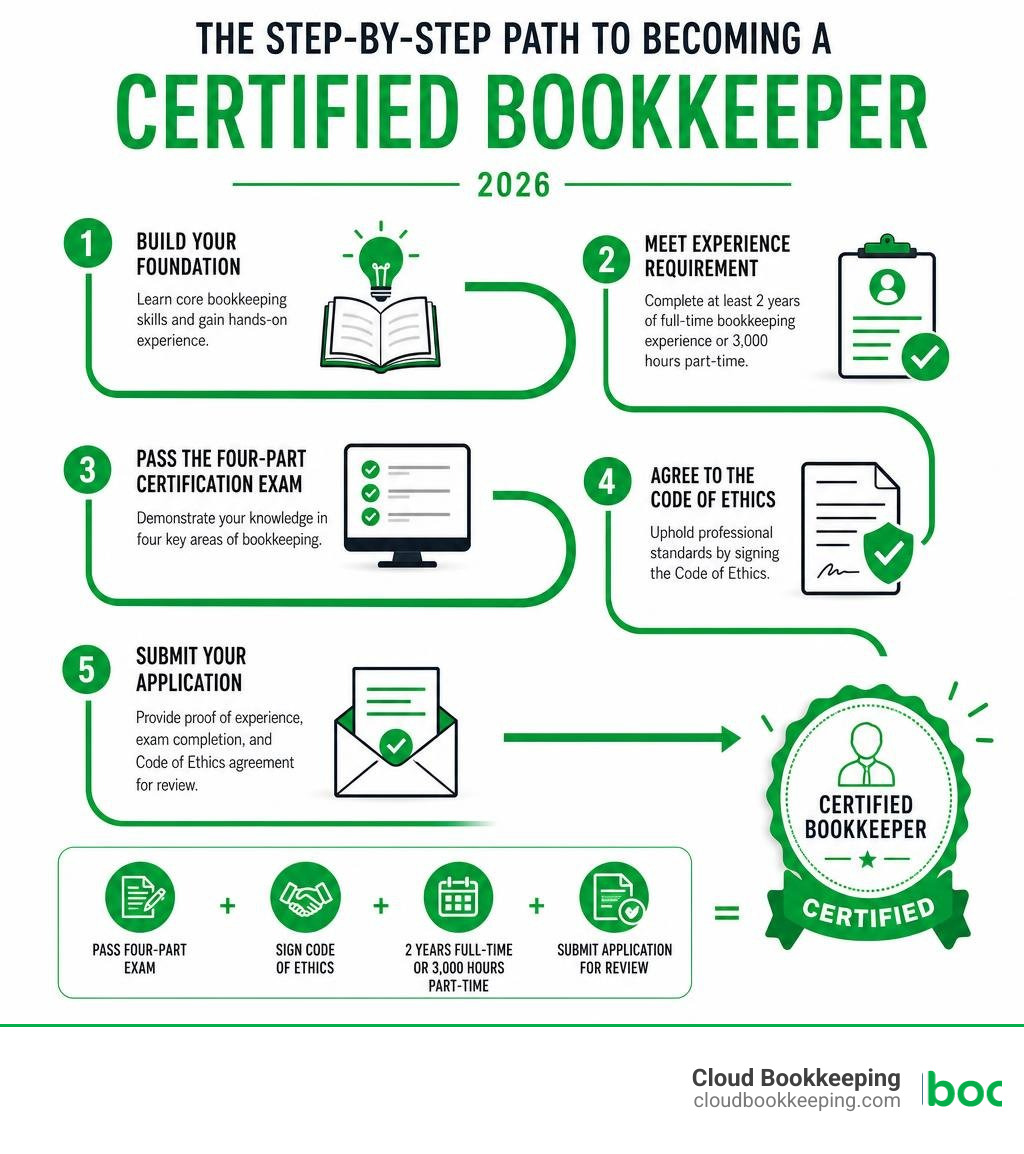
The three core requirements for the AIPB Certified Bookkeeper (CB) designation are:
- Pass a four-part national certification exam
- Sign the AIPB Code of Ethics
- Submit proof of at least 2 years of full-time bookkeeping experience (or 3,000 hours part-time)
Whether you’re a working bookkeeper looking to move up, or a small business owner trying to understand what qualifications to look for when hiring, credentials matter. A certified bookkeeper isn’t just someone who knows how to enter numbers: they’ve proven mastery of advanced skills like inventory valuation, depreciation methods, payroll compliance, and internal controls.
The numbers back this up. According to AIPB survey data, 54% of certified bookkeepers got a new job, promotion, or higher-level responsibilities after earning their credential. And 90% of all CBs recommend certification to other bookkeepers: that’s a remarkably strong endorsement from people who’ve been through the process themselves.
I’m Charlie Perrin, founder of Cloud Bookkeeping, and with over 24 years of hands-on experience helping small businesses get their finances in order, I’ve seen how bookkeeper certification separates professionals who truly understand the numbers from those who are just getting by. In this guide, I’ll walk you through every major credential, what each one requires, and how to choose the right path for your goals.
Key terms for bookkeeper certification:
- difference between bookkeeping and accounting
- what is the difference between a bookkeeper and an accountant
The Value of a National Bookkeeper Certification
Earning a national bookkeeper certification is one of the most impactful career moves a financial professional can make. It is voluntary, meaning no law requires a bookkeeper to be certified to work, but it acts as a powerful differentiator in a crowded job market. For employers, it offers peace of mind; for bookkeepers, it provides a structured path to higher compensation and greater professional respect.

The statistical benefits of becoming a Certified Bookkeeper (CB) are clear and compelling:
- Salary Increases: 59% of CBs received a raise after earning their credential, and 75.5% of those say the certification was directly responsible for the boost.
- Career Advancement: 83% of bookkeepers who received a promotion or higher-level responsibilities with their current employer state that certification was highly important to their advancement.
- Hiring Advantage: 81% of CBs who landed a new job note that their certification was vital in securing job interviews.
- Freelance Growth: For independent bookkeepers, the credential is a marketing powerhouse. 37% of freelance CBs report that certification helped them gain new clients, 48% raised their billing rates, and 82% actively use their certified status in their marketing materials.
- Internal Confidence: Beyond the financial rewards, 58% of certified professionals report increased self-confidence, 46% say it enhanced their self-image, and 49% of employed CBs say it significantly enhanced their standing with their employer.
Certification ensures that a professional is capable of handling a company’s books all the way through the adjusted trial balance. To understand how these advanced skills fit into a larger business strategy, check out our guide on Why Your Business Needs a Bookkeeper and an Accountant.
Eligibility and Experience Requirements for the CB Designation
The Certified Bookkeeper (CB) credential, awarded by the American Institute of Professional Bookkeepers (AIPB), is not designed for complete novices. It is structured as advanced training for working bookkeepers or those who already have a solid foundation, such as at least one year of college-level accounting education.
To officially use the “CB” designation after your name, you must satisfy three key pillars:
- The National Exam: You must pass all four parts of the comprehensive national exam.
- The Experience Requirement: You must submit formal proof of at least two years of full-time bookkeeping experience, or 3,000 hours of part-time work. The AIPB gives you a generous window of up to three years after passing the exam to accumulate and submit this experience verification.
- The Code of Ethics: You must sign a strict code of ethics that outlines your professional obligations to your clients, employers, and the public.
To learn more about the organization behind this standard, you can visit the American Institute of Professional Bookkeepers: Home.
Maintaining Your Credential Through Continuing Education
Getting certified is not a one-time event. Because accounting rules, tax codes, and business technologies change constantly, certified professionals must commit to ongoing education.
To maintain the CB designation, you must earn 60 Continuing Professional Education Credits (CPECs) every three years. This requirement ensures that you stay up to date on the latest regulatory shifts, software updates, and industry best practices. If you fail to meet this requirement or pay the associated maintenance fees, your certification can lapse, and you will lose the right to market yourself as a CB. You can explore the full continuing education guidelines on the AIPB Certification Program page.
Core Topics Covered in Bookkeeping Certification Exams
National certification exams are rigorous because they test practical, real-world scenarios. A certified bookkeeper does not just match bank feed transactions; they understand the underlying mechanics of the entire accounting cycle. This deep knowledge allows them to produce reliable, audit-ready financial statements for business owners and CPA firms alike. To see how these tasks translate into daily business operations, read our breakdown of what a bookkeeper does for a small business.
Adjusting Entries and Error Correction
The first major section of the national exam focuses on adjusting entries and error correction. This is where a bookkeeper’s knowledge of double-entry bookkeeping and accrual accounting is put to the test.
Candidates must master:
- Accrual Adjustments: Recording revenues that have been earned but not yet billed, and expenses that have been incurred but not yet paid.
- Deferrals: Appropriately allocating prepaid expenses (like insurance or rent) and unearned revenues over the periods they actually affect.
- Unadjusted vs. Adjusted Trial Balances: Running trial balances, identifying discrepancies, and making the necessary journal entries to ensure the general ledger is perfectly balanced.
- Error Correction: Systematically locating errors in the general ledger and executing correct, GAAP-compliant reversing and correcting entries.
For a deeper dive into how these adjustments keep financial records accurate, explore Everything You Need to Know About Bookkeeping Versus Accounting.
Payroll, Depreciation, and Inventory Valuation
The second phase of the exam covers specialized accounting areas that have a huge impact on a business’s tax liability and bottom line:
- Payroll Compliance: Understanding how to calculate gross pay, withholdings, and net pay. This includes mastering federal forms like W-4, Form 941 (employer’s quarterly tax return), Form 940 (FUTA), W-2, and W-3.
- Depreciation Methods: Knowing how to write off the value of long-term assets over time. Candidates must be able to calculate depreciation using straight-line, units-of-production, declining balance, and sum-of-the-years’-digits methods, as well as understand the key differences between book (GAAP) depreciation and tax depreciation.
- Inventory Costing: Applying inventory valuation methods under both perpetual and periodic inventory systems. This includes First-In, First-Out (FIFO), Last-In, First-Out (LIFO), and weighted average costing, alongside applying the Lower of Cost or Net Realizable Value (LCNRV) rule.
Internal Controls and Fraud Prevention
The final portion of the exam addresses a business owner’s worst nightmare: employee theft, fraud, and waste. Certified bookkeepers are trained to be a business’s first line of defense.
Exam topics include:
- Bank Reconciliations: Performing detailed bank reconciliations to spot unauthorized transactions or missing funds.
- Segregation of Duties: Designing and implementing internal controls that prevent any single employee from having too much control over financial transactions.
- Fraud Detection: Learning to identify the red flags of computer fraud, vendor fraud, credit card fraud, and check tampering.
Comparing Top Bookkeeping Credentials and Training Programs
Choosing the right path depends on your current experience, career goals, and budget. While some certifications focus heavily on theoretical accounting principles, others are designed to prove your mastery of specific software platforms. Understanding the difference is crucial before investing your time and money.
AIPB Certified Bookkeeper vs. QuickBooks Bookkeeper Certification
The two most common routes are the AIPB Certified Bookkeeper (CB) designation and the QuickBooks Bookkeeping Certification (often earned through Intuit Academy).
- AIPB Certified Bookkeeper (CB): This is a software-agnostic, highly prestigious national credential. It proves you understand the “why” behind the numbers. It requires two years of professional experience, making it highly respected by CPAs and traditional corporate employers.
- QuickBooks Bookkeeping Certification: This credential, co-created with Intuit, focuses heavily on the practical application of accounting principles within the QuickBooks Online platform. It is an excellent option for virtual bookkeepers and freelancers who plan to run their practice entirely on QuickBooks. It can often be completed in about 20 hours of study and practice, making it a faster entry point into the profession.
If you are looking to hire a bookkeeper with specialized software knowledge, you should also consider looking for a ProAdvisor. Learn more about this in our article on 10 Important Things to Look for When Working with a Certified QuickBooks ProAdvisor.
How to Choose the Right Bookkeeper Certification Program
If you decide to pursue the AIPB CB credential, you do not have to study alone. Many colleges and universities offer structured, online preparation courses that include the cost of the exam vouchers in their tuition. These programs typically span 140 hours over six months and guide you step-by-step through the six prep workbooks.
Excellent examples of these comprehensive online programs include:
- The Online Certified Bookkeeper (Exam Cost Included) from City College of New York
- The Online Certified Bookkeeper (Exam Cost Included) from Salt Lake Community College
- The Online Certified Bookkeeper (Exam Cost Included) from Kentucky Wesleyan College
Regional Training and Specialist Programs
For those of us living and working right here in Texas, there are fantastic local and state-specific programs tailored to help you launch or elevate your career.
If you are in the San Antonio area, you have access to incredible local resources:
- Alamo Colleges (St. Philip’s College): Offers a dedicated Bookkeeping Specialist program designed to prepare you for immediate entry into the local workforce. You can check out their curriculum via the SPC : Bookkeeping Specialist – Alamo Colleges page or explore job placement resources through the Bookkeeper – SACC Career Center.
- Texas State University: Offers a robust online prep course for the national exam, which you can view at Certified Bookkeeper.
- Texas A&M University-Corpus Christi: Offers practical, software-focused training through their Professional Bookkeeping with QuickBooks Online program.
Frequently Asked Questions About Bookkeeper Certification
How much does it cost to get a bookkeeping certification?
The cost of earning your bookkeeper certification varies based on the path you choose:
- Self-Study via AIPB: If you study on your own, AIPB members pay a registration fee of $25 (nonmembers pay $60). The exam fees are $100 per part at Prometric test centers, and the six self-study workbooks cost around $314 for members. In total, expect to spend between $479 and $574.
- Structured Online College Programs: Comprehensive courses (like those offered by CCNY or Salt Lake Community College) generally cost between $2,250 and $2,370. While this is a higher upfront cost, it includes all textbooks, workbooks, instructor support, and prepaid exam vouchers.
Do I need a college degree to become a certified bookkeeper?
No, you do not need a college degree to become a certified bookkeeper. A high school diploma or GED is the only basic educational prerequisite to sit for the AIPB national exam. While an associate degree in accounting can certainly give you a competitive edge in the job market, real-world experience and national certification are often valued just as highly by employers.
Is the bookkeeping certification exam taken online or in person?
The AIPB national exam is a hybrid format:
- Parts 1 and 2 (covering adjusting entries, error correction, payroll, and depreciation) must be taken in person under supervised, proctored conditions at one of the 300+ Prometric Test Centers located across the country.
- Parts 3 and 4 (covering inventory and internal controls) are open-book, untimed exams included directly in your self-study workbooks. You complete these at home and submit your answers to the AIPB for grading.
Conclusion
Navigating bookkeeper certification can feel overwhelming, but it is a journey well worth taking. Whether you are an aspiring bookkeeper looking to validate your skills, or a small business owner searching for a qualified professional to protect your hard-earned profits, recognizing the value of these credentials is key to financial success.
At Cloud Bookkeeping, we pride ourselves on delivering unparalleled customer service, clear financial reporting, and expert QuickBooks guidance. Led locally in San Antonio, Texas, by Charlie Perrin, we understand the unique needs of Texas small businesses. We handle the complex adjusting entries, payroll compliance, and internal controls so you can focus on what you do best: growing your business.

Ready to take the stress out of your financial records? Let us do the heavy lifting. Get professional bookkeeping services from Cloud Bookkeeping today!