What Is Payroll Processing and Why Is It Critical?
To process payroll accurately, businesses follow a straightforward sequence: collect employee hours and tax forms, calculate gross earnings, subtract statutory taxes and benefit deductions to reach net pay, disburse funds, and submit tax filings. Effective payroll processing balances precise gross wage calculations with timely tax deductions and statutory compliance.
Getting this sequence right is essential for several reasons:
- Protecting Employee Trust and Morale: Your team relies on steady, accurate compensation to cover their mortgages, groceries, and living expenses. A delayed or incorrect paycheck immediately generates anxiety and erodes morale.
- Statutory and Regulatory Compliance: Employers must withhold the correct amounts for federal income tax, Social Security, and Medicare (FICA), along with applicable state and local assessments. Miscalculations can lead to stiff penalties from tax authorities.
- Accurate Financial Records: Payroll represents one of the largest operating expenses for most businesses. Maintaining precise wage and tax ledgers ensures your profit-and-loss statements reflect reality.
- Operational Continuity: Setting up repeatable workflows helps you avoid last-minute scrambles and penalty notices, allowing you to stay ahead on your payroll compliance throughout every operating quarter.
When systems are poorly organized, mistakes compound quickly. Taking the time to structure your pay runs protects your cash flow and creates a dependable environment for your workforce.
The Three Core Stages of the Payroll Cycle
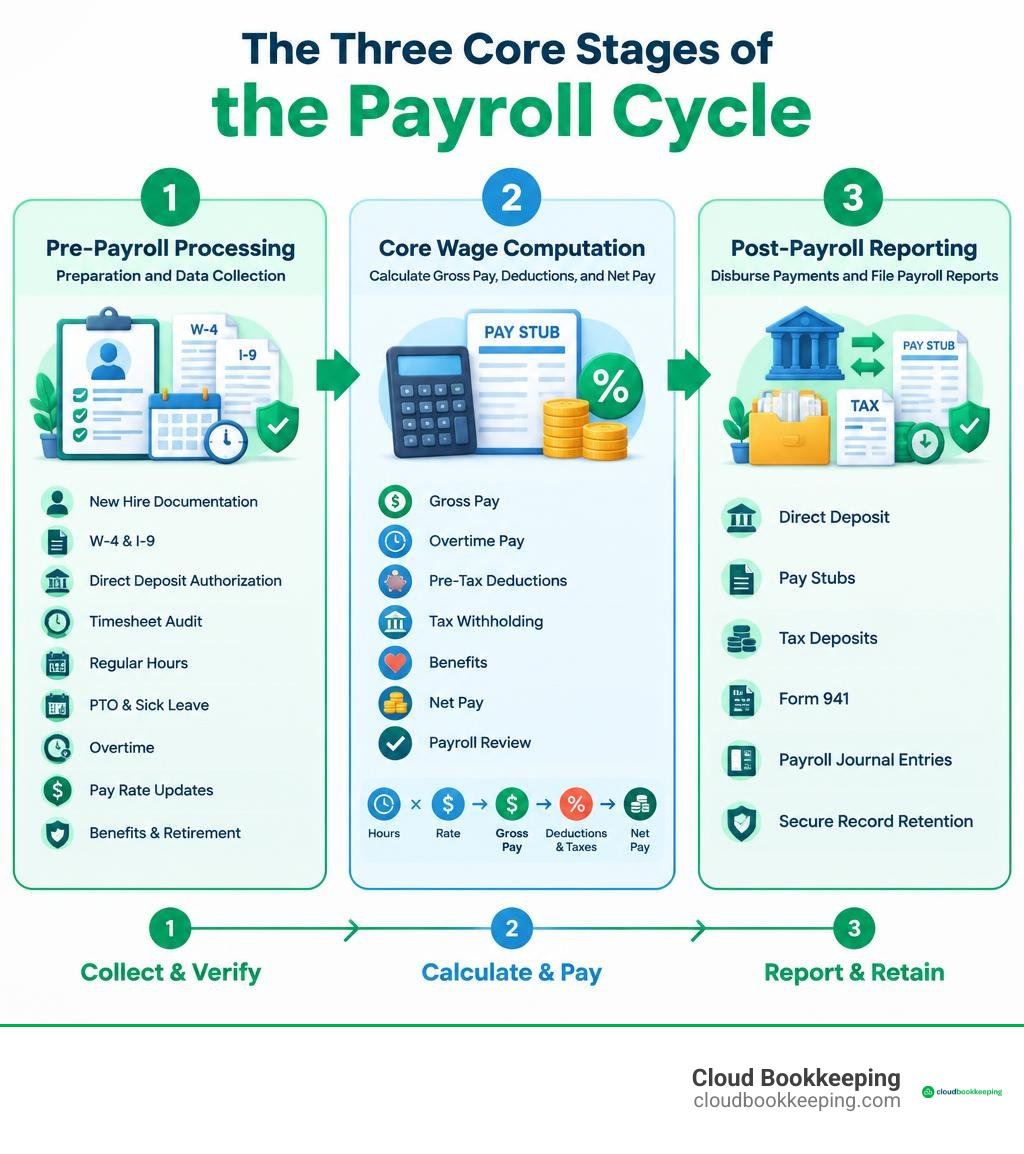
To keep pay runs manageable, professional bookkeepers break the workflow into three distinct, sequential phases: pre-payroll preparation, core wage computation, and post-payroll reporting. Dividing your responsibilities this way prevents authorization slip-ups and catches data discrepancies before funds leave your company account.
Pre-Payroll Processing: Preparation and Data Collection
The pre-payroll phase lays the foundation for everything that follows. If the initial data is flawed, the resulting checks will be flawed as well. During this preparation period, you need to collect and verify several critical inputs:
- New Hire Documentation: Ensure all new team members have completed their Form W-4 (Employee’s Withholding Certificate), Form I-9 for employment eligibility, and direct deposit authorization forms.
- Timecard and Attendance Audits: Total the hours worked for hourly staff, including regular hours, paid time off (PTO), sick leave, and overtime. Applying strong time clock fraud prevention policies ensures recorded hours match actual time worked.
- Rate and Benefit Changes: Update individual employee profiles for any approved wage increases, one-off bonuses, commission payouts, or adjustments to health insurance and retirement contributions.
The Core Calculation and Distribution Stage
Once your baseline numbers are verified, you move into the active calculation phase:
- Gross Pay Calculation: For hourly staff, multiply total regular hours by their base wage and calculate overtime hours at the statutory rate (typically 1.5 times the regular rate for hours worked over 40 in a workweek). For salaried workers, divide annual compensation by the total number of pay periods in the year.
- Withholding Deductions: Subtract pre-tax deductions (such as 401(k) contributions or qualifying medical plans), calculate statutory payroll taxes, and subtract post-tax deductions (like wage garnishments or Roth retirement contributions).
- Net Pay Determination: Deduct all withholdings from gross wages to reach final net pay.
- Fund Distribution: Transmit the direct deposit files through the Automated Clearing House (ACH) network or issue physical, printed checks.
Modern cloud payroll software can automate calculations and flag mathematical errors behind the scenes.
Post-Payroll Processing: Taxes, Reporting, and Compliance
The cycle does not conclude once money enters your employees’ bank accounts. The post-payroll stage ensures your business remains in good standing with government authorities and internal accounting standards:
- Tax Remittances: Submit withheld employee taxes along with your matching employer contributions for Social Security and Medicare according to your designated deposit schedule (monthly or semi-weekly). Proactively managing payroll taxes on time prevents expensive interest charges.
- Form Filings: Prepare and submit quarterly federal tax filings via IRS Form 941, annual federal unemployment reports via Form 940, and corresponding state unemployment insurance forms.
- Ledger Entries: Post detailed journal entries into your general ledger, categorizing gross wages, employer payroll tax expenses, and withholding liabilities.
- Document Archiving: Deliver electronic or printed pay stubs to workers and securely store all records. A reliable full service payroll supports recordkeeping compliance by maintaining historical records for the minimum three- to four-year statutory retention periods required by federal agencies.
Step-by-Step Workflow to Process Payroll Accurately
Establishing a standardized checklist turns a complex operation into a predictable routine. Here is a practical workflow you can follow every pay cycle.
Establish Pay Schedules and Track Employee Hours
Begin by setting a clear payroll calendar for the year. Common pay cycles include weekly (52 pay periods), biweekly (26 pay periods), semi-monthly (24 pay periods), and monthly (12 pay periods).
For hourly team members, require that all digital timecards or physical sheets be submitted and approved by supervisors a few days before your processing cutoff. Reviewing timesheets consistently helps you stay on track with weekly payroll tasks and prevents last-minute panics on distribution day. Salaried employee compensation remains steady each cycle unless you are adding bonuses, commissions, or unpaid leave adjustments.
Calculate Gross Earnings, Deductions, and Net Pay
With verified hours in hand, compute the figures step by step:
- Determine Total Earnings: Sum base hours, approved overtime, commissions, and holiday pay to establish gross earnings.
- Apply Pre-Tax Deductions: Subtract eligible pretax deductions such as Section 125 cafeteria plans, health savings accounts (HSAs), and traditional retirement plans. These reduce the taxable wage base.
- Calculate Tax Withholdings: Apply current federal income tax withholding tables (based on the employee’s Form W-4) along with FICA taxes (6.2% Social Security up to the annual wage base limit and 1.45% Medicare, plus any applicable Additional Medicare Tax for higher earners).
- Apply Post-Tax Deductions: Deduct garnishments, union dues, or voluntary post-tax savings. Using a guide to understanding your semi monthly payroll deductions gives business owners a clear reference for separating pre-tax from post-tax items.
- Verify Net Wages: Perform a summary audit comparing the current run’s totals against the prior pay period to spot unexpected spikes or dropped hours.
Distribute Funds and Maintain Detailed Records
Once calculations pass review:
- Initiate ACH Payments: Submit payroll files to your banking partner. Because direct deposits usually take one to two business days to settle through the banking system, submit your files ahead of your formal pay date.
- Print and Sign Physical Checks: If any employees receive physical checks, ensure they are printed, signed by an authorized signatory, and sealed with corresponding pay vouchers.
- Audit and Reconcile: Reconcile your payroll bank account against your payroll summary report. Identifying and addressing the most common payroll mistakes early on, such as misclassifying an employee or mistyping a bank routing number, prevents major payroll discrepancies down the road.
Comparing Methods: Manual, Automated, and Outsourced Solutions
Small businesses handle payroll using three primary methods: manual spreadsheets, internal payroll software, or fully outsourced payroll management. Each approach offers distinct tradeoffs in cost, administrative effort, and exposure to compliance risk.
| Processing Method | Administrative Time | Error Risk | Regulatory Compliance | Best Suited For |
|---|---|---|---|---|
| Manual Spreadsheets | High (5–10+ hours/run) | Very High | Manual tracking required | Solo operators with 1 worker |
| Payroll Software | Moderate (1–3 hours/run) | Low to Moderate | Semi-automated updates | Businesses with in-house HR/finance |
| Outsourced Management | Minimal (<30 mins/run) | Extremely Low | Fully managed by professionals | Growing SMBs wanting turnkey accuracy |
Manual Processing via Spreadsheets
Managing pay runs manually in Excel or Google Sheets might seem budget-friendly because it avoids software subscription fees. However, manual data entry carries significant drawbacks:
- Formulas can easily break when new rows or deduction categories are inserted.
- You must manually monitor and update tax brackets whenever tax laws change.
- A single misplaced decimal point can cause serious calculation errors.
For growing businesses, outsourcing payroll is often the first step toward reclaiming productive operational hours.
Automated Cloud Payroll Software
Cloud-based payroll software platforms automate routine tax calculations and direct deposits. These tools integrate directly with digital time-tracking apps and accounting platforms, cutting down manual keying. Many solutions also provide employee self-service portals where staff can independently download pay stubs and Form W-2s.
While software speeds up math and filings, your internal team is still responsible for correctly setting up pay codes, verifying hours, and troubleshooting failed direct deposits or tax agency notices.
Fully Outsourced Payroll Services
Outsourcing payroll connects your business with dedicated accounting professionals who oversee the entire lifecycle. Your team simply submits approved hours, and your provider handles calculations, direct deposits, tax payments, quarterly filings, and year-end reporting. Bookkeeping services can also help strengthen the financial processes that support accurate payroll.
Exploring the top benefits of outsourcing payroll shows why many owners prefer this route: it eliminates administrative burdens, ensures compliance with shifting regulations, and frees leadership to focus on core operations. Businesses looking for hands-on guidance often partner with full-service bookkeeping and payroll firms to ensure their team is supported every cycle.
Frequently Asked Questions About Payroll Operations
How long does standard payroll processing take?
Processing timelines depend heavily on your internal tools and banking protocols. According to the Deloitte Global Payroll Benchmarking Survey, payroll processes typically take 2–3 days for 50% of businesses surveyed in North America, compared to 37% in EMEA and 6–9 days for 25% of businesses in LATAM. When a company adopts modern, integrated software solutions, internal prep and calculation time often drops to just 1–2 days.
Because direct deposit transactions usually require 2 business days to clear the ACH network, businesses generally finalize and submit their payroll files two to three days before payday. Having contingency plans for dealing with payroll processing delays (such as banking holidays or unexpected system outages) ensures your team is still paid on time.
What are the main challenges of global payroll compliance?
Managing international payroll introduces layers of complexity beyond standard domestic operations:
- Divergent Labor Laws: Every country enforces unique rules regarding mandatory paid leave, overtime thresholds, notice periods, and statutory severance.
- Tax and Social Contributions: Navigating cross-border income tax withholdings, local pension requirements, and national healthcare schemes requires deep local expertise.
- Currency Volatility and Transfer Fees: Paying international staff requires factoring in foreign exchange rate fluctuations and international wire transfer processing times.
Companies hiring internationally often rely on specialized global payroll platforms or Employer of Record (EOR) services to stay compliant with local jurisdictions.
How much does it cost to process payroll for small teams?
Payroll pricing generally follows a two-tier structure: a fixed base monthly subscription fee plus a variable fee per active employee per month (PEPM). Additional charges may apply for year-end Form W-2 preparation, multi-state tax registrations, or specialized direct deposit schedules.
Investing in effective payroll solutions saves time and money by significantly reducing internal administrative labor and shielding your business from costly late-filing penalties.
Conclusion
Running an accurate, dependable payroll system is an essential operational pillar for any growing business. By breaking your workflow into clear pre-payroll, calculation, and post-payroll stages, you reduce errors, keep your team motivated, and protect your company from compliance penalties.
At Cloud Bookkeeping, under the local San Antonio leadership of Charlie Perrin, we deliver clear financial reporting and dedicated support to help small business owners take the stress out of their back-office workflows. If you are ready to streamline your pay runs and gain peace of mind every pay period, explore our payroll services today.