How Fixed Asset Tracking Keeps San Antonio Business Books Accurate
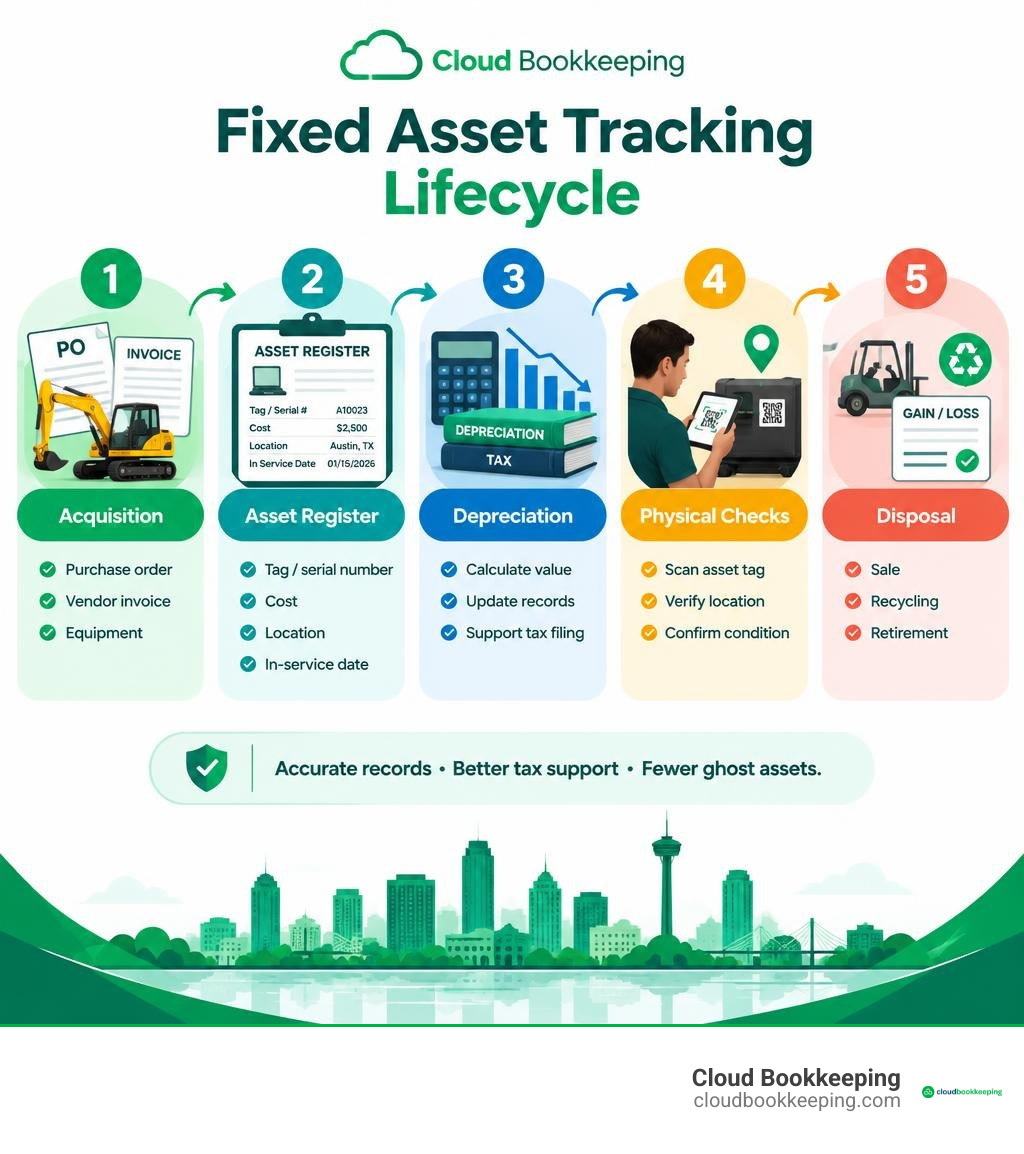
Need help tracking equipment, vehicles, or other long-term assets? Start with an asset register that records each item’s cost, purchase date, location, and date it was put to use. Then have your bookkeeper match it to your accounting records, update depreciation, and record moves or disposals. This helps you see what you own, keep your balance sheet accurate, and prepare for tax filing.
For a San Antonio business, the right fixed asset tracking workflow also makes it easier to find missing equipment and gather records when questions come up. Implementing modern bookkeeping cloud software can help, but it works best when someone checks the records against what you actually own. The IRS provides detailed guidance on depreciation of business assets, which is a useful reference when setting up your tracking system.
I’m Charlie Perrin, founder of Cloud Bookkeeping. I bring more than 24 years of small-business financial experience to our comprehensive fixed asset tracking services, helping local companies maintain clear records and make confident financial decisions.
In addition to equipment management, keeping detailed asset records directly supports compliance with the Texas franchise tax requirements and enhances long-term growth advisory planning.
Why Fixed Asset Tracking in San Antonio Protects Business Capital

Every physical asset your company purchases represents hard-earned capital. From heavy machinery in an industrial yard near Loop 410 to point-of-sale systems in a bustling downtown restaurant, fixed assets drive revenue. However, without meticulous tracking, that capital quietly drains away through overpaid property taxes, missed income tax write-offs, and unexpected replacement expenses.
When you establish a structured system with bookkeeping support, you transform physical machinery and technology into organized financial data. Proper asset valuation gives you a true picture of your balance sheet, ensuring that your equity, collateral value, and net income remain transparent for stakeholders and lenders alike.
Core Benefits of Modern Fixed Asset Tracking
Modern asset management is far more than a checklist; it is an active engine for financial clarity. By deploying dedicated tools alongside structured bookkeeping, our clients capture massive operational and financial gains:
- Real-Time Visibility: You always know where company property resides, who is using it, and its current operating condition across all business locations.
- Maximized Tax Deductions: Automated calculations apply first-year write-offs, bonus depreciation, and standard cost recovery schedules without human error.
- Audit-Proof Financials: Keeping clean financial records ensures you can substantiate every dollar of depreciation during IRS reviews or local property assessments.
- Accurate Insurance Coverage: Up-to-date replacement valuations help you avoid underinsuring critical equipment or paying inflated premiums on obsolete machinery.
- Operational Efficiency: Teams spend less time tracking down missing tools and more time serving customers.
Key Challenges San Antonio Small Businesses Face in Fixed Asset Tracking
Managing long-term property is rarely straightforward. Without dedicated workflows, growing operations run into predictable roadblocks:
- Ghost Assets: These are items recorded on your balance sheet that have been scrapped, broken, or sold, but never removed from the books. You continue paying property taxes and insurance premiums on assets you no longer own.
- Unrecorded Disposals: When employees discard worn-out equipment without informing the finance department, journal entries are missed, skewing financial ratios.
- Misclassified Expenses: Business owners often confuse routine maintenance with capital improvements, leading to inaccurate books. Working with experienced professionals is essential for preventing financial errors that trigger tax penalties.
- Spreadsheet Fragility: Manual spreadsheets quickly suffer from broken formulas, outdated depreciation tables, and missing version control as teams expand.
Complete Asset Lifecycle Management from Acquisition to Disposal
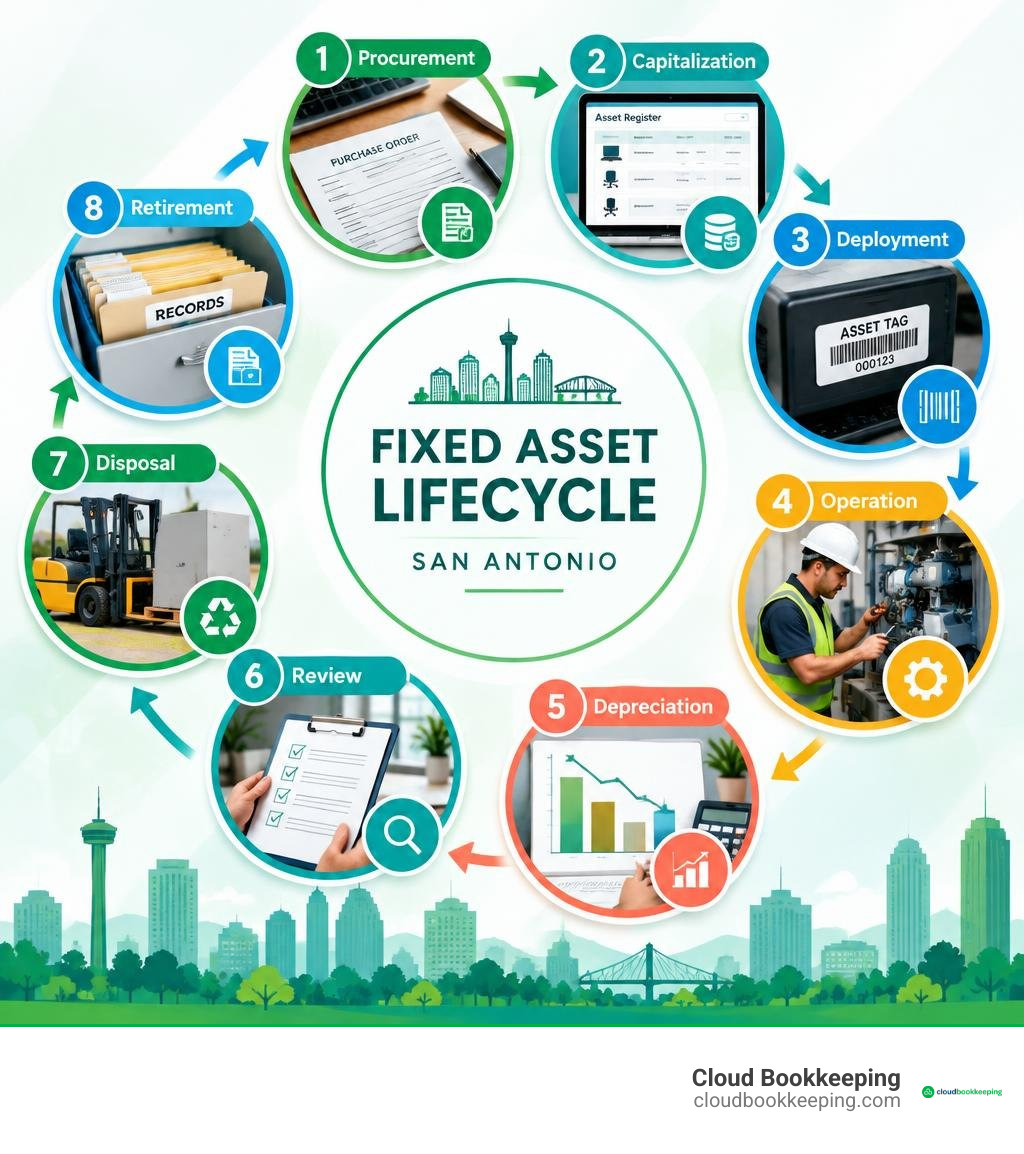
Fixed assets do not exist in a vacuum; they move through a predictable lifecycle. Managing this progression properly safeguards your balance sheet from day one through final retirement.
Capitalization Thresholds and Purchase Documentation
The journey starts at procurement. Every business must establish a clear capitalization policy that defines whether an expenditure is immediately expensed or capitalized over its useful life.
Under the IRS de minimis safe harbor election, small enterprises without an applicable financial statement can immediately expense purchases up to $2,500 per invoice or item. Purchases above that threshold must be capitalized and depreciated over their statutory recovery periods.
Maintaining complete digital documentation is critical. We match purchase orders, detailed vendor invoices, and delivery receipts directly to your digital asset register. This practice creates an unbreakable paper trail, establishing clear cost bases including freight, setup, and testing costs.
Managing Depreciation, Disposals, and Ghost Assets
As machinery operates, it experiences wear, tear, and obsolescence. We systematically adjust the carrying value over time while reconciling journal entries inside your cloud accounting platform.
When an asset reaches the end of its productive life, your bookkeeping team must formally process the retirement. Whether you scrap, trade in, or sell an item, we calculate the realized gain or loss against its accumulated depreciation and salvage value.
Through our strategic growth advisory services, we perform annual balance sheet cleanups to identify ghost assets, purge dead weight, and immediately lower your operating overhead.
Depreciation Methods, Tax Strategies, and Texas Compliance
Handling depreciation correctly requires understanding the difference between financial accounting rules (GAAP) and federal or state tax law. While book depreciation aims to match asset expenses against revenues generated over useful lifespans, tax depreciation focuses on accelerating deductions to minimize income liability.
Modern fixed asset platforms allow you to maintain distinct depreciation books simultaneously, such as GAAP, Federal Tax, Alternative Minimum Tax (AMT), and State books, ensuring compliance across every jurisdiction without duplicating data entry.
| Depreciation Method | Primary Use Case | Key Accounting Advantage | Primary Benefit for Texas Businesses |
|---|---|---|---|
| Straight-Line | Book / GAAP Reporting | Smooth, predictable expense distribution over useful life | Stable financial statements for bank loans and investors |
| MACRS (Modified Accelerated Cost Recovery System) | Federal Tax Compliance | Accelerated write-offs front-loaded into early ownership years | Significant reduction in federal taxable income |
| Section 179 Expensing | Qualified Equipment & Software | Full deduction of purchase price up to annual statutory caps in year one | Immediate capital preservation and cash flow optimization |
MACRS, Section 179, and Bonus Depreciation Rules
For tax purposes, the IRS requires the Modified Accelerated Cost Recovery System (MACRS) for most tangible depreciable property. MACRS assigns assets to recovery classes (such as 3, 5, 7, 15, or 39 years) using either the 200% or 150% declining balance method before switching to straight-line.
To optimize short-term cash flow, businesses frequently leverage Section 179 and Bonus Depreciation:
- Section 179: Allows you to deduct the entire cost of qualifying equipment and off-the-shelf software placed in service during the tax year, subject to annual investment caps and phase-out limits.
- Bonus Depreciation: Enables companies to write off a major percentage of eligible business property immediately, providing substantial first-year tax relief.
Navigating Federal IRS Rules and Texas Franchise Tax Requirements
Operating in Texas brings specific local tax considerations. While the state does not levy a personal or corporate state income tax, businesses must fulfill their Texas franchise tax obligations. When computing the cost of goods sold (COGS) or compensation deductions for the Texas Franchise Tax return, depreciation schedules must accurately conform to state-specific rules.
Furthermore, local taxing entities like the Bexar Appraisal District require annual Business Personal Property (BPP) Renditions. You must report all tangible personal property used to produce income, including machinery, office furniture, computers, and vehicles, that you held on January 1st of each year. Inaccurate asset registers lead to inflated local property tax bills, making precise fixed asset bookkeeping an absolute necessity.
Best Practices for Workflow Integration and Audit Readiness
Managing assets efficiently requires embedding asset tracking directly into your everyday bookkeeping processes rather than treating it as an annual chore.
Implementing Digital Workflows and Cloud Accounting Integrations
By integrating your fixed asset tracking system with your general ledger, you eliminate double data entry and human oversight:
- Cloud Synchronization: When an asset purchase invoice is approved in your accounts payable workflow, the system can automatically generate a corresponding draft record in your fixed asset ledger.
- Automated Journal Entries: Monthly depreciation runs automatically generate balanced debits to depreciation expense and credits to accumulated depreciation across relevant sub-accounts.
- Mobile Scanning Tools: Field employees and warehouse managers can use mobile apps and barcode scanners to scan asset tags, verify locations, and record physical transfers instantaneously.
- Role-Based Controls: Grant appropriate permissions so operational staff can update locations while accounting staff manage financial schedules.
Proven Strategies for Fixed Asset Tracking Audits
Whether dealing with an IRS inquiry, a financial review by a lender, or a Bexar Appraisal District personal property audit, thorough preparation prevents stressful surprises.
We implement robust audit tracking mechanisms that maintain a digital log of every asset modification, revaluation, or disposal. Conducting regular physical inventory counts guarantees that your digital ledger accurately mirrors physical reality. Generating clear monthly financial reporting keeps your leadership team and external auditors fully aligned.
Managing Fixed Asset Tracking Costs, Records, and Data Security
Implementing structured asset tracking is a high-yield investment. The initial effort required to build an asset register pays for itself many times over by preventing asset loss and optimizing tax positions.
Financial Return and Operational Efficiency Gains
Businesses that modernize their fixed asset tracking realize concrete financial returns:
- Direct Tax Savings: Claiming every eligible dollar of depreciation directly lowers federal tax burdens and eliminates overpayments on local Bexar County property renditions.
- Lower Insurance Premiums: Purging decommissioned equipment from insurance schedules prevents you from paying premiums on non-existent property.
- Optimized Capital Allocation: Knowing the condition and age of your machinery helps you plan future capital expenditures proactively rather than reacting to sudden breakdowns.
- Labor Savings: Eliminating manual spreadsheets frees your internal team to focus on core operations.
Data Security and Access Control Standards
Because your asset register contains sensitive business information, such as equipment locations, serial numbers, purchase prices, and vendor data, safeguarding this information is paramount.
We utilize enterprise-grade cloud systems that feature 256-bit data encryption, multi-factor authentication (MFA), continuous cloud backups, and granular, role-based access permissions. These protocols ensure your internal financial data remains fully protected against unauthorized access and hardware failures.
Frequently Asked Questions About San Antonio Fixed Asset Tracking
What is the standard threshold for capitalizing a fixed asset in Texas?
Most small businesses follow the IRS de minimis safe harbor threshold of $2,500 per invoice or item. If an item costs less than $2,500 and has an invoice, it is typically expensed immediately on your profit and loss statement. Items exceeding this amount with a useful life greater than one year should be capitalized on the balance sheet and depreciated over time.
How does fixed asset tracking impact local property taxes and franchise taxes?
In Bexar County, businesses must file an annual Business Personal Property Rendition detailing their tangible income-producing assets. Accurate asset tracking ensures you report only the assets you currently own, depreciated according to appraisal district guidelines, preventing property tax overcharges. For the Texas Franchise Tax, accurate depreciation schedules ensure proper expense deductions when calculating your taxable margin.
Can bookkeeping workflows automate multi-book depreciation calculations?
Yes. Modern fixed asset software integrated with your bookkeeping system automatically calculates different depreciation schedules simultaneously. You can run GAAP straight-line depreciation for your monthly financial statements while running MACRS, Section 179, or Bonus Depreciation for federal and state tax filings, keeping all books synchronized effortlessly.
Conclusion
Protecting your business capital requires clear oversight of your physical equipment, technology, and vehicles. From preventing ghost assets and passing local Bexar County audits to maximizing first-year tax deductions, professional fixed asset tracking is an indispensable pillar of sound financial management.
At Cloud Bookkeeping, under the local leadership of Charlie Perrin, we combine extensive bookkeeping expertise, advanced cloud software, and attentive customer service to keep your balance sheet pristine. Let us manage your asset records so you can focus on expanding your business.
Contact Cloud Bookkeeping to discuss bookkeeping and advisory support that can safeguard your capital and bring clarity to your financial operations.