Determine Whether Your Texas Purchase Qualifies for Sales Tax Exemption
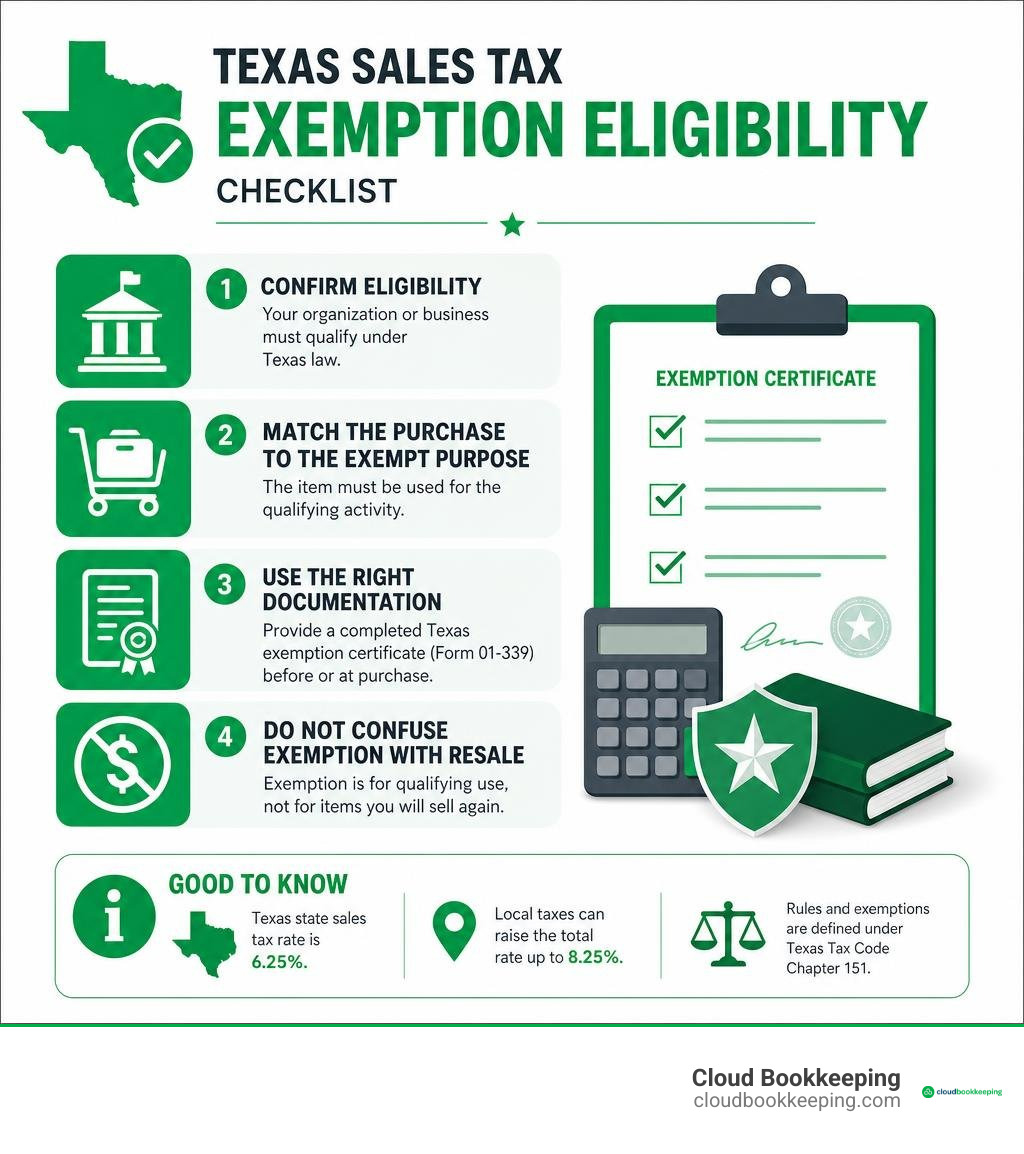
A sales tax exemption in Texas depends on two things: who is buying and what they are buying. Start by confirming that your organization or business activity qualifies under Texas law, then give the seller a complete Texas exemption certificate, usually Form 01-339, before or at the time of purchase.
For most purchases, use this quick check:
- Confirm eligibility. Government bodies, public schools and universities, qualifying nonprofit, charitable, religious, and educational organizations, plus certain manufacturers and agricultural producers, may qualify.
- Match the purchase to the exempt purpose. The item must be used for the qualifying activity. Personal purchases and many travel-related expenses do not qualify.
- Use the right documentation. Give the vendor a completed certificate and keep a copy in your records. Texas does not issue a general sales-tax-exempt number.
- Do not confuse exemption with resale. A resale certificate is for inventory you will sell again. An exemption certificate is for a purchase that is exempt because of the buyer or the item’s qualifying use.
Texas has a state sales tax, and local taxes can increase the total rate. That makes a missed exemption, or an improperly claimed one, meaningful for a small business. The rules under Texas Tax Code Chapter 151 are specific, and exempt organizations can still owe tax on certain purchases and may need to collect tax on their own taxable sales.
At Cloud Bookkeeping, our team helps small business owners build accurate books and clearer financial systems. In the sections ahead, we’ll help you sort out sales tax exemption Texas rules, documentation, and recordkeeping so tax decisions do not become another financial surprise.
Qualifying Entities and Purchases for Sales Tax Exemption Texas
Under the statutory framework enforced by the Texas Comptroller of Public Accounts, exemptions from sales and use tax are not handed out casually. Every gross receipt generated by a seller in Texas is legally presumed taxable until the purchaser presents valid documentation showing why the transaction should be excluded.
Understanding which entities qualify requires looking directly at Texas Tax Code Chapter 151. When businesses do not understand these rules, they either overpay tax on operational overhead or mistakenly waive taxes for customers who do not qualify. Good exemption decisions work best when they are supported by clean bookkeeping and a repeatable sales tax process, which is why many owners pair exemption tracking with professional sales tax return services from Cloud Bookkeeping.
Mastering how to calculate Texas sales tax the right way is the foundation for managing your sales tax obligations. Businesses that sell in multiple Texas cities also benefit from understanding common sales tax reporting headaches before exemption certificates, local rates, and filing deadlines turn into accounting problems.
Nonprofits, Charities, and 501(c) Organizations
Federal tax-exempt status from the IRS does not automatically confer sales tax exemption in Texas. Texas recognizes several specific Internal Revenue Code (IRC) Section 501(c) categories, including:
- 501(c)(3): Religious, charitable, scientific, literary, or educational organizations
- 501(c)(4): Civic leagues and social welfare organizations
- 501(c)(8): Fraternal beneficiary societies
- 501(c)(10): Domestic fraternal societies
- 501(c)(19): Veterans’ organizations
To claim state sales tax relief, these groups must submit a formal application and receive official recognition from the state, as detailed in the official Guidelines to Texas Tax Exemptions.
Once recognized, qualifying nonprofits can purchase items tax-free provided the purchases relate directly to the organization’s exempt purpose. However, an exemption on purchases does not mean an exemption on sales. When an exempt entity sells taxable goods or services, it generally must collect and remit sales tax.
The primary statutory exception is the “two one-day tax-free sales” rule. Qualifying 501(c)(3) and charitable entities can hold up to two tax-free sales per calendar year, each lasting 24 consecutive hours. During these events, items sold within the applicable Texas limit, or items manufactured by or donated to the organization, can be sold without collecting sales tax.
Government Agencies, Public Universities, and Statutory Immunity
Under Texas Tax Code Section 151.309 and the constitutional doctrine of intergovernmental tax immunity, state agencies, local municipalities, counties, federal government bodies, and Texas Independent School Districts (ISDs) are statutorily exempt from sales and use tax on official purchases.
Public institutions do not hold IRS 501(c)(3) determination letters; their immunity is derived from their status as governmental instrumentalities. To claim this exemption at checkout, authorized personnel must use official procurement channels, such as:
- Formal institutional Purchase Orders (POs)
- Direct institutional billing accounts
- State or agency-issued procurement cards (P-cards)
If an employee uses personal cash or a personal credit card to pay for goods or business meals, Texas treats the transaction as a non-exempt purchase of a personal nature, even if the worker is later reimbursed.
Manufacturing, Fabricating, and Processing Operations
For-profit commercial enterprises can also qualify for substantial sales tax exemptions if they engage in manufacturing, fabricating, or processing tangible personal property for ultimate sale.
The exempt manufacturing process begins at the first physical or chemical transformation of raw materials and concludes when the final packaging is complete. Qualifying items include:
- Direct production machinery and automated equipment
- Pollution and wastewater control equipment required by environmental regulations
- Specialized cleanroom environments and air handling systems used in semiconductor or pharmaceutical manufacturing
- Electricity and natural gas used directly in the production process, substantiated by an engineering predominant use study
Non-exempt items include hand tools, such as hammers, wrenches, and screwdrivers, intraplant transportation equipment, such as standard forklifts moving finished inventory, and administrative office equipment, which remain fully taxable under state Manufacturing Exemptions rules.
Understanding Agricultural and Timber Sales Tax Exemption Texas Requirements

Commercial agriculture and timber operations operate under specialized provisions established in Texas Tax Code Section 151.316. To qualify, farmers, ranchers, and timber operators must apply to the Comptroller for an official Ag/Timber registration number, which features a fixed expiration date.
Certain basic farming items are statutory exemptions by nature and never require a certificate:
- Livestock and poultry raised for human consumption, including cattle, hogs, and chickens
- Work animals, including draft horses and mules
- Animal feeds, including hay, oats, bulk corn, and deer corn
- Seeds and annual plants producing human or animal food
However, when purchasing commercial equipment such as balers, combines, brush hogs, squeeze chutes, automated irrigation pipe, or precision agriculture navigation telecommunications, producers must furnish a completed 01-924 Texas Agricultural Sales and Use Tax Exemption Certification displaying their active Ag/Timber number.
Standard road vehicles, clothing, pet food, guns, ammunition, and general storage barns do not qualify for agricultural sales tax exemptions.
Resale Certificates vs. Sales Tax Exemption: Key Differences and Required Forms
Small business owners frequently conflate resale certificates with exemption certificates. While both eliminate sales tax at the point of purchase, they serve distinct legal purposes and carry different accounting workflows.
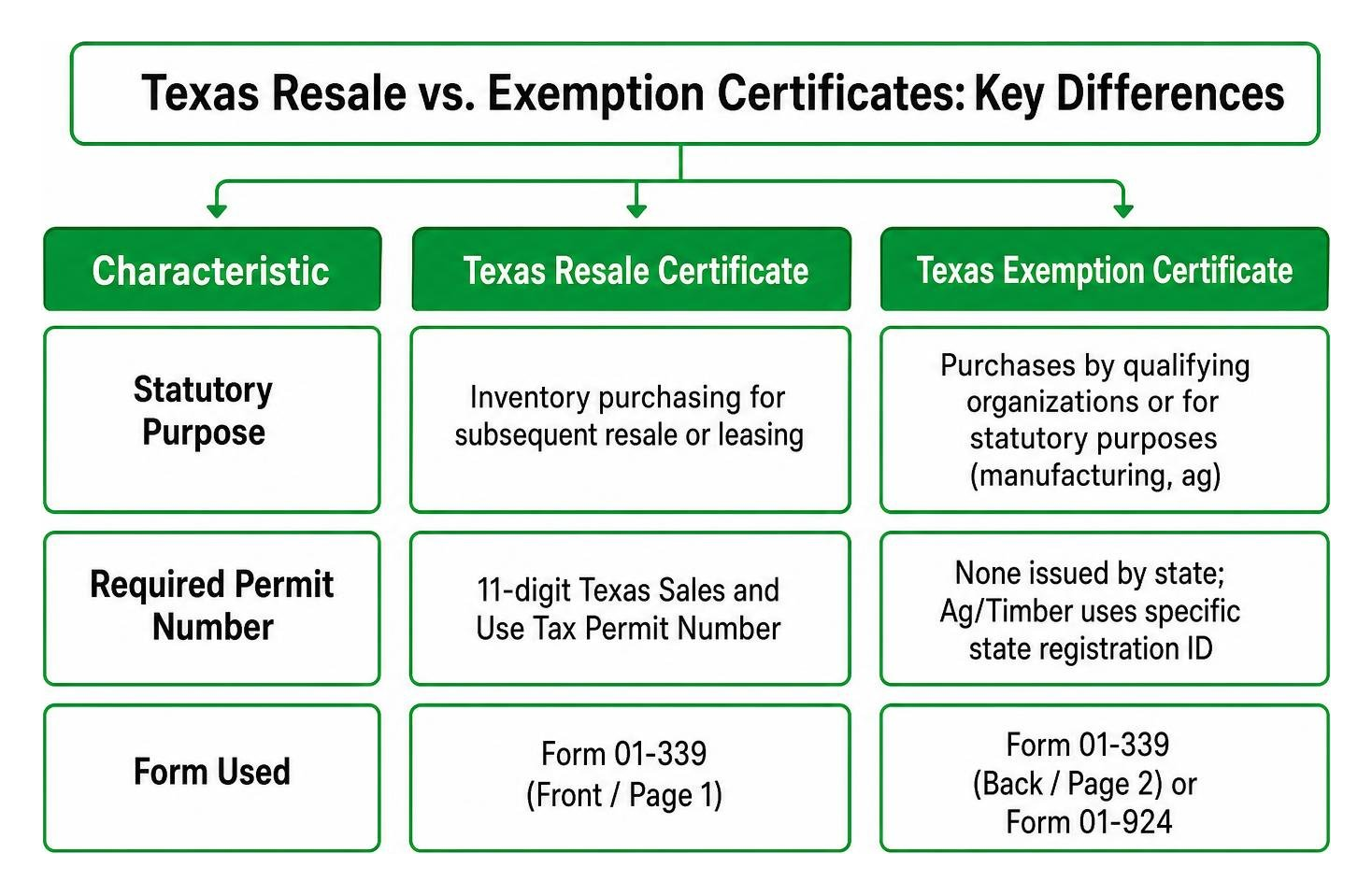
| Characteristic | Texas Resale Certificate | Texas Exemption Certificate |
|---|---|---|
| Statutory Purpose | Inventory purchasing for subsequent resale or leasing | Purchases by qualifying organizations or for statutory purposes, including manufacturing and agriculture |
| Required Permit Number | 11-digit Texas Sales and Use Tax Permit Number | None issued by state; Ag/Timber uses specific state registration ID |
| Form Used | Form 01-339, front or Page 1 | Form 01-339, back or Page 2, or Form 01-924 |
| Out-of-State Retailers | Permitted via out-of-state license or Mexican RFC registration | Restricted to statutory activities or qualifying recognized 501(c) entities |
| Tax Divergence Liability | Fair market rental value or full purchase price | Fair market rental value or monthly pro-rata depreciation formula |
When businesses mix up these certificates, it leads to bookkeeping discrepancies that surface during state compliance reviews. Clear certificate coding, customer records, and exemption notes help prevent small filing issues from turning into financial penalties.
How Form 01-339 Operates for Resale and Statutory Exemptions
The Texas Comptroller issues a single master document: Form 01-339, officially titled the Texas Sales and Use Tax Resale Certificate / Exemption Certification.
Page 1 serves as the Resale Certificate and mandates an active 11-digit Texas Sales and Use Tax Permit number, or Mexican Federal Taxpayers Registry / RFC documentation for Mexican retailers purchasing goods for export. Page 2 serves as the Exemption Certification and covers statutory buyers, nonprofits, and manufacturing processes.
Texas Tax Code Chapter 151 contains no provision for a generic state “tax-exempt number.” To be legally binding, Form 01-339 must include five mandatory elements:
- Full legal name and physical address of the purchasing entity
- Complete name and physical address of the vendor/seller
- Detailed, intelligible description of the tangible items or services purchased
- Specific statutory reason explaining the exact legal basis for the exemption
- Signature of the authorized agent along with the transaction date
Executing these forms accurately is a vital part of staying compliant. When exemption certificates affect monthly close, filing reviews, or customer invoicing, Cloud Bookkeeping can also support broader professional bookkeeping services that keep sales tax records organized.
If your team needs practical context for certificate workflows, our article on improving accuracy in sales tax reports explains how better source documentation reduces filing issues. You can also use our resource on Texas sales tax accuracy to connect exemption decisions with everyday bookkeeping controls.
Purchases That Remain Taxable Even for Exempt Organizations
Holding an approved tax-exempt status does not exempt an organization from every state and local tax. Texas law carves out explicit exclusions where sales tax must still be collected:
- Motor Vehicle Leases and Rentals: Vehicles leased, rented, or purchased for highway transportation remain taxable under Chapter 152 of the Texas Tax Code. Form 01-339 cannot be used for auto rentals.
- Personal and Travel Expenses: Individual employee meals, personal toiletries, and standard parking garage fees incurred during business travel remain taxable.
- Hotel Occupancy Tax: Federal 501(c) entities are not automatically exempt from the Texas state hotel occupancy tax or municipal hotel assessments unless granted specific religious or educational status under separate hotel tax statutes.
If an exempt organization pays sales tax erroneously because a vendor declined its certificate, the buyer should not alter their books with manual adjustments. Instead, request an official Assignment of Right to Refund (Form 00-985) from the vendor and submit a direct refund claim with the Comptroller.
How to Apply, Verify, and Maintain Texas Tax Exemption Status
Maintaining compliance requires establishing proper procedures through the Comptroller’s WebFile and eSystems portals. To protect against audit liabilities, businesses must pair active exemption records with clean bookkeeping workflows.
Applying for Sales Tax Exemption Texas Status via Form AP-201 and Specialized Applications
Organizations seeking formal recognition must file specialized applications based on their corporate profile through the Texas Applications for Tax Exemption portal:
- Form AP-204: Federal 501(c) organizations and all other non-charitable entities
- Form AP-205: Strictly dedicated charitable organizations
- Form AP-206: Qualifying homeowners’ associations, including HOAs with at least 51% individual owner voting control
- Form AP-207: Educational institutions and nonprofit schools
- Form AP-209: Churches and religious organizations
When filing, you must provide your Certificate of Formation and governing bylaws. If applying under federal 501(c) status, you must attach your official IRS determination letter. If the IRS letter was issued more than four years ago, the Comptroller requires an updated IRS status verification letter, obtained by contacting the IRS Exempt Organizations division.
Tax exemptions do not transfer between corporate entities. If your organization changes structure, such as reorganizing from an unincorporated association to a nonprofit corporation, the new legal entity must reapply for both federal and Texas state tax exemptions.
Verifying Status via the Texas Tax-Exempt Entity Search Database
Vendors and purchasers can verify organization status using the Texas Comptroller’s online database.
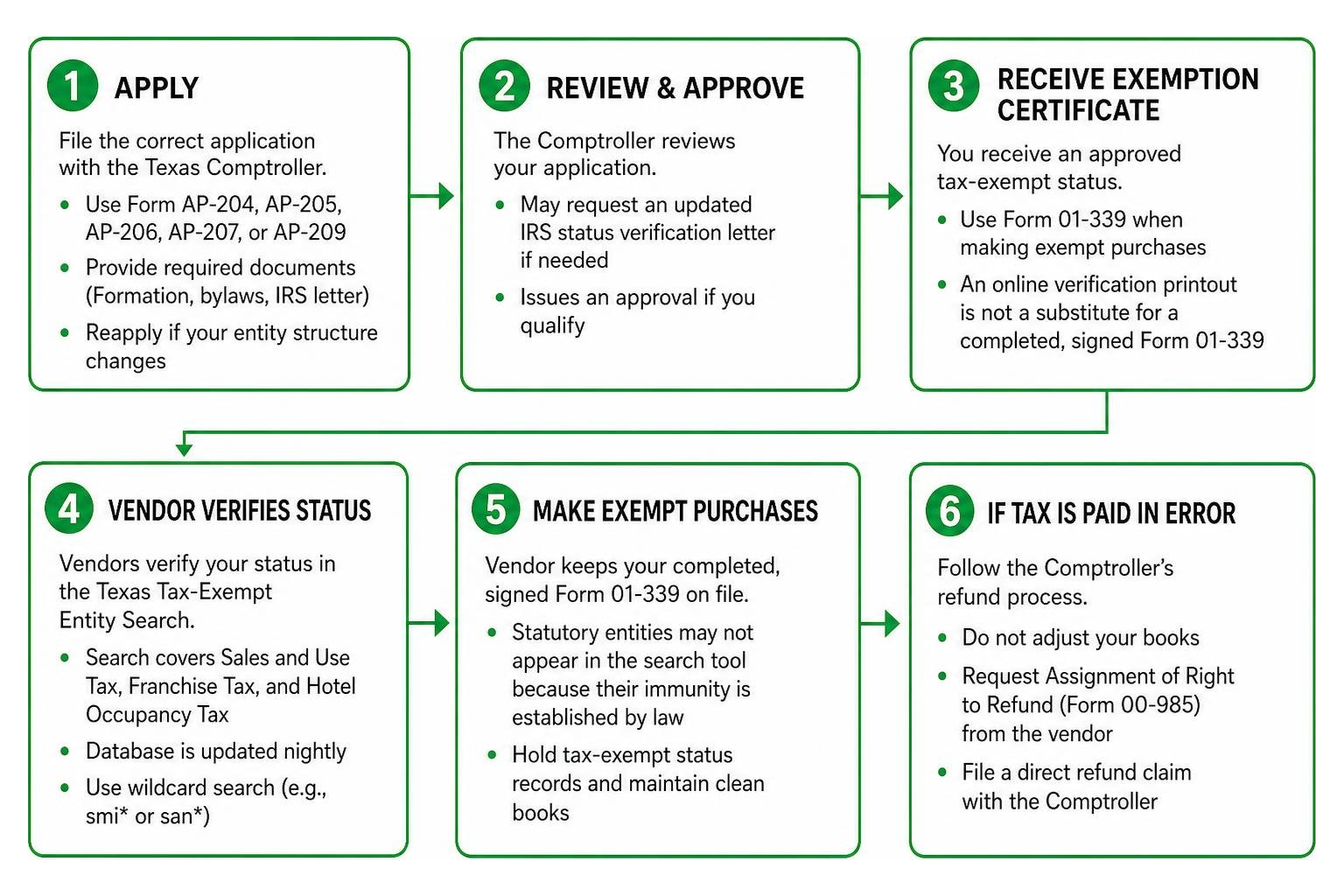
The database covers exemptions for Sales and Use Tax, Franchise Tax, and Hotel Occupancy Tax.
The database is updated nightly. Users can employ wildcard operators, such as smi* or san*, to locate organizations across broad municipal filings. While businesses can download and print official verification letters from the database, an online verification printout is not a substitute for a completed, signed Form 01-339 on file.
Statutory entities like local school districts, municipalities, and state agencies will not always appear in this search tool because their immunity is established directly by law rather than by an application.
Remote Sellers, Out-of-State Entities, and Multi-Year Audit Rules
Under economic nexus standards, out-of-state sellers who generate more than the Texas economic nexus threshold in gross Texas sales revenue during the preceding 12 calendar months must register to collect, report, and remit sales tax in Texas.
Remote sellers must keep detailed accounting records and store all exemption certificates for the required Texas retention period. If you discontinue operations or cease to have nexus in Texas, you must still maintain those records following your closure date. Meeting strict state deadlines is critical, as detailed in our breakdown on navigating sales tax return deadlines.
Divergent Use and Legal Penalties for Misusing Exemption Certificates
Claiming a sales tax exemption is a legally binding assertion. Sellers who accept invalid certificates in bad faith, or buyers who misuse certificates, face serious statutory penalties governed by 34 Tex. Admin. Code § 3.287, Exemption Certificates. Understanding these rules helps businesses stay compliant with sales tax returns in Texas across all operational activities.
Calculating Tax on Divergent Use and Dual-Use Equipment
Divergent use occurs when equipment purchased tax-free under an exemption is subsequently used for a non-exempt, taxable purpose.
For manufacturers and commercial equipment operators, Texas administrative rules provide clear calculation guidelines:
- Monthly safe harbor: If divergent use stays within the allowed incidental-use range during a calendar month, no tax is due for that period.
- Service-life limit: Divergent use tax liability expires after the equipment has been in service for the applicable Texas period from the original purchase date.
- Tax assessment formula: When divergent use exceeds the allowed range during the applicable window, the business must calculate and remit tax based on the taxable share of use.
Alternatively, businesses can assess sales tax based on the fair market rental value of the equipment for the duration of the non-exempt usage.
Criminal Classifications and Civil Audit Liabilities
During a Texas Comptroller sales tax audit, a business must produce valid, fully completed exemption certificates for untaxed sales within the state’s required audit response window. Incomplete or missing certificates are automatically disallowed, shifting liability for the uncollected sales tax back onto the seller, along with statutory penalties and compounding interest.
Intentionally issuing a false or fraudulent exemption certificate is a direct criminal offense in Texas, with penalties tiered by the dollar amount of tax evaded. These strict criminal tiers show how important it is to keep accurate exemption records in your everyday accounting systems.
Frequently Asked Questions About Texas Sales Tax Exemptions
Are out-of-state organizations eligible for sales tax exemption in Texas?
Yes, but out-of-state organizations must qualify under Texas rules. An out-of-state 501(c) entity must submit Form AP-204 along with its IRS determination letter, governing bylaws, and a Certificate of Existence from the Texas Secretary of State to secure Texas state recognition. Out-of-state exemption certificates from other state revenue departments are not accepted by Texas vendors.
Does Texas issue a specific sales tax exemption number?
No. Texas Tax Code Chapter 151 does not create or issue a dedicated “tax-exempt number” for nonprofits or general organizations. Entities substantiate tax-exempt purchases exclusively by presenting a signed, complete Form 01-339 Exemption Certification. The only specialized registration IDs issued by the Comptroller are Ag/Timber numbers and 11-digit Sales Tax Permit numbers used on resale certificates.
Are retailers legally required to accept Texas exemption certificates?
No. Texas retailers are not statutorily mandated to accept an exemption certificate at checkout. If a retailer is unsure about the validity of a certificate or chooses not to accept it, they may charge standard sales tax. The purchaser can then request an Assignment of Right to Refund (Form 00-985) from the merchant and apply directly to the Texas Comptroller for a full refund of the tax paid.
Conclusion
Managing sales tax exemptions in Texas requires consistent oversight. From determining qualifying 501(c) nonprofit operations and direct manufacturing processes to issuing Form 01-339 and tracking audit records, keeping clean books protects your business from unnecessary liabilities.
At Cloud Bookkeeping, based in San Antonio, Texas, our team helps small businesses, nonprofits, and growing enterprises maintain accurate financial systems. Whether you need ongoing QuickBooks management, audit-ready sales tax recordkeeping, or strategic business advisory, our team provides reliable support so you can focus on running your business.
For help keeping exemption certificates, filings, and bookkeeping records aligned, contact our professional sales tax specialists today.