Why Learning How to Address Pay Disparity Could Save Your Business From a Costly Lawsuit
How to address pay disparity starts with these core steps:
- Conduct a pay equity audit: Compare compensation across employees doing similar work, controlling for role, tenure, and performance.
- Identify root causes: Look for gaps in hiring, promotions, performance ratings, and starting salary decisions.
- Standardize job classifications: Create clear salary bands and leveling criteria across your organization.
- Remediate unexplained gaps: Adjust pay upward for underpaid employees; never lower the higher earner’s pay.
- Monitor continuously: Build pay equity checks into every hiring decision, promotion, and merit review cycle.
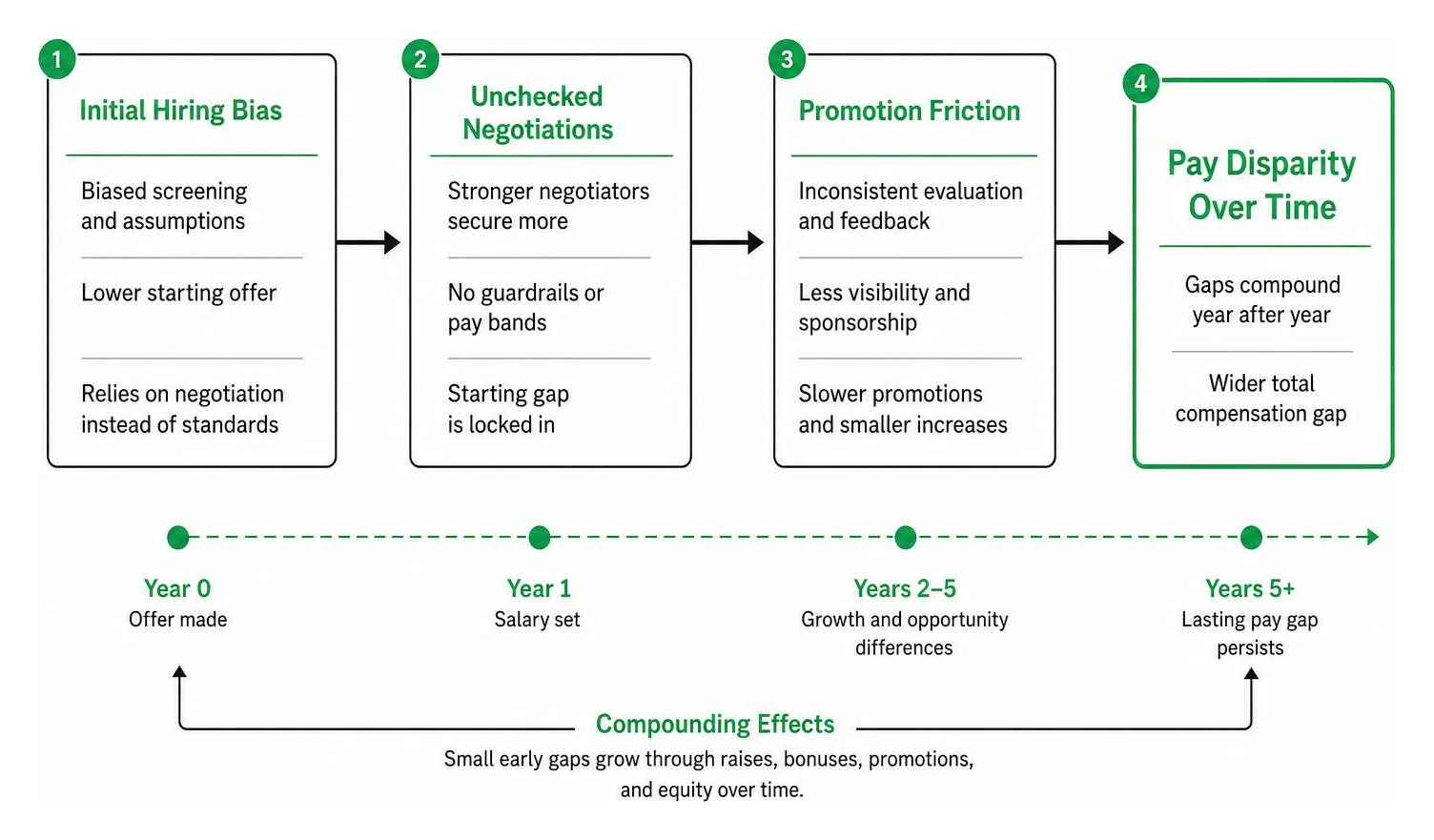
Pay gaps do not usually start with bad intentions. They start with one rushed hiring decision, one salary negotiation that went unchecked, or one performance review that was not applied consistently. Then they compound quietly, year after year, until a frustrated employee compares notes with a colleague.
And by then, you are not just dealing with a morale problem. You are dealing with potential legal exposure under the Equal Pay Act of 1963 and Title VII of the Civil Rights Act.
The numbers make the stakes clear. In 2022 alone, working women in the U.S. lost more than $1.6 trillion in wages due to the gender wage gap, equivalent to 6.3% of U.S. GDP. Organizations with unexplained pay disparities also average a 1.8% drop in return on net operating assets and are less likely to appear on Fortune’s “100 Best Places to Work” list.
For small business owners, the risk is just as real and often harder to catch without dedicated HR infrastructure.
At Cloud Bookkeeping, our team has spent decades helping small business owners strengthen payroll systems and financial operations. We have seen how untracked compensation decisions quietly create the kind of pay disparity that turns into expensive legal and retention problems. This guide gives you a practical, clear-eyed framework to find those gaps and fix them before they become lawsuits.
Understanding Pay Disparity vs. Gender Pay Gap
When business leaders ask us how to address pay disparity, we always start by untangling two concepts that sound similar but mean very different things in practice: pay disparity and the unadjusted gender pay gap.
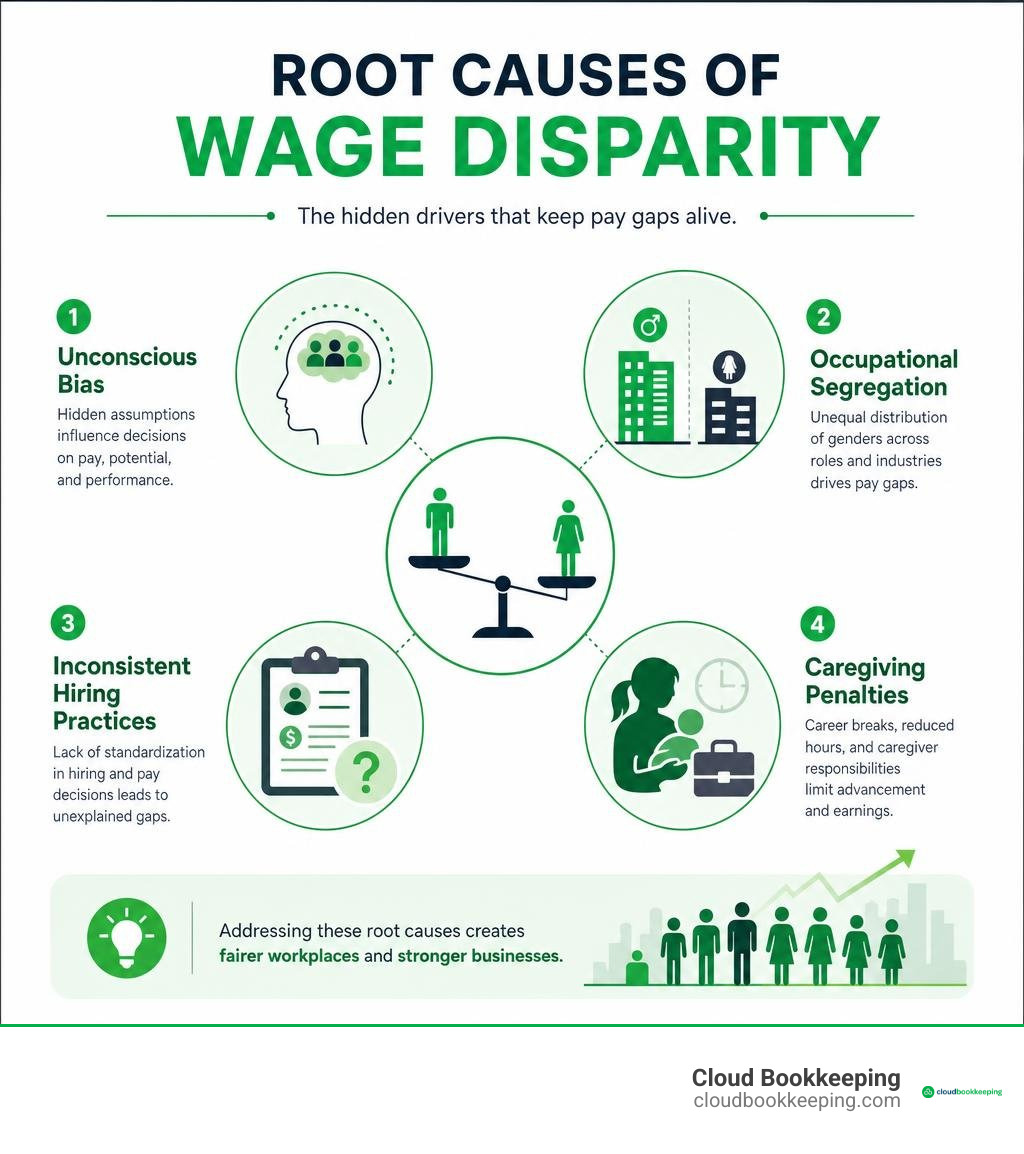
The unadjusted gender pay gap looks at the macro-level difference between average earnings across all men and all women across an entire company or economy. In 2022, median working women received 78 cents for every dollar earned by male counterparts overall, while full-time, year-round female workers earned 84 cents on the dollar. This overall gap is heavily driven by structural issues like occupational segregation, where men are overrepresented in higher-paying technical or executive roles while women dominate lower-wage service or caregiving roles, as well as caregiving penalties that reduce total paid hours.
Pay disparity, on the other hand, refers to an adjusted pay gap. It occurs when employees performing substantially equal work under similar conditions are paid differently, without a legitimate business justification like tenure, skill level, or performance.
Here is how these two concepts compare:
| Dimension | Unadjusted Gender Pay Gap | Role-based pay disparity |
|---|---|---|
| Primary scope | Macro-level average wage differences across demographic groups | Micro-level compensation differences between specific employees in similar roles |
| Adjustment factors | Does not control for role, experience, location, or performance | Controls for legitimate job factors like tenure, skill, duties, and output |
| Main root causes | Occupational segregation, societal caregiving expectations, historical barriers | Subjective hiring offers, aggressive initial negotiation bias, inconsistent merit raises |
| Primary risk | ESG rating hits, broad public relations and employer brand damage | EEOC claims, Equal Pay Act litigation, mandatory back pay, severe team turnover |
| How to fix it | Long-term pipeline building, equal promotion pathways, flexible work structures | Immediate salary adjustments, structured salary bands, standardized job architecture |
While fixing macro gaps requires structural shifts over several years, role-to-role pay disparities represent immediate compliance risks that you can and must solve inside your payroll and HR processes right now.
The Legal Framework and Financial Risks of Unresolved Wage Gaps
Ignoring compensation gaps is not just bad for culture; it is illegal under multiple federal statutes. The primary statutes governing wage equity are the Equal Pay Act of 1963 (EPA) and Title VII of the Civil Rights Act of 1964.
Under the Equal Pay Act, employers are prohibited from paying different wages to men and women who perform equal work in jobs requiring equal skill, effort, and responsibility performed under similar working conditions within the same establishment. Job titles are irrelevant; federal enforcement agencies evaluate actual day-to-day job duties. Furthermore, Title VII prohibits compensation discrimination based on race, color, religion, sex, or national origin.
According to the official EEOC guidance on compensation discrimination, compensation includes base salary, overtime, bonuses, stock options, allowances, and fringe benefits. If wage discrimination is established, federal law explicitly mandates that you cannot fix the gap by lowering the pay of the higher-earning employee. You must bring the underpaid employee’s pay up.
The legal and financial risks of failing to resolve these issues are severe:
- Back pay and statutory damages: EPA lawsuits can trigger two years of back pay, or three years if the violation is deemed willful, plus liquidated damages and attorney fees. Furthermore, employees are not required to file an EEOC administrative charge before suing directly in federal court under the EPA.
- Loss of financial productivity: Research from Harvard Business School highlights that firms with unexplained pay gaps face an average 1.8% drop in return on net operating assets due to reduced employee effort, erosion of trust, and elevated voluntary turnover.
- Accounting and payroll compounding: Uncaught compensation errors propagate through every pay period, creating tax filing mismatches and liability accruals. Accurate financial reports help business owners track payroll changes, spot unusual compensation trends, and keep audit documentation organized.
How to Address Pay Disparity Through Internal Audits and HR Processes
If you want to solve wage gaps permanently, you cannot rely on ad-hoc salary fixes. You need a structured, repeatable audit and job architecture framework.
Only 54% of HR leaders conduct annual pay audits, even though 63% view regular wage reviews as a core commitment to fairness and inclusion. Conducting an internal pay review allows you to spot compliance issues before an employee or government agency does.
To build a reliable process, HR and finance teams can pair statistical analytics with sound job evaluation principles, then make sure those changes are reflected accurately in payroll. For many small businesses, professional payroll services help keep equity adjustments calculated correctly, taxed properly, and disbursed on time without adding administrative strain.
Step-by-step audit framework and remediation strategies
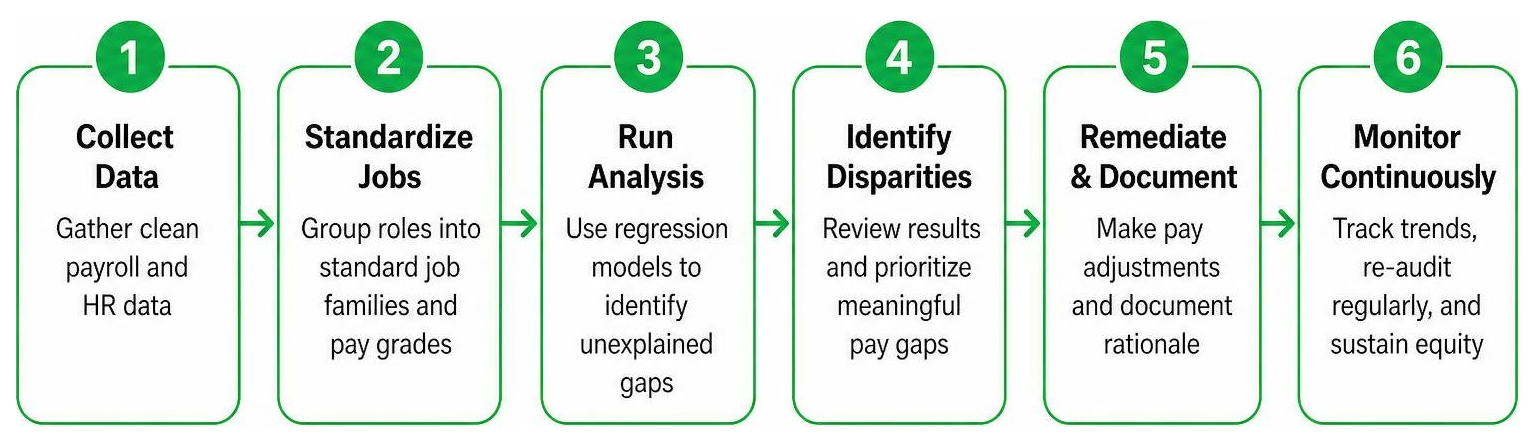
When we help small and mid-sized businesses organize their payroll data, we recommend following a clear six-stage audit framework:
- Collect clean payroll and HR data: Gather comprehensive data for all full-time and part-time staff, including base salaries, bonuses, commissions, tenure, performance ratings, education, location, and demographic details.
- Standardize job architecture: Group employees into standardized job families and pay grades based on equivalent skill, effort, and responsibility.
- Run statistical regression analyses: Analyze compensation using multi-variable regression models. This allows you to isolate legitimate factors, like experience, certifications, and location, from unexplained differences linked to protected demographic characteristics.
- Distinguish statistical vs. economic significance: Statistical significance indicates whether a gap is unlikely to have happened by chance, which is critical for legal liability, while economic significance measures the practical dollar size of the gap. Establishing clear tolerance thresholds, such as 1% or less, helps prioritize where adjustments are needed most.
- Develop a remediation action plan: Calculate targeted salary increases for underpaid individuals. If budget constraints prevent immediate fixes, execute a phased remediation plan across a fixed timeframe, such as 6 to 12 months.
- Document decisions and re-audit: Maintain detailed audit logs explaining the business rationale behind all compensation decisions to prove compliance in the event of an inquiry.
Best practices for HR leaders on how to address pay disparity proactively
Fixing current gaps is only half the battle; you must also stop new gaps from creeping back in. Modern HR leaders adopt structured strategies to maintain long-term equity:
- Ban salary history inquiries: Stop asking job applicants about their previous earnings. Relying on salary history perpetuates historical pay discrimination into new roles.
- Publish clear pay bands: Include salary ranges in job postings and internal promotion notices. State pay transparency laws are growing rapidly, making transparent compensation a competitive hiring advantage.
- Train hiring managers: Provide mandatory training on objective scoring, compa-ratios, which compare actual pay to the midpoint of a salary band, and negotiation boundaries so managers do not grant subjective salary premiums during hiring or merit reviews.
- Integrate accounting and payroll systems: Ensure your compensation adjustments flow seamlessly into your accounting records. When pay changes create questions about responsibility, timing, or approvals, clarifying who should manage your company’s payroll helps your team maintain complete pay governance.
Mitigating Risk and Supporting Employees Facing Pay Discrepancies
When employees discover they are earning less than peers performing the same job, their trust in the organization is shattered. How management responds in that moment determines whether the situation is resolved amicably or escalates into a lawsuit.
Employees want to know that compensation is governed by objective criteria rather than secret handshakes. A clear internal process helps your team respond consistently, protect employee trust, and document decisions before frustrations escalate.
When an employee raises a pay query internally, HR leaders should follow this protocol:
- Listen and validate: Treat internal pay inquiries seriously. Never dismiss concerns or cite “budget limitations” without examining the wage data.
- Review job comparables: Evaluate the employee’s actual duties, tenure, performance evaluations, and skill set alongside peer benchmarks in the same job family.
- Provide transparent explanations: If a pay difference is justified by bona fide seniority, specialized skills, or quantifiable performance metrics, share those objective criteria clearly.
- Correct unjustified gaps quickly: If an unexplained disparity is discovered, outline a clear adjustment timeline and raise the employee’s salary accordingly.
Legal and operational risks when learning how to address pay disparity
Mishandling pay discussions creates severe organizational hazards. If an employee feels ignored, they may consult an Equal Pay Act attorney or file a formal charge with the EEOC or state labor board.
Beyond court judgments, retaliating against an employee for discussing wages or seeking pay fairness violates federal law. Title VII and the EPA strictly prohibit adverse actions, such as demotions, unfavorable reassignments, or termination, against workers who raise compensation grievances or participate in wage discussions.
From an operations perspective, disorganized payroll oversight is often the primary reason wage gaps slip through unnoticed. Coordinated bookkeeping services can help small businesses keep payroll records, compensation changes, and financial reporting aligned as pay equity policies mature.
Economic Benefits and Long-Term Policies for Sustainable Pay Equity
Achieving pay equity is not merely a compliance expense; it is an economic growth driver. From 1967 to 2021, American women lost a cumulative $61 trillion in total wages due to the gender wage gap. Closing this gap would generate substantial macroeconomic growth while delivering immediate benefits to individual companies.
When women receive fair compensation, household financial security rises, consumer spending increases, and reliance on public safety nets decreases. Businesses that proactively eliminate internal pay gaps also enjoy distinct talent advantages:
- Higher retention and engagement: Companies utilizing modern compensation software and pay equity auditing are 3.2 times more likely to drive higher employee retention and engagement.
- Enhanced recruitment appeal: Transparent pay policies make businesses 7 times more likely to attract top-tier talent in competitive labor markets.
To support these efforts, companies should analyze operational levers like promotion pipelines, part-time career mobility, and parental leave uptake to prevent structural wage stagnation. Combining macro policy adjustments with continuous internal audits ensures that fair pay remains a permanent part of your business culture.
Pay equity work also depends on clean, consistent records. Before an audit begins, it helps to review common causes of payroll discrepancies so your team can identify data errors, missed adjustments, and reporting gaps that may distort the results.
Frequently Asked Questions About Pay Disparity
What is the difference between statistical significance and economic significance in pay equity?
Statistical significance measures whether a pay gap between demographic groups is statistically reliable or merely the result of random chance. Courts and regulatory bodies look closely at statistical significance to determine potential legal liability.
Economic significance, on the other hand, measures the practical dollar size or percentage gap, such as a 1% vs. a 12% difference. Even if a small gap is not statistically significant due to a small employee sample size, it may still carry economic significance that hurts employee trust and requires attention.
Can pay differences between employees in identical roles ever be legally justified?
Yes. Under the Equal Pay Act, compensation differences between employees performing substantially equal work are lawful if they are based on one of four affirmative defenses:
- A bona fide seniority system
- A bona fide merit system
- A system that measures earnings by quantity or quality of production
- A differential based on any factor other than sex, such as geographic cost-of-living differences, specialized technical credentials, or relevant professional experience
All such systems must be documented, objective, and applied consistently across all staff.
How frequently should an organization perform a pay equity audit?
Organizations should perform a full pay equity audit at least once per year. However, pay equity is a dynamic metric that shifts with every talent decision. Modern best practices involve embedding pay equity checks into real-time HR workflows, reviewing starting salary offers, off-cycle raises, and promotion packages against your compensation model as they happen to prevent new gaps from forming.
Conclusion
Understanding how to address pay disparity is not just about managing legal risk; it is about building a healthy, resilient business where high-performing employees stay, thrive, and trust leadership. Unexplained wage gaps quietly damage company culture, lower productivity, and leave your organization vulnerable to legal challenges and regulatory fines.
By establishing structured salary bands, auditing payroll data regularly, and eliminating subjective hiring decisions, you can protect your bottom line while fostering an equitable workplace.
At Cloud Bookkeeping, based right here in San Antonio, Texas, our team helps small business owners cut through payroll complexity with expert setup, transparent reporting, and dedicated local support. If you want to streamline your financial operations and keep your compensation systems clean, accurate, and compliant, contact our payroll specialists today.