Choose a Bookkeeping Partner That Turns Numbers Into Growth Decisions
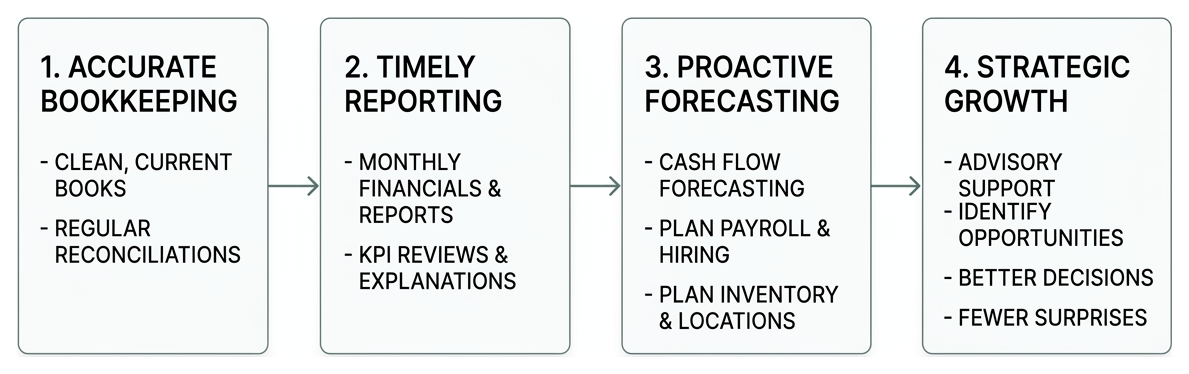
The right San Antonio bookkeeping growth advisory partner does more than keep transactions organized. They deliver timely, accurate financial reports, track the few metrics that matter most, forecast cash needs, and help you turn the numbers into clear next steps.
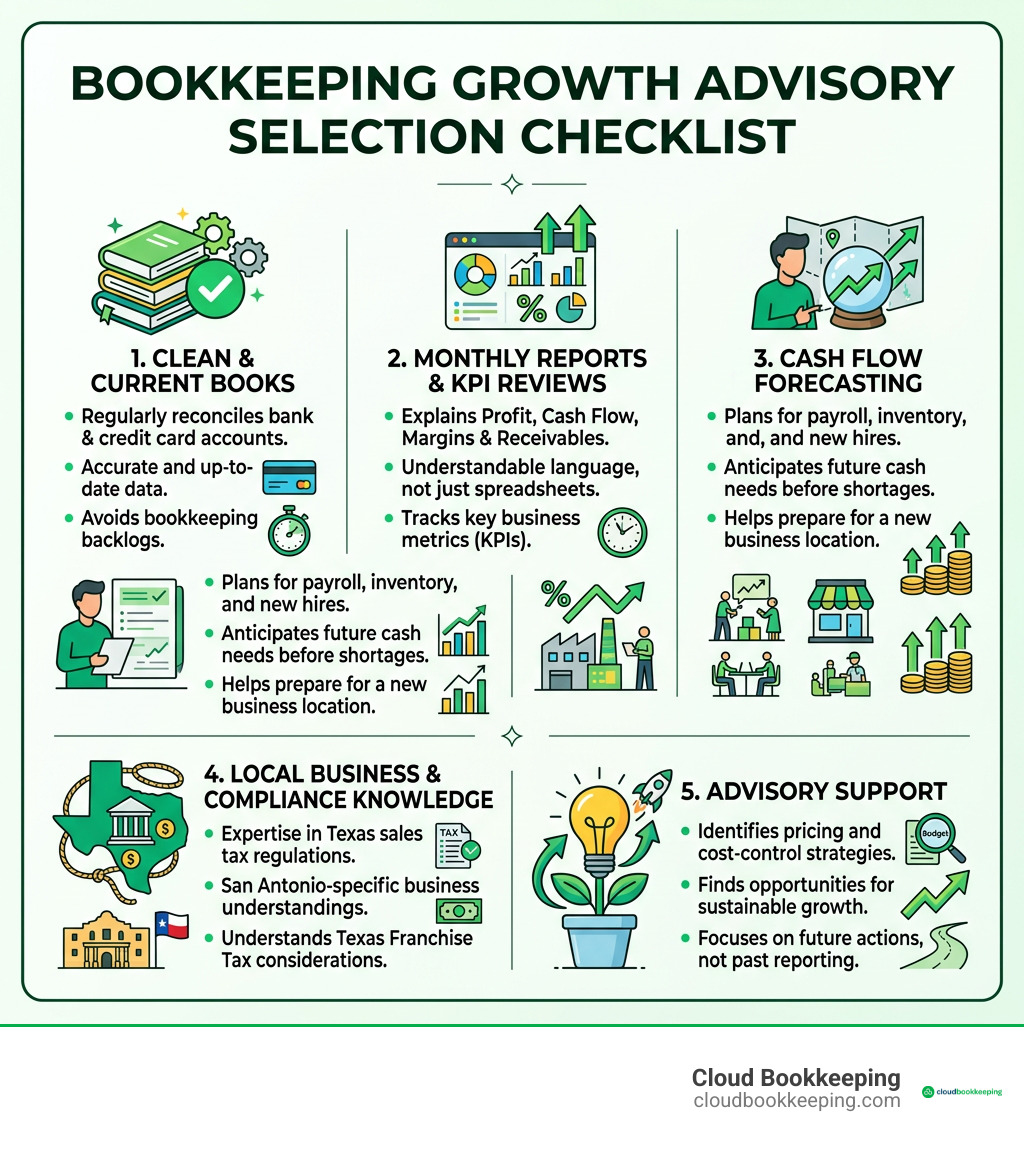
When choosing a provider, look for:
- Clean, current books with regular bank and credit-card reconciliations.
- Monthly reports and KPI reviews that explain profit, cash flow, margins, and receivables in plain language.
- Cash flow forecasting to plan payroll, inventory, hiring, or a new location before cash gets tight.
- Local business and compliance knowledge, including Texas sales tax and franchise tax considerations.
- Advisory support that identifies pricing, cost-control, and growth opportunities instead of simply reporting past activity.
For an overwhelmed owner, this shift matters. Monthly financial statement reviews are linked with stronger profitability, while cash flow forecasting can help businesses improve how they manage available cash. The goal is not more spreadsheets. It is fewer financial surprises and better decisions about where to invest next.
I am Charlie Perrin, founder of Cloud Bookkeeping, with more than 24 years of experience helping small businesses build clearer financial systems, improve profitability, and use QuickBooks reporting with confidence. My approach to bookkeeping growth advisory connects accurate books with practical guidance for sustainable growth.
Common San Antonio bookkeeping growth advisory vocab:
Why Bookkeeping Growth Advisory Is Essential for Scaling Businesses
Many small business owners view bookkeeping as an administrative chore: a rear-view mirror exercise required only to file annual taxes. However, relying solely on historical reporting leaves leadership blind to emerging cash bottlenecks and missed opportunities. Scaling a modern enterprise requires forward-looking financial insights that transform static ledger entries into operational action.
When business leaders leverage strategic financial planning, the impact is tangible. In fact, small businesses that partner with professional bookkeeping teams are 30% more likely to experience revenue growth compared to those attempting to balance ledgers alone.
By outsourcing the heavy lifting of reconciliations, reporting, and financial forecasting, companies eliminate administrative drag. Deciding to rely on outsourced bookkeeping services allows leadership to reallocate precious internal hours toward client acquisition, staff retention, and operational refinement.
Moving Beyond Traditional Compliance to Forward-Looking Strategy
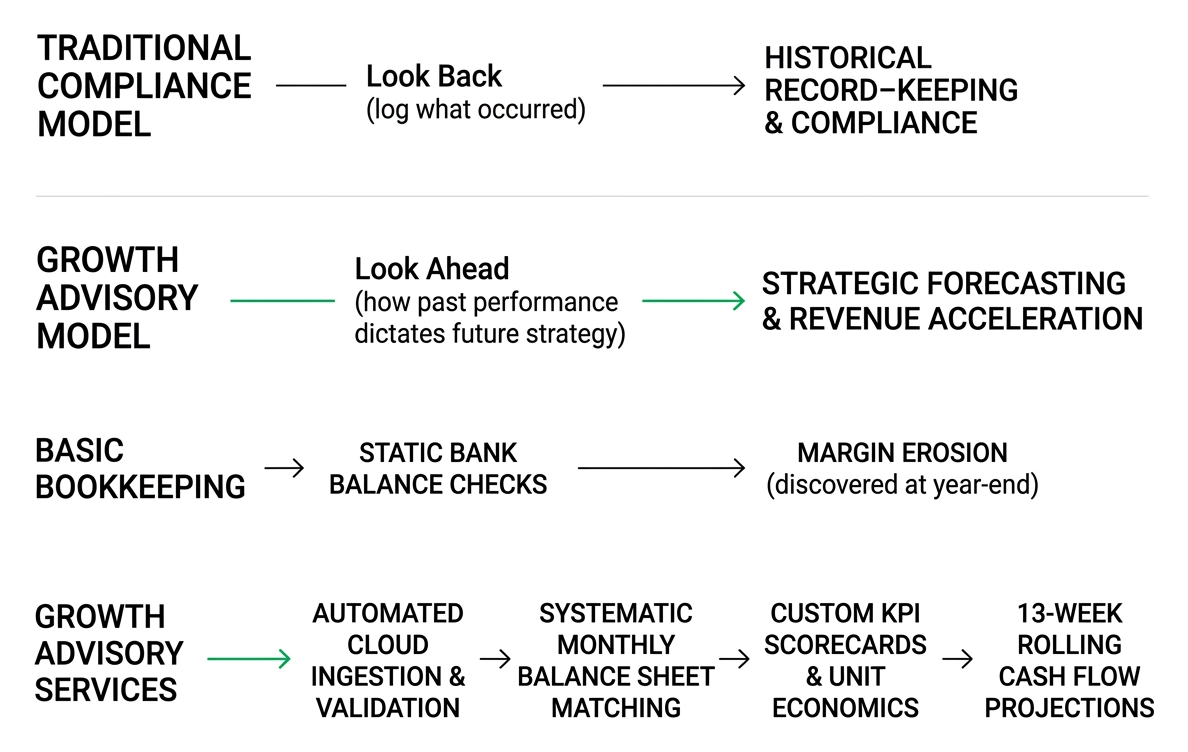
The fundamental difference between basic transaction tracking and true advisory lies in mindset: one looks back, while the other looks ahead. Traditional bookkeeping logs what occurred last month, whereas proactive financial planning asks how last month’s performance dictates next quarter’s strategy.
Integrating comprehensive small business advisory services empowers local businesses to establish real-time revenue enablement frameworks. Rather than waiting until year-end to discover margin erosion, advisory services deliver continuous oversight.
Furthermore, making the switch to outsourced financial management can reduce accounting costs by up to 40% for small businesses, freeing up capital to reinvest into operational efficiency and new market opportunities.
How Bookkeeping Growth Advisory Drives Measurable Revenue Expansion
A dedicated advisory partner turns messy rows of numbers into actionable business intelligence. Through systematic margin optimization, customer lifetime value analysis, and revised pricing strategies, companies that use growth advisory services see an average of 15% increase in annual revenue.
| Feature / Capability | Basic Bookkeeping | Growth Advisory Services |
|---|---|---|
| Primary Focus | Historical record-keeping & compliance | Strategic forecasting & revenue acceleration |
| Transaction Recording | Manual data entry & categorization | Automated cloud ingestion & validation |
| Reconciliations | Periodic (often quarterly or annual) | Systematic monthly balance sheet matching |
| Reporting Output | Standard Balance Sheet & P&L | Custom KPI scorecards & unit economics |
| Cash Management | Static bank balance checks | 13-week rolling cash flow projections |
| Strategic Advisory | None / Reactive communication | Proactive monthly strategic reviews |
The bedrock of this model is accuracy. When you keep your books clean and accurate, every subsequent strategic recommendation rests on dependable, verifiable financial data.
Core Financial Metrics and Cash Flow Strategies for Local Market Expansion
Sustainable growth requires disciplined visibility into key performance indicators (KPIs). Tracking high-level revenue alone is deceptive; a business can easily grow itself out of business if operational overhead accelerates faster than collections.
Prioritizing proper financial management gives owners the clarity needed to balance rapid expansion with healthy capital reserves.
Key Financial Indicators Every Texas Business Must Track
Businesses that review financial statements monthly are 2.5 times more likely to achieve profitability. By maintaining monthly reviews, owners identify variances before they derail growth plans.
Every expanding company should track these core metrics:
- Gross Profit Margin by Service/Product: Evaluates actual profitability after direct fulfillment or production costs.
- Customer Acquisition Cost (CAC) vs. Lifetime Value (LTV): Ensures client acquisition investments generate sustained returns.
- Operating Cash Flow: Measures the liquidity produced directly from core business activities.
- Debt Service Coverage Ratio (DSCR): Confirms operational profits comfortably service current loans and credit facilities.
Consistently tracking key financial metrics eliminates guesswork, providing clarity when planning major hiring initiatives or capital investments.
Advanced Cash Flow Forecasting and Working Capital Optimization
Revenue is vanity, profit is sanity, but cash is reality. Many profitable businesses run into severe trouble simply due to timing mismatches between receivables and payable cycles.
Advisory services that include cash flow forecasting can improve cash flow by 25% within the first year. By implementing a rolling 13-week forecast, businesses gain clear visibility into upcoming capital surpluses or deficits.
Integrating proactive cash flow management strategies alongside advanced financial forecasting and projections enables owners to optimize inventory purchases, negotiate vendor terms, and safeguard adequate cash reserves for sustained local expansion.
Navigating San Antonio’s Economic Landscape and Compliance Challenges
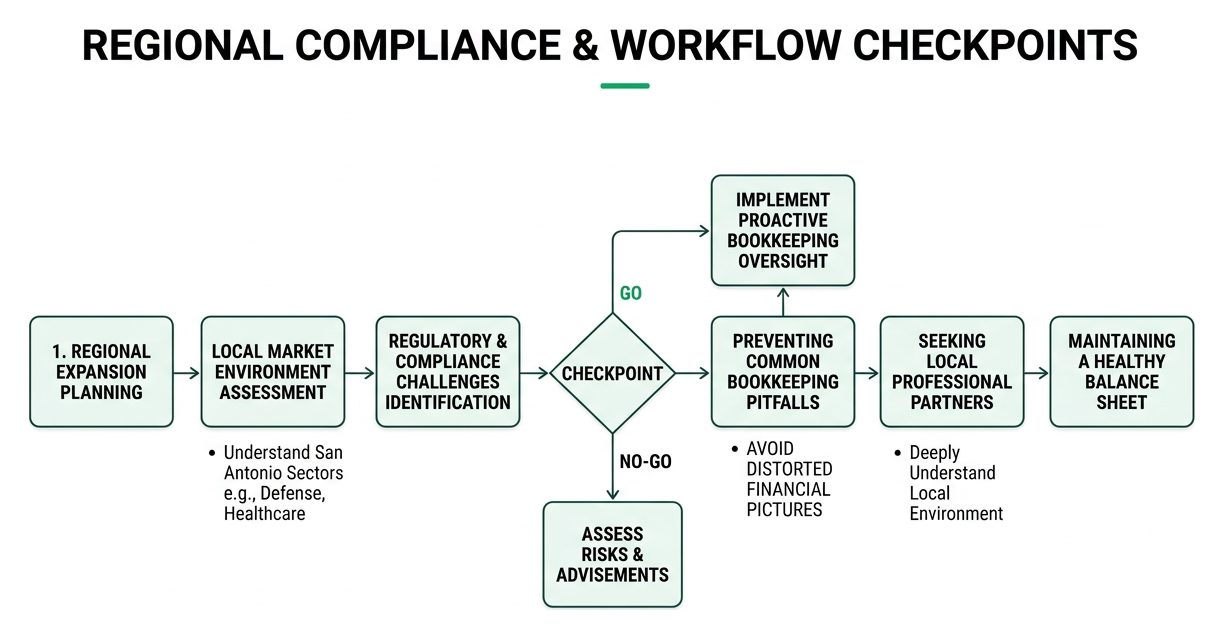
The San Antonio economy continues to thrive across varied sectors, including defense, healthcare, logistics, manufacturing, and hospitality. However, regional expansion introduces distinct operational and regulatory challenges.
When searching for trusted local professionals on reputable bookkeeping directories, companies must seek partners who deeply understand the local business environment.
Overcoming Common Bookkeeping Pitfalls That Stifle Growth
Without dedicated oversight, growing companies often fall into classic traps that distort their true financial picture. Identifying and preventing these errors early is critical to maintaining a healthy balance sheet.
Common pitfalls include:
- Commingling Funds: Mixing personal and business expenses, complicating tax filings and weakening liability protections.
- Delayed Bank and Card Reconciliations: Postponing reconciliations, creating inaccurate views of available capital.
- Unmanaged Accounts Receivable: Failing to enforce strict invoicing cadences, resulting in aged balances and liquidity shortages.
- Uncategorized Overhead: Letting recurring software subscriptions and vendor rate increases go unchecked.
Neglecting these issues creates costly bookkeeping mistakes that divert leadership attention away from strategic expansion.
Leveraging Advisory for Tax Readiness and Regulatory Alignment
A major advantage of continuous growth advisory is stress-free compliance. Rather than scrambling during tax season, accurate books ensure permanent audit-readiness throughout the year.
Maintaining ongoing Texas sales tax compliance protects businesses against costly state audits and penalties. Furthermore, precise year-round tracking streamlines state franchise tax reporting, ensuring local enterprises retain their hard-earned profits while staying fully aligned with state and Bexar County regulatory mandates.
Best Practices for Evaluating and Selecting an Advisory Partner
Choosing the right financial partner requires looking beyond basic software data entry. You need a dedicated team that acts as an extension of your leadership, providing real-time financial strategy.
Key qualifications to evaluate include:
- QuickBooks ProAdvisor Certification: Deep technical mastery of cloud systems to automate workflows and minimize errors.
- Tiered Financial Support: Access to advanced fractional controller services that elevate basic bookkeeping into high-level budget controls and executive analysis.
- Comprehensive Back-Office Integration: Integrated capabilities for streamlining payroll processing to keep workforce management accurate and compliant.
Assessing Controller Services, Software Stacks, and Industry Experience
A top-tier advisory firm integrates your accounting ledger seamlessly with leading point-of-sale platforms, time-tracking applications, and inventory systems. When evaluating prospective partners, prioritize firms that offer clear communication schedules, responsive support, and tailored dashboard reporting. Transparent financial visibility ensures you spend less time deciphering spreadsheets and more time executing strategic growth plans.
Frequently Asked Questions About San Antonio Bookkeeping Growth Advisory
How does growth advisory differ from standard bookkeeping or tax filing?
Standard bookkeeping records past financial transactions, and tax filing ensures annual compliance with regulatory authorities. In contrast, growth advisory is forward-looking. It analyzes historical trends to deliver real-time budgeting, margin optimization, cash forecasting, and actionable strategic planning to help businesses scale sustainably.
What immediate impact does monthly financial advisory have on cash flow?
Monthly advisory pinpoints operational inefficiencies, working capital leaks, and aging receivables. By instituting rolling cash flow forecasts, businesses routinely improve available cash by up to 25% within the first twelve months, preventing cash shortages before they occur.
When should a growing San Antonio small business hire an advisory service?
Businesses should consider an advisory partner when experiencing steady top-line growth, adding team members, preparing for multi-location expansion, or noticing margin compression. When basic compliance reports no longer answer forward-looking questions about hiring or capital investments, growth advisory becomes essential.
Conclusion
Sustained business expansion demands more than clean ledgers; it requires actionable financial intelligence, proactive forecasting, and dedicated strategic guidance. Transitioning from reactive data logging to proactive financial advisory gives small business owners the clarity needed to scale confidently, protect margins, and seize local market opportunities.
At Cloud Bookkeeping, under the local leadership of Charlie Perrin, we provide small businesses with clear reporting, unparalleled customer service, and the forward-looking insights needed to turn everyday numbers into powerful catalysts for growth. Connect with us today to explore our scalable bookkeeping and advisory services and build a solid financial foundation for your company’s future.