Why a Financial Statements Review Matters for Your Business
A financial statements review sits in the middle ground between a basic compilation and a full audit — and for many small business owners, it’s the smartest, most cost-effective way to add credibility to your numbers.
Here’s a quick summary of what a financial statements review is:
| Question | Answer |
|---|---|
| What is it? | An engagement where a CPA performs analytical procedures and inquiries to provide limited assurance on your financial statements |
| Who performs it? | A licensed CPA or accounting firm |
| What assurance does it provide? | Limited (negative) assurance — the CPA confirms nothing has come to their attention indicating material misstatements |
| How does it differ from an audit? | A review does not test internal controls or verify individual transactions like an audit does |
| What does it cost? | Roughly 20%–50% of the cost of a full audit |
| Who needs it? | Privately held businesses, nonprofits, and entities seeking loans or credit lines that require CPA-reviewed statements |
For many San Antonio small business owners, the question isn’t whether to get your financials reviewed — it’s understanding what a review actually involves, and whether it’s the right fit for your stage of growth.
I’m Charlie Perrin, founder of Cloud Bookkeeping, and with over 24 years of experience helping small business owners bring clarity to their finances, I’ve guided countless clients through the financial statements review process — from getting their books ready to understanding what the final report means for their business.
Financial statements review word list:
What is a Financial Statements Review?

At its core, a financial statements review is a structured service conducted by an independent Certified Public Accountant (CPA). The primary goal is to provide “limited assurance” (also referred to as negative assurance) that the company’s financial statements do not require any material modifications to comply with an applicable financial reporting framework, such as Generally Accepted Accounting Principles (GAAP).
Unlike a comprehensive audit, a review does not require the accountant to obtain a deep understanding of your internal controls, test your transactions by pulling physical receipts, or send out independent verifications to your bank or customers. Instead, the CPA relies heavily on analytical procedures, trend analysis, and direct inquiries with management. This makes it an elegant, streamlined solution for businesses that want to show lenders, donors, or potential buyers that their books are reliable without paying the premium price of a full audit.
Understanding the health of your business is vital because clear financial reporting directly impacts your ability to secure capital, maintain compliance, and make informed decisions. A review bridges the gap between basic, unverified financial reporting and the exhaustive scrutiny of an audit.
Objectives of a Review Engagement
The main objective of a review engagement is to provide a level of comfort to third-party stakeholders. When a CPA signs off on a review, they are stating that, based on their review procedures, they are not aware of any material modifications that need to be made to the financial statements.
To achieve this, the CPA designs and executes:
- Analytical procedures: Analyzing relationships among both financial and non-financial data to identify unusual fluctuations or unexpected trends.
- Management inquiries: Asking targeted questions about your accounting policies, recording methods, and significant business transactions.
- Compliance checks: Ensuring your statements conform to GAAP or another acceptable reporting framework.
By focusing on these areas, the review helps catch obvious errors, inconsistencies, or omissions without the need for exhaustive, transaction-level testing.
Preparing Your Business for a Financial Statements Review
You cannot expect a smooth review if your day-to-day books are a tangled web of receipts and unreconciled bank accounts. Proper preparation is the key to keeping your CPA fees low and avoiding stressful delays.
Before the review begins, you should ensure that your:
- Trial Balance is Reconciled: Every balance sheet account, from cash and accounts receivable to loans and equity, must match supporting documentation.
- General Ledger is Clean: Ensure transactions are categorized correctly and that there are no duplicate entries.
- Supporting Documentation is Organized: Keep copies of bank statements, loan agreements, major vendor contracts, and board minutes readily accessible.
Having clean records is where professional bookkeeping pays off. We always emphasize that proper bookkeeping gives you better control over key financial metrics and keeps your business transaction-ready. If you have clean, monthly reconciled books, your CPA can jump straight into their analytical procedures instead of spending hours fixing basic accounting errors.
Comparing Levels of Assurance: Audits, Reviews, and Compilations
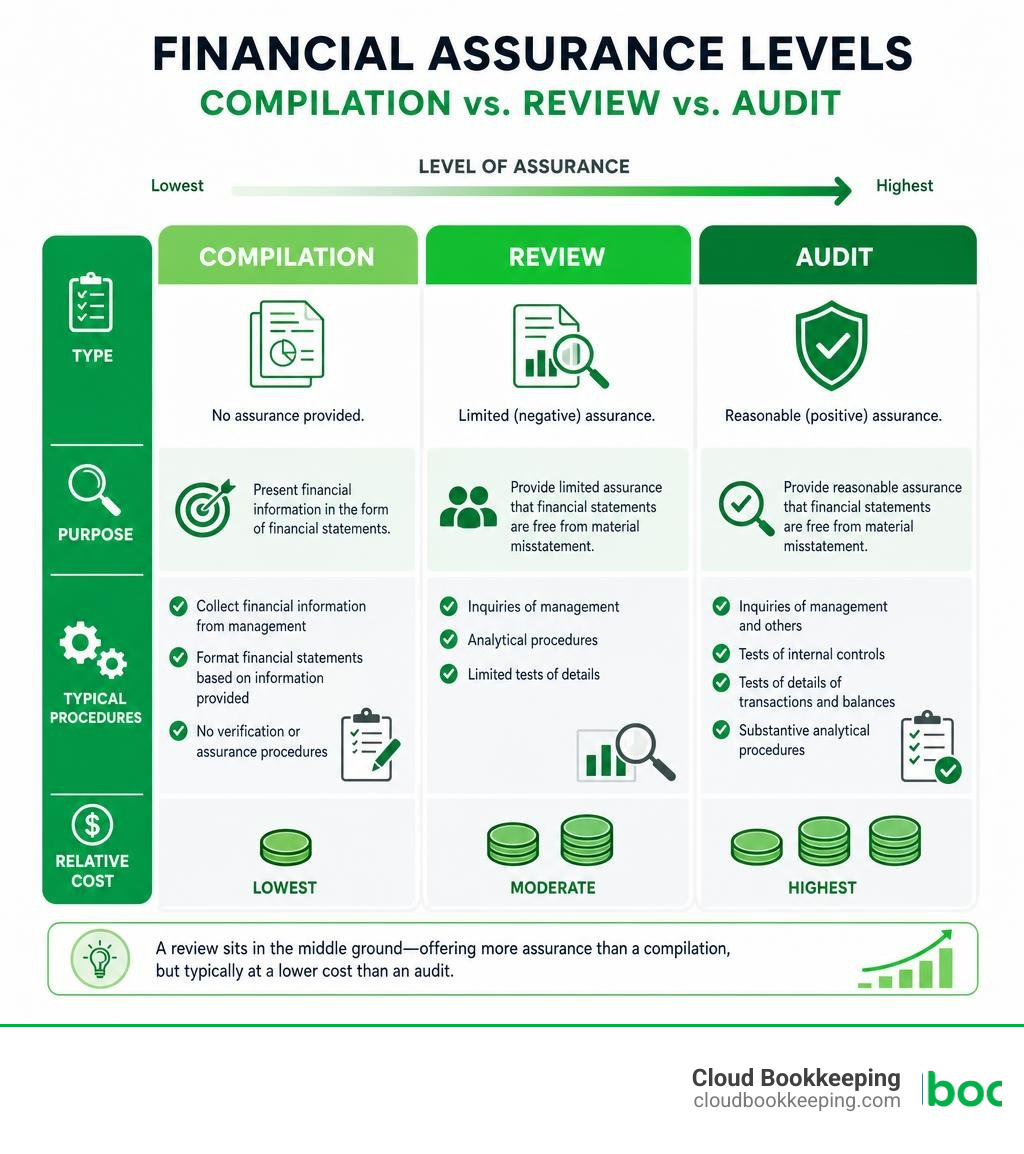
To understand where a financial statements review fits, it helps to compare the three primary levels of service a CPA can perform on your financial statements:
| Service Level | Level of Assurance | Primary Procedures | Internal Control Testing? | Relative Cost |
|---|---|---|---|---|
| Compilation | No Assurance | Formatting client data into financial statements; no testing or analysis. | No | Low (1x) |
| Review | Limited (Negative) Assurance | Analytical procedures, ratio analysis, and management inquiries. | No | Moderate (2x to 4x) |
| Audit | Reasonable (Positive) Assurance | Physical inspection, third-party confirmations, testing transactions, and internal control evaluation. | Yes | High (8x to 10x) |
All of these services are performed in accordance with standards established by the American Institute of Certified Public Accountants (AICPA). For reviews, compilations, and preparation engagements, CPAs follow the Statements on Standards for Accounting and Review Services (SSARS). Specifically, SSARS No. 21 (and subsequent updates like SSARS No. 26, which became effective for periods ending on or after December 15, 2025) outlines the rigorous professional requirements a CPA must follow.
Lenders, licensing boards, and investors establish specific third-party requirements regarding which level of service they will accept. Knowing what your stakeholders require prevents you from paying for an expensive audit when a review would have sufficed. For example, getting your financial reports in order before tax season can help you determine exactly what level of scrutiny your business needs to stay compliant with both lenders and tax authorities.
For a deeper dive into these standards, you can review the Microsoft PowerPoint – 2024 Update on Standards for Reviews, Compilation, and Preparation Engagements to see how quality management and CPA guidelines continue to evolve in 2026.
When to Choose a Review Over an Audit
Choosing a review over an audit is a highly practical business decision. An audit is incredibly invasive, requiring weeks of on-site or virtual testing, deep dives into your internal controls, and extensive verification of assets. For many privately held businesses, this level of scrutiny is simply overkill.
A review is often preferred when:
- You need a bank loan or a line of credit: Many local San Antonio banks require CPA-reviewed statements for loans up to a certain threshold (e.g., $1 million to $5 million) rather than requiring a full audit.
- You are seeking outside investors: Investors often want independent validation of your financial health but are comfortable with the limited assurance of a review.
- You are preparing for an eventual sale: Having a few consecutive years of reviewed financial statements makes your business far more attractive to potential buyers.
- You want cost savings: Because a review takes significantly less time, it allows you to allocate your resources toward growing your business rather than paying high CPA fees.
Key Procedures: How Reviews Leverage Ratio Analysis

Because a review does not involve testing individual invoices or performing physical inventory counts, the CPA must find other ways to ensure your numbers make sense. They do this primarily by leveraging financial ratio analysis and trend analysis.
When your bookkeeping is handled correctly, generating the reports needed for these analytical procedures is straightforward. Using easy-to-read financial reports lets you monitor these key ratios yourself throughout the year, so you are never surprised when the CPA begins their review.
Analytical Procedures in a Financial Statements Review
Analytical procedures are not just about comparing this year’s numbers to last year’s numbers and hoping for the best. It is a structured, four-phase process:
- Expectation Formation: Before even looking at the current year’s recorded amounts, the CPA must form an expectation of what those numbers should be. They do this based on industry trends, prior-year data adjusted for known operational changes, and non-financial metrics (such as headcount or square footage).
- Identification of Fluctuations: The CPA compares the recorded balances to their expectations to identify any unusual variances or unexpected trends.
- Inquiry of Management: If a ratio or balance deviates significantly from the expectation, the CPA will interview management to understand the business reasons behind the shift.
- Evaluation: The CPA evaluates management’s responses to determine if they are plausible and consistent with other financial data.
To make these expectations precise, CPAs often look at disaggregated data — analyzing your revenues or expenses by month, location, or product line rather than just looking at annual totals. Mastering your financial reports before year-end gives you time to identify and resolve any unusual accounting anomalies before the formal review begins.
Inquiry and Management Representations
In addition to ratio analysis, the CPA will make a series of inquiries. These inquiries cover:
- Significant or unusual transactions occurring near the end of the reporting period.
- Your company’s accounting principles and practices.
- Any subsequent events — such as a major customer bankruptcy or a pending lawsuit — that occurred after the balance sheet date but before the review report is issued.
- Inquiries regarding potential litigation, claims, or assessments.
At the conclusion of the engagement, the CPA will require management to sign a formal written representation letter. In this document, you formally state that all financial records provided are complete, accurate, and that you have disclosed all material facts to the CPA. This letter is a mandatory requirement under review standards.
Cost, Time, and Technology Considerations
In 2026, technology plays a massive role in how reviews are conducted. CPAs increasingly leverage cloud collaboration platforms, automated data ingestion, and AI-powered analytical tools to streamline the process.
For business owners, this shift toward automation means less manual document gathering and faster turnaround times. If you use modern cloud platforms, you can easily integrate your systems with advanced tools. For example, QuickBooks forecasting and projection tools can help you keep your financial data structured and easier for a CPA to review.
Budgeting and Timeline Expectations
How much does a financial statements review actually cost? While a full audit can easily run into tens of thousands of dollars, a review is highly cost-effective, typically costing between 20% and 50% of the cost of an audit.
The exact cost and timeline depend on:
- The size and complexity of your business.
- The industry you operate in (e.g., construction companies with complex contract accounting may require more time).
- The quality and organization of your underlying bookkeeping.
While public entities and school districts in Texas must adhere to rigid compliance guidelines — such as those outlined by the Texas Education Agency’s financial reporting standards — private businesses have more flexibility. Generally, a review can be completed in a matter of weeks, compared to the months-long process required for a traditional audit.
Frequently Asked Questions about Financial Ratio Analysis
What is the difference between a review and an audit?
A review provides limited (negative) assurance, stating that the CPA is not aware of any material changes that need to be made to the financial statements. It relies on analytics and inquiries. An audit provides reasonable (positive) assurance, which is the highest level of assurance. An audit requires the CPA to test transactions, evaluate internal controls, and physically verify assets.
How much does a financial statements review cost?
A review typically costs 20% to 50% of the cost of a full audit. For a typical San Antonio small business, the exact price will vary based on your annual revenue, the complexity of your transactions, and how clean your books are before the CPA begins their work.
Why do lenders prefer reviewed financial statements?
Lenders prefer reviewed financials because they carry the signature and stamp of an independent, licensed CPA. This provides a level of credibility and risk mitigation that self-prepared or compiled financial statements simply cannot offer.
Conclusion
Getting your financial statements reviewed doesn’t have to be a stressful or overly expensive process. By keeping your monthly bookkeeping clean, leveraging modern accounting technology, and understanding what CPAs look for during their analytical procedures, you can easily secure the limited assurance your lenders or investors require.
At Cloud Bookkeeping, led by Charlie Perrin right here in San Antonio, Texas, we specialize in helping small businesses keep their financial records pristine and ready for any CPA review or reporting requirement. If you are ready to take the stress out of your financial reporting, contact us today and find out how our bookkeeping services can help your business grow with confidence.