Why Retail Bookkeeping Can Make or Break Your Store
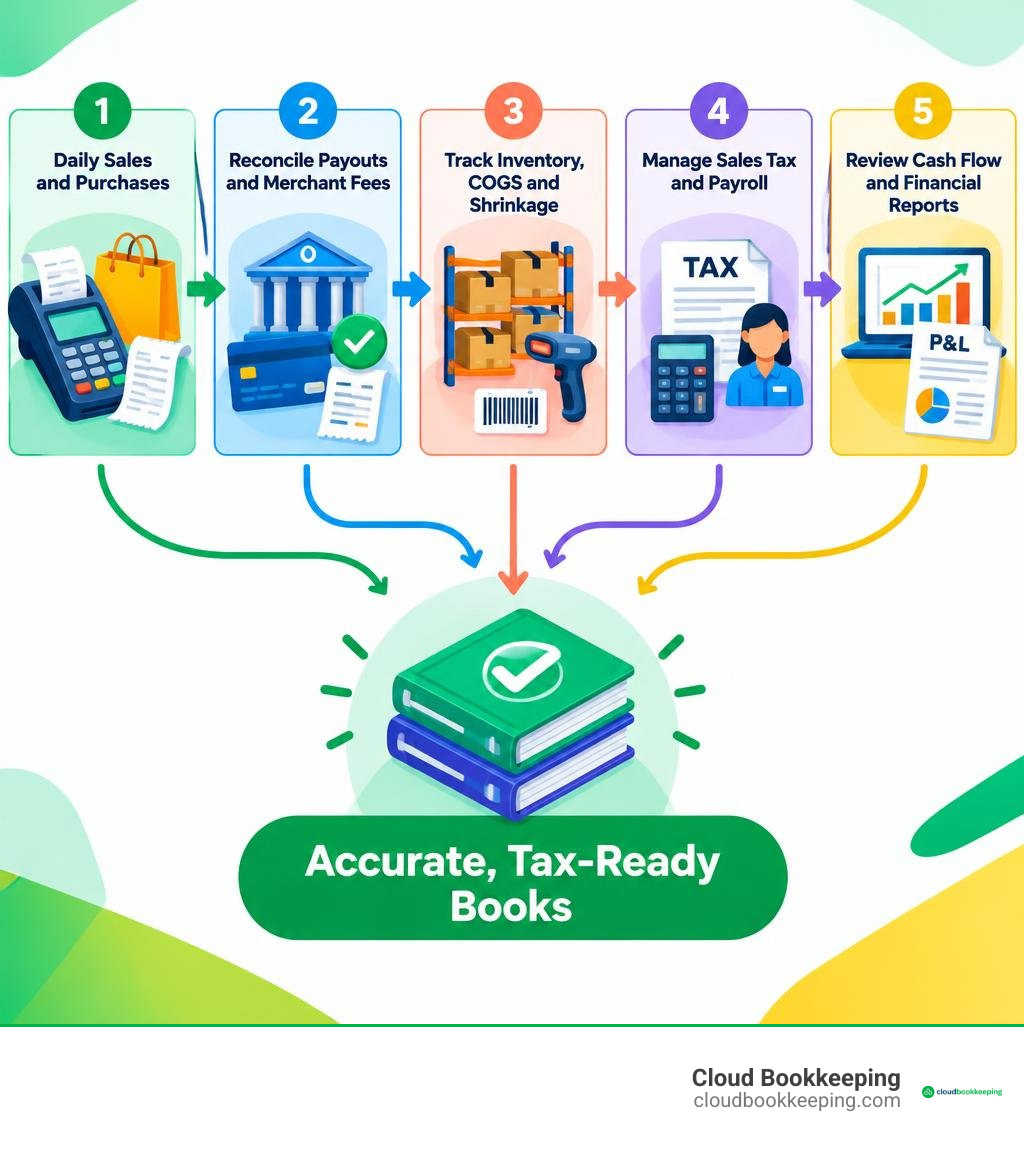
Bookkeeping for retail businesses is the process of recording, organizing, and tracking every financial transaction in your store, including daily sales and inventory purchases, payroll, sales tax, and merchant fees.
Here’s a quick snapshot of what it covers:
- Sales tracking: recording revenue from every channel (in-store, online, marketplaces)
- Inventory management: tracking stock purchases, cost of goods sold (COGS), and shrinkage
- Bank reconciliation: matching your POS deposits to your actual bank account
- Sales tax compliance: calculating and filing tax obligations by jurisdiction
- Payroll: managing wages, deductions, and contractor payments
- Financial reporting: profit & loss statements, cash flow summaries, and balance sheets
Retail is unforgiving. Tight margins, high transaction volumes, and seasonal cash flow swings leave very little room for error. As one industry principle puts it: minor errors quickly erode tight profit margins. Most retail owners are managing stock, serving customers, and chasing suppliers. The books are the last thing on their mind, until tax time hits and everything catches up at once.
That’s exactly the problem this guide is here to solve.
I’m Charlie Perrin, founder of Cloud Bookkeeping, with over 24 years of experience helping small business owners, including retailers, build clean, accurate financial systems through specialized bookkeeping. In the sections ahead, I’ll walk you through every key challenge, best practice, and tool you need to keep your retail books under control.
What is Bookkeeping for Retail Businesses and Why Does It Matter?

To understand retail bookkeeping, we first have to distinguish it from standard bookkeeping. In a service-based business, bookkeeping is relatively straightforward: you send an invoice, receive a payment, and pay your basic overhead expenses.
Retail is a completely different beast. It operates on a high-transaction-volume model with constant cash and digital exchanges. Instead of tracking five or ten large invoices a month, a retail store might process hundreds or thousands of micro-transactions daily across cash, credit cards, mobile payments, and gift cards.
Furthermore, retail bookkeeping is deeply intertwined with inventory valuation. For most retailers, inventory is their largest active asset. How you track that inventory directly impacts your profitability and tax liabilities.
Additionally, retail businesses face intense cash flow fluctuations due to seasonal variations in sales. Your bank account might look incredibly healthy in December during the holiday rush, but if you don’t account for the cash needed to restock your shelves in the slower spring months, you can easily run into a cash crunch.
Understanding these differences is crucial because the core responsibilities in small-business bookkeeping provide the financial foundation a retailer needs to manage sales, expenses, and inventory with confidence.
Key Challenges in Retail Bookkeeping

Running a storefront or an e-commerce shop in San Antonio means juggling multiple financial moving parts simultaneously. Here are the most common hurdles retail owners face:
- POS Reconciliation: Your Point of Sale (POS) system records the gross sales, but the amount deposited into your bank account is almost always less. Why? Because merchant processors deduct their credit card fees before the money hits your account. If you don’t reconcile gross sales against net bank deposits, your revenue numbers will be inflated, and your merchant fees will go unrecorded.
- Multi-Channel Sales: If you sell in-person at your brick-and-mortar boutique, online through Shopify, and occasionally on Amazon, you have multiple streams of financial data flowing in on completely different payout schedules.
- Sales Tax Compliance: In Texas, retail businesses are responsible for collecting and filing state and local sales tax. With varying local tax rates across different municipalities, keeping these liabilities separated from your operating cash is vital.
- Inventory Shrinkage: Theft, damaged items, and administrative errors mean your physical stock rarely matches your digital records perfectly. Failing to adjust for shrinkage leads to inaccurate asset values on your balance sheet.
Managing Inventory and Cost of Goods Sold (COGS)
Inventory tracking is where retail bookkeeping gets highly technical. To understand your true profitability, you must accurately calculate your Cost of Goods Sold (COGS). This isn’t just what you paid for the items currently sitting on your shelves; it is the cost of the inventory you actually sold during a specific period.
There are three primary methods used for inventory valuation:
- FIFO (First-In, First-Out): Assumes that the oldest inventory items are sold first. This is highly common and generally reflects the physical flow of goods for most retailers.
- LIFO (Last-In, First-Out): Assumes the newest stock is sold first. This is rarely used in modern small retail, but it can occasionally offer tax advantages in highly inflationary environments.
- Average Cost Method: Calculates a weighted average cost of all similar items in stock. This is excellent for retailers selling high volumes of identical, low-cost items.
Beyond the wholesale cost of the items, your inventory valuation must also account for freight-in costs (the shipping fees you pay to get the inventory to your store). These costs should be factored into your inventory asset value rather than immediately expensed as a regular operating cost.
Finally, regular shrinkage adjustments are necessary. Retail businesses that implement robust inventory management and bookkeeping practices can reduce inventory discrepancies by up to 25%. We recommend conducting physical inventory counts at least once or twice a year to reconcile your actual physical stock with your bookkeeping records and adjust your COGS accordingly.
Reconciling Multi-Channel Sales and POS Systems
Modern retail requires an omnichannel approach. You might use Square or Clover for your physical storefront, Shopify for your e-commerce platform, and offer Buy Now, Pay Later (BNPL) options like Afterpay or Klarna.
Reconciling these platforms is a major headache. BNPL platforms, for example, pay out on a delay and deduct heavy transaction fees upfront. If you simply record the net deposits hitting your bank account as your revenue, you are underreporting your actual sales and failing to track your merchant fee expenses.
To keep your books accurate, your bookkeeping system must pull daily sales summaries directly from your POS and e-commerce platforms, separate gross revenue from processing fees, and map delayed payouts to a clearing account until they clear your bank. Retailers that need hands-on help maintaining this process can benefit from bookkeeping services for small businesses.
Best Practices for Bookkeeping for Retail Businesses
To keep your retail business profitable and stress-free, we recommend establishing a few non-negotiable bookkeeping habits:
At Cloud Bookkeeping, led by local San Antonio expert Charlie Perrin, we provide bookkeeping support tailored to the needs of retail businesses. Clear financial reporting and deep QuickBooks expertise can help reduce profit leaks, streamline inventory tracking, and keep your books tax-ready.
- Separate Business and Personal Expenses: Never buy store inventory with your personal credit card, and never buy personal groceries with the business account. Keeping these completely separate protects your liability and makes tax season a breeze.
- Automate Your Bookkeeping: Connect your bank accounts, credit cards, and POS systems directly to your accounting software so transactions flow in automatically.
- Monitor Cash Flow Closely: Because retail relies on upfront cash to buy inventory before making a profit, tracking cash flow is your lifeline.
- Reconcile Regularly: Do not wait until the end of the year to look at your bank statements.
These habits become easier to sustain when they are part of a consistent routine, as outlined in these bookkeeping tips for small businesses.
Implementing Monthly Bookkeeping for Retail Businesses
The secret to a stress-free tax season is a structured monthly close process. Waiting until April to sort through twelve months of retail transactions is a recipe for missed deductions and massive tax penalties.
A standard monthly bookkeeping routine for a retailer should include:
- Reconciling all bank and credit card accounts.
- Matching daily POS reports with actual bank deposits.
- Adjusting inventory balances and recording monthly COGS.
- Filing state and local sales tax returns.
- Reviewing key financial statements (Profit & Loss, Balance Sheet, and Cash Flow).
By staying on top of your financial records month to month, you keep your books tax-ready. A documented monthly bookkeeping process also makes it easier to spot discrepancies before they affect reporting or cash flow.
Choosing the Right Retail Accounting Software
For retail businesses with high transaction volumes and inventory to track, QuickBooks Online can provide a practical cloud-based foundation. Its integrations and reporting tools can help bring sales, expenses, and inventory-related activity into a more consistent bookkeeping workflow.
Key QuickBooks Online capabilities for retail businesses include:
| QuickBooks Online capability | Why it matters for retail bookkeeping |
|---|---|
| POS integrations | Connects with tools such as Square, Clover, Shopify, and Lightspeed to help centralize sales activity. |
| Inventory tracking | Supports inventory management features that can help retailers monitor stock and cost of goods sold. |
| Reporting | Provides profit and loss, balance sheet, and cash flow reports for regular financial review. |
| Payroll options | Offers payroll tools that can support a more connected bookkeeping process. |
A retail-ready chart of accounts and a consistent workflow are easier to establish with a practical QuickBooks bookkeeping guide.
Frequently Asked Questions about Retail Bookkeeping
How often should a retail business reconcile its bank accounts?
While standard small businesses can get away with reconciling their bank accounts once a month, retail businesses should aim for weekly or even daily reconciliations.
Because of the sheer volume of daily transactions, credit card batches, and cash deposits, catching a discrepancy early is much easier than trying to track down a missing $50 deposit from three weeks ago. During high-volume sales periods, such as the holiday shopping season, daily reconciliation is highly recommended to catch merchant processing errors, cash register shortages, or POS sync failures immediately.
What is the difference between tax bookkeeping and operational bookkeeping?
Tax bookkeeping is purely reactive. It is built for compliance, meeting IRS deadlines, and filing your annual returns. While necessary, tax-only bookkeeping does not help you run your business day-to-day.
Operational bookkeeping, on the other hand, is proactive. It provides real-time financial data, allowing you to monitor your true profit margins, track inventory turnover, manage overhead costs, and make informed hiring or purchasing decisions. To understand how to leverage these operational insights for your store, read our guide on The Power of Proper Bookkeeping: How to Manage Key Financial Metrics.
When should a retail store outsource its bookkeeping?
Many retail owners start out handling their own books using basic spreadsheets or entry-level software. However, as your business grows, bookkeeping quickly becomes a time sink that takes you away from managing your team and serving customers.
You should consider outsourcing your retail bookkeeping if:
- You are managing multi-channel sales (e.g., brick-and-mortar plus Shopify).
- Your inventory values are constantly fluctuating, and you struggle to calculate COGS.
- You are falling behind on sales tax filings or bank reconciliations.
- You want to scale your business but lack the clean financial reports needed to secure a business loan.
Outsourced retail bookkeeping services can be tailored to the complexity of your store, from straightforward monthly reconciliation to deeper support for multi-channel sales, inventory reporting, and financial planning.
Conclusion: Let Us Take the Burden Off Your Shoulders
Managing a retail store is a full-time job. Between managing staff, curated collections, customer service, and local marketing in San Antonio, you shouldn’t have to spend your late nights staring at spreadsheets and trying to force your POS system to reconcile with your bank account.
Ready to take control of your store’s finances without losing your mind? Explore our professional bookkeeping services today and schedule a consultation with our San Antonio team.