Core Differences: Choosing Between a Bookkeeper or Accountant
Understanding the boundary between a bookkeeper or accountant begins with recognizing how data moves through a business. Bookkeepers lay the groundwork by capturing, categorizing, and organizing daily transactional financial information. Accountants step in to interpret those financial records, turning transactional data into strategic business insight, tax strategy, and audit compliance.
While both professionals work with financial numbers, their day-to-day focus serves two distinct objectives:
- Bookkeeping focuses on accuracy, data entry, transactional integrity, and ongoing recordkeeping.
- Accounting focuses on financial analysis, structural planning, regulatory reporting, tax minimization, and forecasting.
As a general rule, bookkeeping generates financial data, while accounting translates that data into strategic financial intelligence. You can learn more about how these roles contrast in our detailed breakdown of bookkeeper vs accountant functions.
| Task Category | Bookkeeper Focus | Accountant Focus |
|---|---|---|
| Primary Goal | Record daily transactions and balance ledgers | Interpret financial reports and offer strategic counsel |
| Main Output | Organized general ledger and trial balance | Financial statements, tax returns, and forecasts |
| Key Deliverables | Invoices, receipts, payroll, bank reconciliations | Tax strategies, audit reports, budget projections |
| Time Horizon | Present and historical recordkeeping | Future projections, tax planning, and strategic scaling |
| Required License | Certifications optional (AIPB, NACPB) | Bachelor’s degree minimum; CPA license for public reporting |
Daily Responsibilities of a Bookkeeper
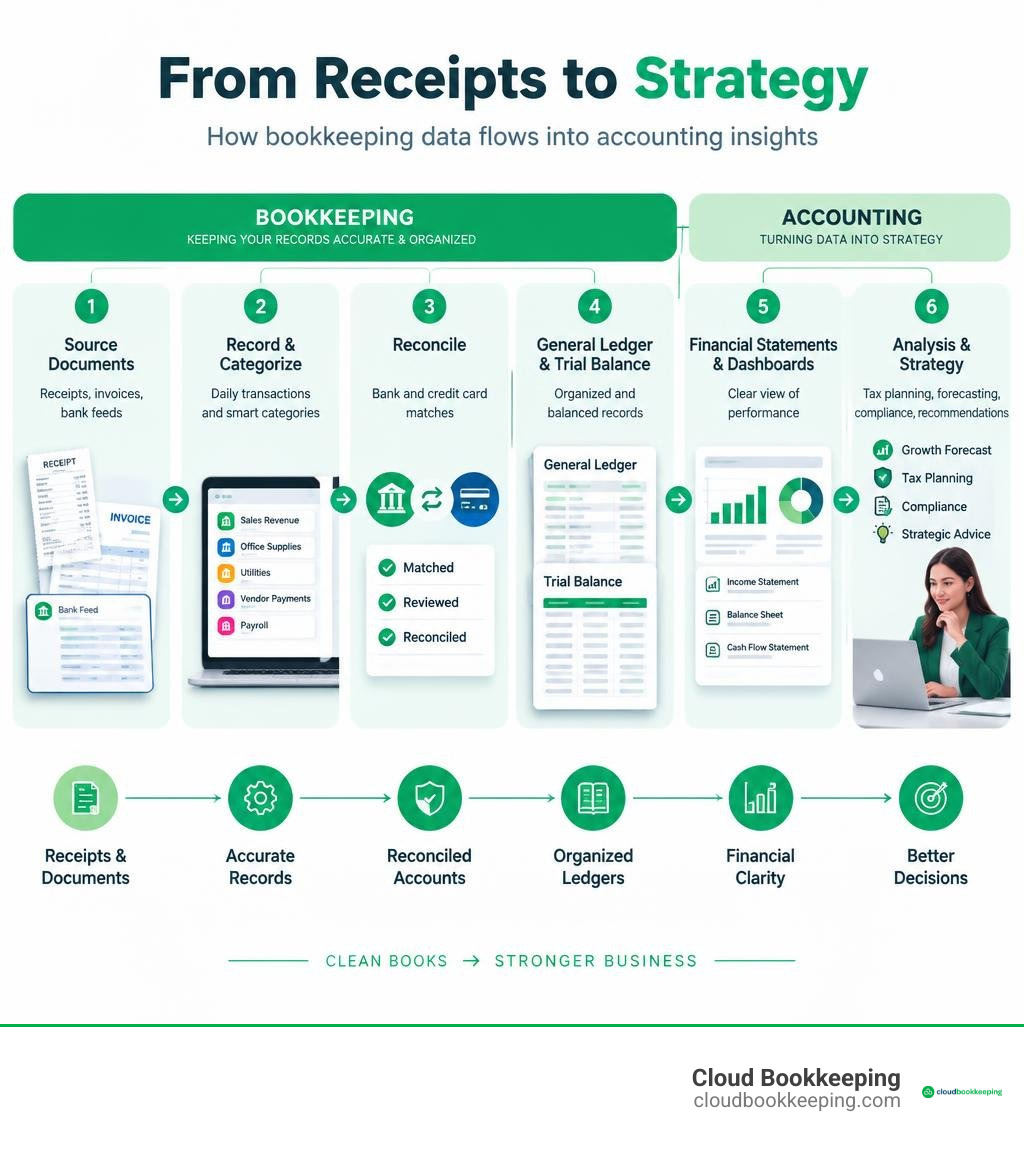
A bookkeeper manages the administrative pulse of your business’s day-to-day operations. Without clean bookkeeping, financial statements become inaccurate, making it difficult to understand where your cash flow stands at any given moment.
Typical daily and monthly tasks performed by a bookkeeper include:
- General ledger maintenance: Documenting everyday business receipts, expenses, sales revenue, and vendor payments.
- Bank and credit card reconciliations: Matching bank account statements against internal ledger records to eliminate discrepancies.
- Accounts payable (AP): Reviewing incoming bills, managing vendor accounts, and making timely disbursements.
- Accounts receivable (AR): Generating customer invoices, processing payments, and tracking past-due accounts.
- Payroll management: Calculating wage distributions, tracking payroll deductions, and ensuring timely payroll runs.
When you evaluate what a bookkeeper does for a small business, their key value lies in keeping financial records current and organized so business owners can make sound operational choices.
Strategic Duties Exclusive to an Accountant
While bookkeepers handle ongoing transactional administration, accountants handle strategic and regulatory duties that demand deeper technical knowledge and professional licensure.
Functions exclusively handled by qualified accountants and CPAs include:
- Tax planning and advisory: Designing long-term strategies to legally minimize corporate tax liability and take full advantage of credits and deductions.
- Formal audit preparation and execution: Conducting thorough internal audits and issuing verified, audited financial statements.
- IRS audit representation: Formally representing clients before state or federal tax authorities during official audits (a power limited legally to CPAs, enrolled agents, and tax attorneys).
- Financial forecasting and modeling: Analyzing historical revenue patterns to build complex growth models, risk assessments, and capital allocation plans.
Understanding this division resolves the debate between bookkeeping vs accounting: bookkeepers maintain the financial foundation, while accountants build the strategic roadmap on top of it.
Credentials, Compensation, and Career Outlook
Both bookkeeping and accounting offer viable career options within the financial services industry, but they differ significantly in required education, average earning potential, and long-term job projections.
For regional education and career statistics, resources like the state guide on bookkeeping, accounting, and auditing clerks outline regional baseline metrics.
Qualifications Needed for a Bookkeeper or Accountant
The educational path and certification requirements diverge substantially between the two roles:
- Bookkeeper Qualifications:
- Education: A high school diploma or associate degree in accounting or business administration is typical.
- Professional Certifications: Optional credentials include certifications from the American Institute of Professional Bookkeepers (AIPB) or National Association of Certified Public Bookkeepers (NACPB), which require passing national exams and completing 2,000 hours of practical work experience. Software designations, like becoming a QuickBooks ProAdvisor or Xero Certified professional, are also widely recognized.
- Accountant Qualifications:
- Education: A bachelor’s degree in accounting or finance is required for entry-level positions.
- Professional Licensure: Becoming a Certified Public Accountant (CPA) requires completing 150 college credit hours, passing the uniform CPA exam, and fulfilling state licensing board experience requirements.
- Academic Mobility: Up to 76% of associate degree accounting credits can transfer toward a bachelor’s degree in accounting, allowing bookkeepers to upgrade their qualifications over time.
Salary Differences and 10-Year Growth Trends
Compensation and market expansion reflect the higher technical barriers to entry in accounting:
- Bookkeeper Compensation: According to baseline industry metrics, bookkeepers earn a median annual salary of $42,411, with national average wage data from 2023 recording $47,440 per year ($22.81 per hour).
- Accountant Compensation: Accountants earn a median annual salary of $73,570, a 73% salary premium over bookkeepers. In 2023, the median salary for accountants reached $79,880 per year ($38.41 per hour).
- 10-Year Job Growth Trends: Driven by advancements in accounting software automation that reduce manual data entry, job demand for pure bookkeeping roles is projected to contract by 1.9% over the next decade. Conversely, job growth for accountants is projected to expand by 6.1% over the same period, reflecting rising corporate governance needs and complex international tax codes.
Hiring Strategy for Small Business Financial Health
Selecting whether to engage a bookkeeper or accountant depends on your current business stage, transaction volume, and administrative burden.
Signs Your Business Needs a Bookkeeper or Accountant

Recognizing when your internal operations require outside financial management prevents operational bottlenecks and costly year-end surprises.
Key indicators that you need a bookkeeper:
- Transaction volumes have grown too large to manage single-handedly.
- Bank accounts are several months behind on reconciliations.
- Invoices are sent late or customer unpaid balances are mounting.
- You spend weekends catching up on receipts and payroll instead of growing your business.
Key indicators that you need an accountant:
- Your business is undergoing rapid revenue growth or adding new product lines.
- You face complex tax obligations, multi-state sales tax rules, or corporate restructuring.
- You need investor-ready financial reports, balance sheets, and cash flow projections.
- You require formal legal representation for an IRS query or state tax audit.
Reviewing how both financial roles support cash flow highlights how deploying both professionals at the right times protects cash flow while positioning you for strategic growth.
Outsourcing Financial Services for Growth
For many growing small businesses, hiring full-time in-house financial personnel adds unnecessary overhead. Outsourcing allows business owners to access skilled financial expertise through Cloud Bookkeeping’s software support at a fraction of the cost of a full-time employee salary and benefits package.
Key benefits of outsourcing your bookkeeping and accounting functions include:
- Lower operational overhead: Pay only for the specific hours or services you require without full-time payroll commitments.
- Improved financial accuracy: Reduce administrative errors that lead to tax penalties, overpaid expenses, or lost revenue opportunities.
- Scalable support: Adjust service levels seamlessly as your transactional volume grows.
- Focus on core competency: Delegate routine financial management so you can focus on sales, customer service, and business strategy.
Exploring the top reasons to invest in outsourced bookkeeping services will give you a clearer view of how remote financial services support long-term stability.
Frequently Asked Questions About Financial Roles
Can a bookkeeper perform an audit or sign tax returns?
No. A bookkeeper cannot conduct independent financial audits, issue audited financial statements, or represent clients before the IRS during a formal audit. Legally, representation rights before the IRS are restricted to licensed CPAs, enrolled agents (EAs), and tax attorneys. While bookkeepers can assist in assembling underlying transaction records, official tax filings and attestations require an accountant or certified tax professional.
How are cloud accounting tools changing both roles?
Cloud accounting applications like QuickBooks Online and Xero automate repetitive data entry, automated bank feeds, and invoice generation. As routine clerical entry decreases, the role of modern bookkeepers has evolved toward full-charge bookkeeping, cash flow monitoring, software integration, and financial oversight. For accountants, cloud platforms deliver real-time ledgers, allowing them to provide proactive tax advice and strategic forecasting throughout the year rather than relying solely on static year-end reviews.
Should a small business hire a bookkeeper and accountant together?
Yes, combining both roles often creates the most cost-effective solution for small businesses. Utilizing a bookkeeper for daily recordkeeping, payroll, and monthly reconciliations keeps ongoing operational costs manageable. When tax season arrives, your accountant receives clean, audited general ledger data, dramatically reducing billable CPA hours. This collaborative workflow provides clean day-to-day accounts alongside high-level tax planning.
Conclusion
Choosing between a bookkeeper or accountant does not have to be an all-or-nothing proposition. Bookkeepers deliver the daily precision, ledger organization, and payment tracking needed to keep your business running smoothly. Accountants provide the strategic analysis, tax planning, and compliance protection needed to build scalable wealth and protect your assets.
At Cloud Bookkeeping, led by Charlie Perrin in San Antonio, Texas, we help small business owners establish clear, dependable financial foundations. Whether you need routine transactional maintenance, software optimization, or organized records ready for tax season, our team delivers the personalized service you deserve. Explore our professional bookkeeping services today to bring clarity, accuracy, and peace of mind back to your business finances.