Why creating an advisory board for a small business could be your best growth decision
Creating an advisory board for a small business is one of the highest-leverage moves you can make as an owner, and it costs far less in legal complexity than most people think.
Here’s the short version of what you need to know:
- An advisory board is a small group of outside experts, typically 3 to 7 people, who give you strategic guidance, honest feedback, and industry connections.
- It is not a board of directors. Advisors have no legal authority, no fiduciary duties, and no voting power over your business.
- You stay in control. Advisors consult. You decide.
- You can start small. Even 2 to 3 well-chosen advisors can fill critical skill gaps you can’t afford to hire for full-time.
- Compensation is flexible. Equity, small stipends, or even service trades all work, especially at the early stage.
Most small business owners are running on instinct, a tight team, and sheer determination. That works until it doesn’t. At some point, the decisions get harder, the stakes get higher, and the expertise you need isn’t sitting inside your four walls.
Over 80% of organizations that establish an advisory board are doing it for the first time. So if this feels unfamiliar, you’re in good company.
At Cloud Bookkeeping, our team has worked directly with small business owners on financial strategy, profitability, and clear reporting for years. That practical experience shapes how we approach creating an advisory board for a small business and what we recommend in this guide.
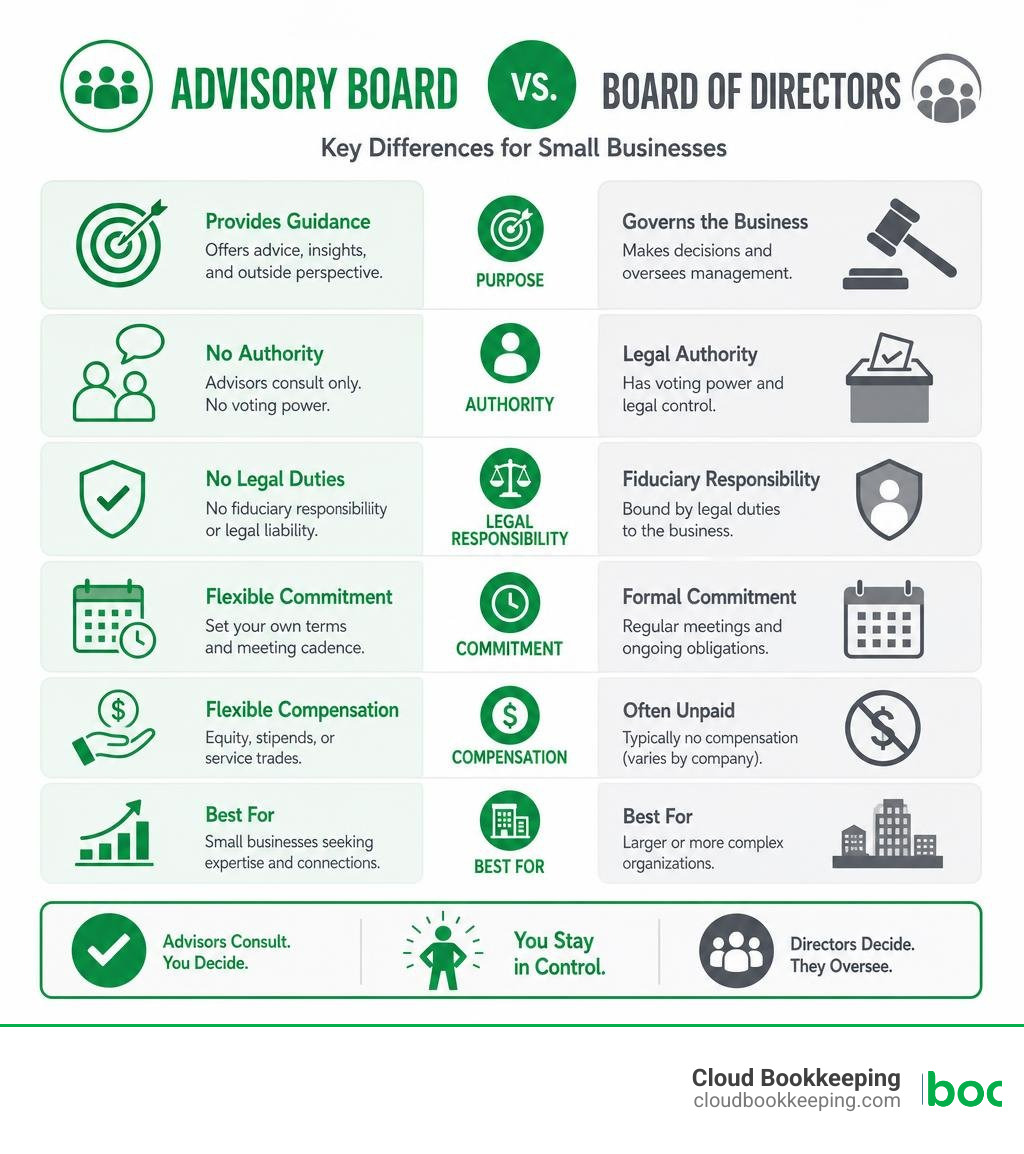
Board of directors vs. advisory board: key differences
To understand why an advisory board is so valuable for a small business, we first have to clear up a major point of confusion: the difference between an advisory board and a formal board of directors.
Many business owners think they need a formal board of directors when what they actually want is a strategic, flexible sounding board. If you establish the wrong one, you could end up giving away control of your own company.
Here is how the two structures break down across five critical dimensions:
1. Fiduciary duty and legal liability
A board of directors is a formal, legally mandated governing body. Its members have a strict fiduciary duty to the company’s shareholders. If they make negligent decisions, they can be sued.
An advisory board has no legal or fiduciary liability. Because they do not make binding corporate decisions, advisors carry minimal legal exposure and do not require the expensive Directors and Officers (D&O) liability insurance that formal boards require.
2. Decision-making authority
This is the big one. A board of directors has the legal power to vote on major business decisions, approve budgets, issue stock, and even hire or fire the CEO, which could include you as the founder.
An advisory board has exactly zero formal authority. They cannot vote on your business operations, and they cannot override your decisions. They exist purely to provide guidance. You maintain 100% of the control.
3. Governance vs. guidance
A board of directors is built for governance and compliance. They ensure the business complies with laws, protects shareholder interests, and operates within strict regulatory bounds.
An advisory board is built for guidance, growth, and mentorship. Their job isn’t to police you; it’s to help you solve problems, open doors, and scale.
To help you visualize these differences at a glance, we’ve broken them down in the table below:
| Feature | Board of directors | Advisory board |
|---|---|---|
| Primary role | Governance, compliance, and oversight | Strategic guidance, mentorship, and support |
| Legal authority | Votes on binding corporate decisions | None; recommendations are strictly non-binding |
| Fiduciary duty | Yes, legally liable to shareholders | No legal or fiduciary liability |
| Authority over CEO | Can hire, evaluate, and fire the CEO | None; serves at the pleasure of the owner |
| Typical structure | Highly rigid, regulated, and formal | Flexible, informal, and highly adaptable |
| Compensation | High cash fees, significant equity, D&O insurance | Equity, small stipends, or pro-bono |
If you are looking to scale your business without the heavy legal and financial overhead of a corporate board, an advisory board is the most practical path forward. It gives you the brainpower of a corporate giant while keeping your small business agile and entirely yours.
The strategic benefits of creating an advisory board for small business
When you are the boss, “isolation” is an occupational hazard. You have to be the visionary, the operator, the HR manager, and the financial strategist all at once. By creating an advisory board for a small business, you instantly surround yourself with a fractional executive team that can accelerate your growth in several key ways:
1. Access to specialized expertise
As a small business owner, you cannot possibly be an expert in everything. You might have a brilliant product or service, but lack experience in enterprise sales, international expansion, digital marketing, or complex tax strategies.
For example, having an advisor with deep financial expertise is critical when navigating complex tax laws. Our team often collaborates with business advisors to show the role of financial advisory in tax planning, ensuring that your growth strategies are fully aligned with smart, tax-efficient financial structures.
2. An objective, external perspective
Your employees want to please you. Your spouse wants to comfort you. Neither of them can give you completely unbiased, objective feedback on your business model.
Independent advisors have no emotional attachment to your business. They can look at your operations, your cash flow, and your long-term goals with fresh eyes, pointing out blind spots and challenging your assumptions before they turn into costly mistakes.
3. Risk management and credibility
If you are planning to raise capital, secure a commercial loan, or land major enterprise clients, credibility is your primary currency. Having highly respected industry veterans on your advisory board acts as a strong credibility signal.
Investors and banks are far more comfortable backing a business when they see that seasoned professionals are actively guiding the leadership team.
4. Succession and legacy planning
Many family-owned businesses struggle with what happens next. In fact, a recent family business survey revealed that 52.7% of family business owners plan to transfer their business to another family member when they are ready to leave. Yet 45.9% of respondents indicated that they do not have a management succession plan in place.
An independent advisory board acts as an objective, diplomatic bridge during these transitions. They can help prepare the next generation, mediate family disagreements, and ensure the business remains profitable throughout the leadership handoff.
Determining the right time and mapping your skill gaps
How do you know when your business is actually ready for an advisory board?
Many owners assume they need to reach a certain revenue milestone first. While organizations commonly establish advisory boards when they reach a meaningful growth stage, the decision should actually be based on your strategic needs and mentality, not just your balance sheet.
You are ready for an advisory board if:
- You have hit a growth plateau: You’ve built a solid business, but you don’t know how to scale to the next level.
- You are facing make-or-break decisions: You are considering a major pivot, entering a new market, launching a new product line, or planning an acquisition.
- You have reached your personal capacity limit: You are spending all your time working in the business instead of on the business, and you need structured external accountability to step back.
Before you bring anyone on, you must get your financial house in order. If your books are a mess, your advisors won’t be able to give you accurate strategic advice. That is why financial management should be a top priority before you begin recruiting outside help. Clear, organized financial reporting is the foundation upon which all great strategic advice is built.
Mapping your gaps before creating an advisory board for small business
A common and critical mistake when creating an advisory board for a small business is starting with who you want on the board rather than what gaps you need to fill. Do not just recruit your friends, your attorney, or big names who have no practical relevance to your current challenges.
Instead, perform a structured skills gap analysis using a simple framework:
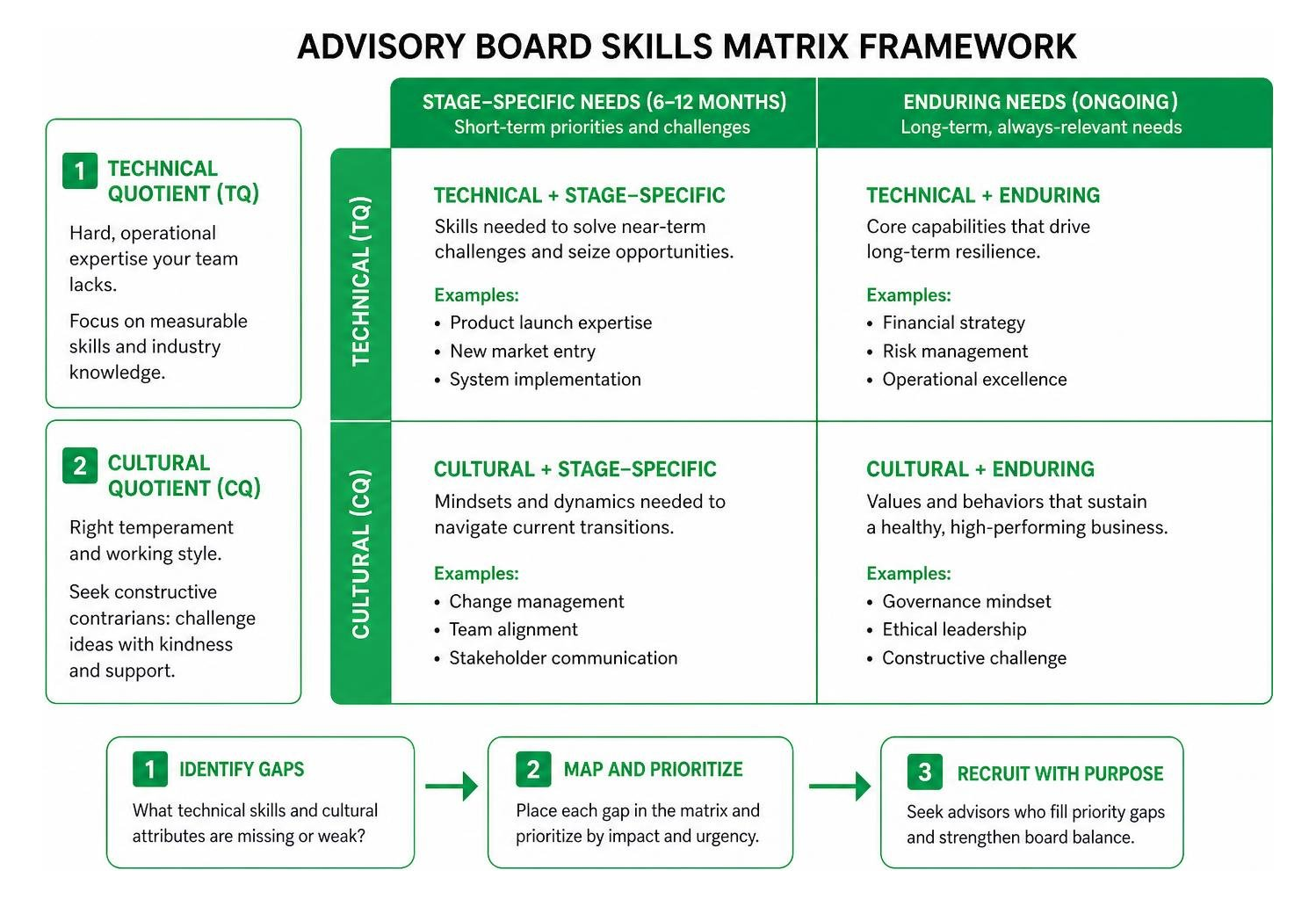
- Identify the Technical Quotient (TQ): What hard, operational skills are completely missing from your team? Do you need someone who has scaled a B2B sales team? Someone who understands regulatory compliance in healthcare? Or someone with deep experience in franchise operations?
- Evaluate the Cultural Quotient (CQ): Your advisors must have the right temperament. You want constructive contrarians: people who are secure enough to challenge your ideas, but collaborative enough to do it with kindness and a supportive mindset. Avoid yes-men at all costs; they are the most expensive free resource you will ever hire.
- Separate stage-specific vs. enduring needs: Use a simple matrix to map out what you need in the next several months, such as navigating a software launch, versus what your business will always need, such as long-term financial strategy and risk management.
Step-by-step guide to recruiting and structuring your board
Once you have mapped out your skill gaps and know exactly what profiles you need, it is time to build your target list and start recruiting.
1. Build your target list
Aim to identify candidates who fit your target profiles. Look for operators who have successfully overcome the exact obstacles you are currently facing, rather than retired corporate executives who have never run a lean, resource-constrained small business.
2. Leverage LinkedIn and warm introductions
Do not post a public job opening for board members. Instead, use highly targeted search queries on LinkedIn to find professionals with the exact operational backgrounds you need.
Look for mutual connections who can provide a warm, double-opt-in introduction. If you have to send a cold message, keep it brief. Focus on a specific hook, explain your business challenge, and ask for a brief, low-commitment call to get their perspective.
3. Use a trial period
Before signing a formal agreement, treat your first few meetings as office hours or a small consulting project. This allows you to test your personal chemistry, evaluate their problem-solving style, and ensure they actually have the time and passion to commit to your business.
4. Structure the compensation
While some advisors work pro-bono out of a desire to mentor, professional advisors expect to be compensated for their time and preparation.
- Equity compensation: For early-stage or high-growth businesses, offering a small equity stake is one way to align incentives. Use a written advisor agreement and professional guidance to decide whether equity makes sense for your structure.
- Cash compensation: For established, bootstrapped small businesses that do not want to dilute their ownership, you can offer an annual stipend or simple per-meeting fees without naming specific dollar amounts in the article.
Best practices for creating an advisory board for small business
To ensure your board remains highly effective and doesn’t devolve into an expensive, unproductive distraction, build it around these proven operational frameworks:
- Keep the board small: The sweet spot for a small business advisory board is a small, focused group of members with distinct expertise. If you expand too far beyond that, collaboration drops significantly, and the meeting coordination overhead can quickly eat up the board’s value.
- Hold 1-on-1 meetings instead of group meetings: While a formal board of directors meets as a group, early-stage small businesses often get far more value from focused individual sessions with advisors. Group meetings can easily lead to posturing, surface-level discussions, and lost focus.
- Implement the 88/12 Rule: When you do hold meetings, you are paying for their expertise, not yours. The 88/12 Rule means independent advisors should do most of the talking while management spends only a small share of the time presenting.
- Draft an advisory board charter: This is a simple, non-binding document that outlines the board’s scope, meeting cadence, roles, term limits, and conflict of interest guidelines. It ensures absolute clarity of expectations from day one.
Strong advisory board conversations depend on clean numbers, current reports, and a bookkeeping process your team can trust. Cloud Bookkeeping supports owners with professional bookkeeping and advisory services that make it easier to prepare accurate financial reports before those strategic meetings.
If your internal financial process still feels reactive, improving the way you capture, review, and use financial data can make advisor recommendations much more actionable. Our guide to better financial management for small businesses explains how better bookkeeping support can help owners make decisions with more confidence.
Managing, measuring, and offboarding board members
An advisory board is only as good as its management. If you don’t keep your advisors engaged and accountable, your board will quickly become ornamental: names on your website that provide zero actual value.
1. Avoid the reporting trap
The most common mistake small business owners make is turning advisory meetings into historical reporting sessions. Do not spend your limited time reading slides about what happened last quarter. Your advisors are not here to look backward; they are here to look forward. Send out your financial reports and operational updates in advance, and spend the entire meeting collaborating on your top forward-looking strategic challenges.
2. Track advisor value with a commitment log
Keep a simple, central log of every commitment, introduction, and piece of advice your advisors offer.
- Did they make the introduction they promised?
- Did you implement the marketing strategy they suggested?
- What were the actual results?
This keeps both you and your advisors accountable and gives you a clear picture of each member’s return on investment (ROI).
3. Graceful offboarding and member rotation
Your business will look completely different in a couple of years than it does today. The advisor who helped you through one growth stage might not have the expertise to help you through the next one.
To prevent awkward conversations, write term limits into your advisory agreements. When the term is up, you have a natural, built-in opportunity to either renew the relationship or part ways gracefully with a heartfelt thank-you and an honest conversation about your shifting strategic needs.
Advisory boards work best when the owner can bring timely, organized financial information to every discussion. If you want to understand how stronger bookkeeping support affects day-to-day growth decisions, this breakdown of how bookkeeping services help businesses grow connects consistent reporting with better planning, cash flow visibility, and advisor-ready conversations.
Frequently asked questions about advisory boards
How much do you pay advisory board members?
Compensation varies based on your stage of business, cash flow, and the advisor’s expected level of involvement. For early-stage startups, equity that vests over time may be appropriate. For established small businesses, owners often use an annual retainer, a per-meeting fee, or alternative compensation like service trades. The right structure should reflect your budget, your advisor’s contribution, and your long-term ownership goals.
What legal agreements are required for an advisory board?
At a minimum, you should have three documents in place:
- A Non-Disclosure/Confidentiality Agreement (NDA): To protect your sensitive financial data, trade secrets, and intellectual property.
- An Advisory Board Charter: To outline the scope of the board, meeting cadence, and code of conduct.
- An Advisor Agreement: To formalize their term limit, compensation, and explicitly state that they have no fiduciary duties or legal authority over the company.
Can investors serve on a small business advisory board?
Yes, but you must proceed with caution. While investors often have great networks and a vested interest in your success, they also have a financial conflict of interest. They are looking out for their investment first. To maintain balanced counsel, ensure that your independent, non-investor advisors always outnumber your investor advisors.
Conclusion: build your strategic sounding board today
Creating an advisory board for a small business is one of the most powerful steps you can take to step out of entrepreneurial isolation, protect your business from risk, and unlock meaningful enterprise value. It gives you access to high-level expertise that you could never afford to hire full-time, all while keeping you in complete control of your company’s destiny.
But remember: you cannot build a successful strategy on top of messy financials.
At Cloud Bookkeeping, our San Antonio-based team provides accurate, clear, and reliable financial reporting to help you run your business and your advisory board meetings with confidence.
If you are ready to get your books in order and build a solid financial foundation for your business’s next growth chapter, contact our professional bookkeeping and advisory specialists today. Let’s build something incredible together.