Find the Best Inventory Management Software for Your Business
The best inventory management software is the one that matches your sales channels, number of locations, SKU complexity, and accounting system without creating more work for your team. Start by shortlisting tools that offer:
- Real-time stock updates across every location and sales channel.
- Barcode or QR scanning to reduce manual entry errors.
- Low-stock alerts and reorder rules based on supplier lead times.
- Two-way integration with your accounting platform and e-commerce store.
- Reporting for inventory value, cost of goods sold, stock turnover, and dead stock.
If you still run inventory in spreadsheets, this choice matters more than it may seem. Research suggests that 43% of companies still rely on spreadsheets for inventory visibility, while inaccurate planning contributes to more than $1.8 trillion in global losses. A dedicated system gives you one reliable record of what you have, where it is, what it costs, and when to reorder it.
That does not mean every business needs a complex ERP. A small contractor may need a simple mobile app for tools and materials. A growing retailer may need multichannel order syncing. A manufacturer may need bills of materials, lot tracking, and production planning. This guide compares the leading options so you can focus on the features that solve your actual problems and skip the ones you will never use.
I am Charlie Perrin, founder of Cloud Bookkeeping, and I have spent more than 24 years helping small businesses build clearer financial systems and use tools such as QuickBooks to understand their numbers. Choosing the best inventory management software is often a key part of that work because clean inventory data leads to more accurate books, better cash flow decisions, and fewer surprises.
Quick best inventory management software definitions:
Why Upgrading From Spreadsheets to Dedicated Inventory Tools Is Urgent
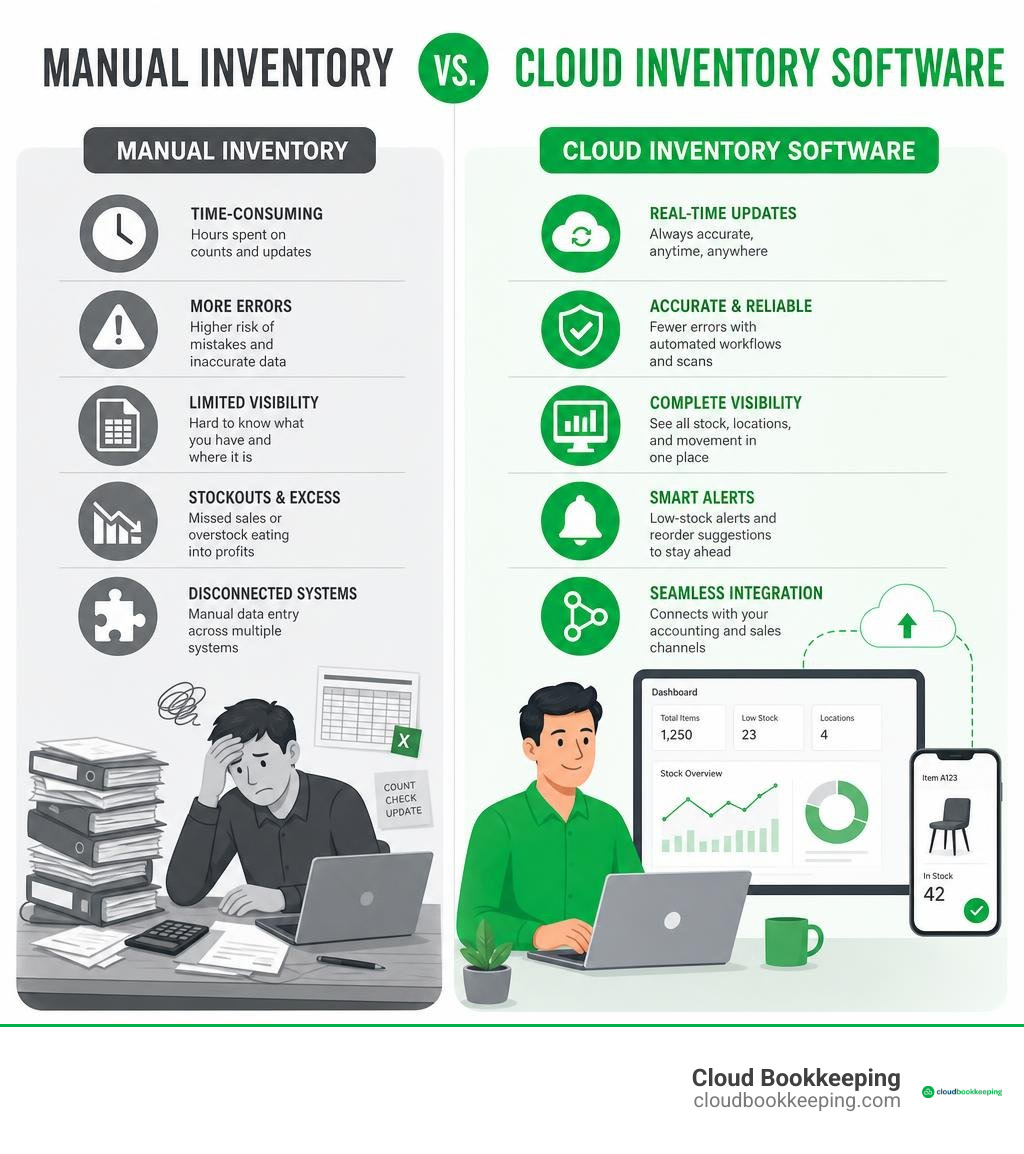
Manual inventory tracking in spreadsheets creates operational friction that steadily drains profits. When operations rely on manual entries, a 23% error rate is common. Across physical warehouses, misplaced stock, manual counting errors, and inefficient travel routes lead to an average annual loss of $300,000.
Staff members often spend up to 4.2 hours daily resolving stock discrepancies, hunting down misplaced goods, and updating disconnected records. These administrative delays cause stockouts on high-demand items, tie up working capital in dead stock, and lead to inflated holding costs.
Modern businesses handling physical goods require coordinated logistics, robust systems, and clear financial oversight. Using dedicated platforms, such as an end-to-end Inventory Management System – Texas Logistic Services, gives companies total visibility over their goods in transit and storage. Pairing these operational tools with the best software for keeping track of expenses in 2026 ensures your overhead, purchase costs, and carrying fees remain accurate in your financial statements.
Key Features and Deployment Models to Evaluate

Choosing the correct platform requires understanding deployment architectures and security frameworks. Cloud-based Software-as-a-Service (SaaS) applications offer real-time updates, remote accessibility across job sites, and automated backups without internal server maintenance. On-premise systems provide direct local database control but require dedicated IT personnel, hardware upkeep, and manual software upgrades.
When evaluating total cost of ownership, look beyond software licensing to implementation timelines, staff training, and data security. Leading solutions adhere to strict security frameworks like SOC 2 Type II compliance and ISO 27001 certifications. Protecting customer and vendor records is just as essential as understanding the role of accounting software solutions within your overall operational stack.
Core Features of the Best Inventory Management Software
Modern stock control systems must include essential tracking and automation capabilities:
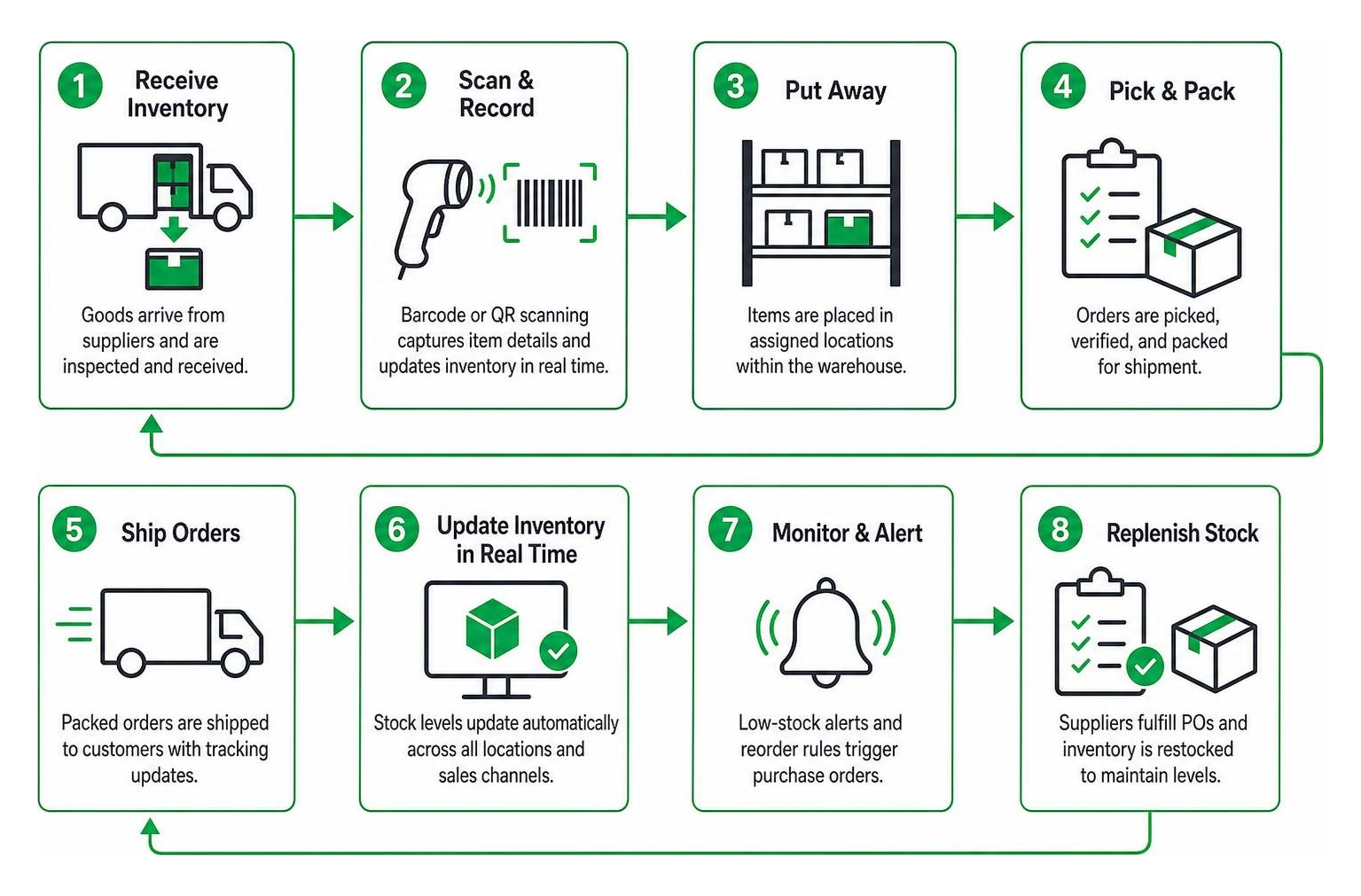
- Barcode and RFID Scanning: Captures receipts, bin transfers, and order picks directly on mobile devices to eliminate manual entry errors.
- Automated Reordering and Safety Stock: Calculates dynamic min/max thresholds and supplier lead times to trigger purchase orders before items run out.
- Multi-Location and Bin Tracking: Tracks quantities across distinct warehouses, storefronts, and mobile service vehicles down to specific shelf bins.
- Batch and Lot Traceability: Monitors expiry dates, production batches, and serial numbers to support regulatory compliance and swift product recalls.
Platforms such as Inventory Control Software: Stock, Costs & POs | Fuse Inventory demonstrate how built-in purchase order workflows, multi-stage vendor payment terms, and landed cost tracking give growing brands complete inventory control.
Cloud-Based vs. ERP-Integrated Systems
Standalone cloud inventory software handles stock movement, purchase orders, and sales channel synchronization cleanly. However, as manufacturing complexity and order volumes rise, businesses frequently require Enterprise Resource Planning (ERP) integrations.
ERP-integrated systems provide bi-directional synchronization across production, inventory, sales, and the general ledger. They feature multi-level Bills of Materials (BOMs), assembly cost tracking, and automated work orders that update raw material quantities instantly. Selecting suitable accounting software solutions for small teams ensures these detailed inventory transactions post cleanly to your balance sheet without manual journal adjustments.
Comparing the Best Inventory Management Software in 2026
The leading platforms serve distinct operational scales, complexity requirements, and industry needs:
| Software | Target Business Size | Key Strengths | Primary Integrations |
|---|---|---|---|
| Sortly | Small businesses & field teams | Visual folder system, offline mobile scanning | Export APIs, basic webhooks |
| Zoho Inventory | Startups & growing e-commerce | Multichannel syncing, shipping carrier links | Zoho Suite, Shopify, Amazon, QuickBooks |
| inFlow | SMBs, distributors & light manufacturing | Bundled hardware, manufacturing BOMs | QuickBooks, Xero, Shopify, Amazon |
| Unleashed | Mid-market manufacturing & wholesale | Multi-currency, real-time landed cost | Xero, QuickBooks, Shopify, Amazon |
| Enterpryze ERP | Mid-market SMEs & multi-site | Full financial & ERP engine, 4-week rollout | 57+ pre-built native connectors |
| Fuse Inventory | Fast-growing consumer brands | Multi-level BOMs, landed cost duties | Major ERPs, Shopify, 3PL platforms |
| NetSuite | Mid-market to enterprise | SuiteSuccess workflows, Item 360 view | Native NetSuite ERP environment |
| Nautilus Inventory | Warehouses & complex supply chains | 200 ms AI scanning, 3D floor maps | QuickBooks, Xero, SAP, Shopify |
Top Small Business & Entry-Level Trackers
- Sortly: Trusted by over 15,000 businesses, Sortly simplifies stock control through an intuitive, folder-based visual hierarchy. Teams can organize items with photos, generate custom QR labels, and execute stock counts in an offline mobile app without requiring Wi-Fi.
- Zoho Inventory: Ideal for emerging multichannel retailers, offering tools for barcode tracking, batch numbers, item assemblies, and automated reorder alerts across e-commerce channels.
- inFlow: Serving more than 50,000 businesses, inFlow balances simplicity with powerful light-manufacturing tools, kitting features, and dedicated mobile hardware scanners.
Advanced Mid-Market & Manufacturing Platforms
- Unleashed Software: Built for growing manufacturers and wholesalers, Stock & Inventory Management Software – Try for FREE | Unleashed delivers dynamic demand planning, batch and serial traceability, and average landed cost tracking.
- Enterpryze ERP: Trusted by over 2,500 businesses, this platform connects inventory, sales, purchasing, and finance in a unified cloud interface with average four-week deployments.
- Fuse Inventory: Manages over 792,000 SKUs and billions in gross sales volume. Customers experience an average 70% reduction in overstock and 10% revenue gains through advanced multi-level BOMs and container tracking.
- NetSuite Inventory Management: Offers comprehensive supply chain intelligence through NetSuite Inventory Management Systems Software, featuring Smart Count cycle counting and Item 360 management.
AI-Powered Warehouse Intelligence Systems
For high-volume distribution centers, AI-native platforms like Nautilus Inventory — AI-Powered Warehouse Management elevate operational accuracy to 99.7%. By using machine learning models on standard mobile devices, Nautilus scans and identifies barcodes in under 200 milliseconds—even when labels are torn or damaged.
Interactive 3D floor planning maps warehouse activity visually, cutting operator walking distance by 41% and speeding up cycle counts by 70%. Real-time predictive anomaly alerts warn managers of potential stock shortages days before stockouts happen, transforming manual fulfillment centers into agile, automated operations.
Implementation, Accounting Integrations, and Calculating True ROI

A successful software rollout requires structured data migration, clean SKU naming conventions, and continuous team onboarding. Migrating messy data into a new platform only amplifies existing counting errors.
Calculate the return on investment (ROI) across three primary areas:
- Labor Reduction: Eliminate manual data entry and spreadsheet consolidation (saving up to 4.2 hours daily).
- Carrying Cost Savings: Reduce excess safety stock and dead inventory by 20% to 70% using dynamic demand forecasting.
- Fulfillment Accuracy: Prevent costly stockouts, overselling penalties, and rush shipping fees through real-time channel syncing.
How to Pick the Best Inventory Management Software for Your Business Size
Follow a systematic evaluation process when shortlisting vendors:
- Audit SKU Complexity and Variations: Determine whether your products require simple unit counts, variable sizes/colors, expiration tracking, or complex multi-tier assembly BOMs.
- Map Sales Channels and Order Volume: Match your daily order throughput with software platforms capable of real-time multichannel syncing across your e-commerce and wholesale channels.
- Evaluate Regulatory and Traceability Needs: Regulated sectors like food, health, and construction require lot tracking, serialized audit trails, and strict quality control workflows.
- Assess Hardware and Mobility Requirements: Decide if your team needs standard mobile smartphone camera scanning or ruggedized barcode scanners for heavy-duty warehouse scanning.
Seamless Synchronization With Accounting and Financial Reporting
Your inventory management platform must communicate directly with your general ledger. When purchases, assemblies, bin transfers, and customer fulfillments happen, stock valuations and Cost of Goods Sold (COGS) should update automatically.
Establishing a reliable sync between inventory tracking and your accounting ledger prevents painful tax-time adjustments. Review our detailed guide to using QuickBooks for bookkeeping and our ultimate guide to QuickBooks financial forecasting and projections to ensure your stock valuations and financial forecasts match your operational reality.
Frequently Asked Questions about Inventory Software
How much does inventory management software typically cost?
Inventory software pricing varies widely based on user seats, monthly order volume, and functional complexity. Entry-level trackers designed for small teams often use tiered subscription models based on item limits or user counts. Mid-market platforms with manufacturing BOMs, multi-warehouse routing, and ERP engines typically charge monthly user seat fees alongside initial implementation and onboarding packages.
How does inventory software integrate with QuickBooks and e-commerce platforms?
Leading inventory software uses native connectors and REST APIs to sync stock counts bidirectionally across storefronts like Shopify, Amazon, and WooCommerce. When an order is placed, the inventory software deducts available stock across all channels, triggers warehouse fulfillment workflows, and automatically generates sales receipts and COGS journal entries within QuickBooks.
What is the fastest way to transition away from manual spreadsheets?
Begin by standardizing your product master catalog into a clean CSV file, assigning unique SKUs to every product variation. Complete a physical cycle count to establish baseline counts, then import your data into the new system. Roll out mobile barcode scanning in a single location or product category first, ensuring staff are fully trained before switching off legacy spreadsheets entirely.
Conclusion
Upgrading from spreadsheets to modern inventory software protects your margins, eliminates fulfillment errors, and unlocks working capital trapped in excess stock. Selecting a system tailored to your specific SKU complexity and order volumes gives your team the real-time visibility needed to scale confidently.
Clean inventory data forms the foundation of accurate business accounting. If you need expert guidance selecting, implementing, or reconciling your inventory software with QuickBooks, explore our specialized Cloud Bookkeeping software advisory services to keep your numbers accurate and your operations moving forward.