Find Trusted Small Business Advisory Support
Trusted small business advisory gives you an outside expert who can turn messy financial information and tough decisions into a clear action plan. Start by identifying your biggest need, such as reliable books, cash flow visibility, tax planning, funding readiness, or growth strategy. Then choose an advisor with relevant experience, a clear scope of work, and reports you can understand and use.
For many owners, the most valuable first step is getting accurate, current financial records. Clean books help you spot cash shortfalls early, measure profit, prepare for lending, and make decisions based on facts instead of surprises.
Small business advisory can also mean two different things:
- Private advisory services help an individual business improve finances, operations, sales, leadership, or planning.
- Public advisory committees bring business-owner feedback to government leaders on regulations, ordinances, capital access, and other issues affecting local companies.
Both matter, but they solve different problems. A private advisor helps you run your business better. A public committee helps shape the rules and resources around it.
At Cloud Bookkeeping, our team helps owners build clearer financial systems, improve profitability, and understand their numbers. In this guide, we explain how small business advisory works and how to find support that fits your goals.
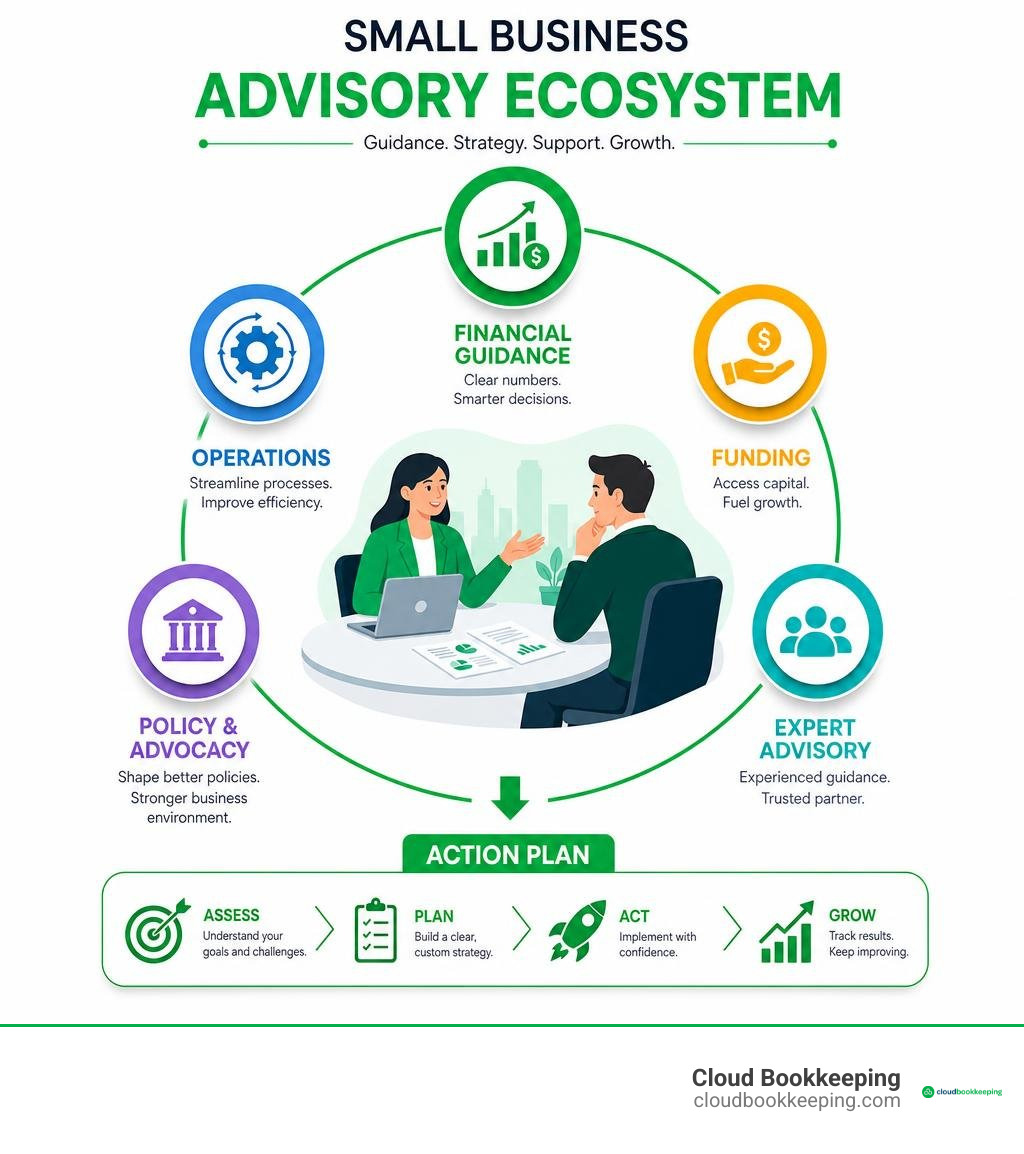
Core Pillars and Types of Small Business Advisory
When you explore trusted advisory support, you quickly discover that business guidance falls into distinct categories. Every business encounters operational hurdles as it expands. Demands on your time compound, managing a growing team becomes delicate, and decisions carry heavier financial consequences.
To solve these growing pains, private advisory generally leverages a structured three-step framework:
- Understand: Conduct a thorough assessment of your operational structure, financial records, and operational bottlenecks.
- Strategize: Build a prioritized roadmap with clear goals, milestones, and performance metrics.
- Implement: Execute targeted improvements, ranging from customized accounting systems to executive decision support.
While private consulting focuses internally on your company’s growth, public committees focus externally on the business environment. Here is how private advisory services compare directly with public advisory committees:
| Dimension | Private Advisory Services | Public Advisory Committees |
|---|---|---|
| Primary Mission | Boost individual company profits, cash flow, and operational efficiency. | Advise public officials on policies, zoning, regulations, and economic programs. |
| Who Participates | Business owners, fractional CFOs, bookkeepers, and operational consultants. | Appointed local business owners, civic leaders, and government liaisons. |
| Direct Deliverables | Cash flow forecasts, customized reports, QuickBooks cleanup, strategic plans. | Policy recommendations, ordinance reviews, and public hearing testimonies. |
| Funding & Access | Private professional engagement tailored to your specific enterprise. | Publicly accessible meetings, civic applications, and open-door forums. |
| Scope of Impact | Internal day-to-day operations, margin growth, and company valuation. | Community-wide commercial environment and regulatory landscape. |
Financial and Accounting Small Business Advisory
A business cannot outgrow weak numbers. If your bookkeeping is weeks behind or your monthly reports are confusing, making strategic choices feels like throwing darts in a dark room. This reality is why financial management should be a top priority for every founder aiming for sustainable growth.
Our financial advisory work focuses on turning your ledger into a strategic compass. By organizing your chart of accounts and maintaining an accurate QuickBooks ecosystem, we provide a crystal-clear look into your gross margins, unit economics, and operational overhead.
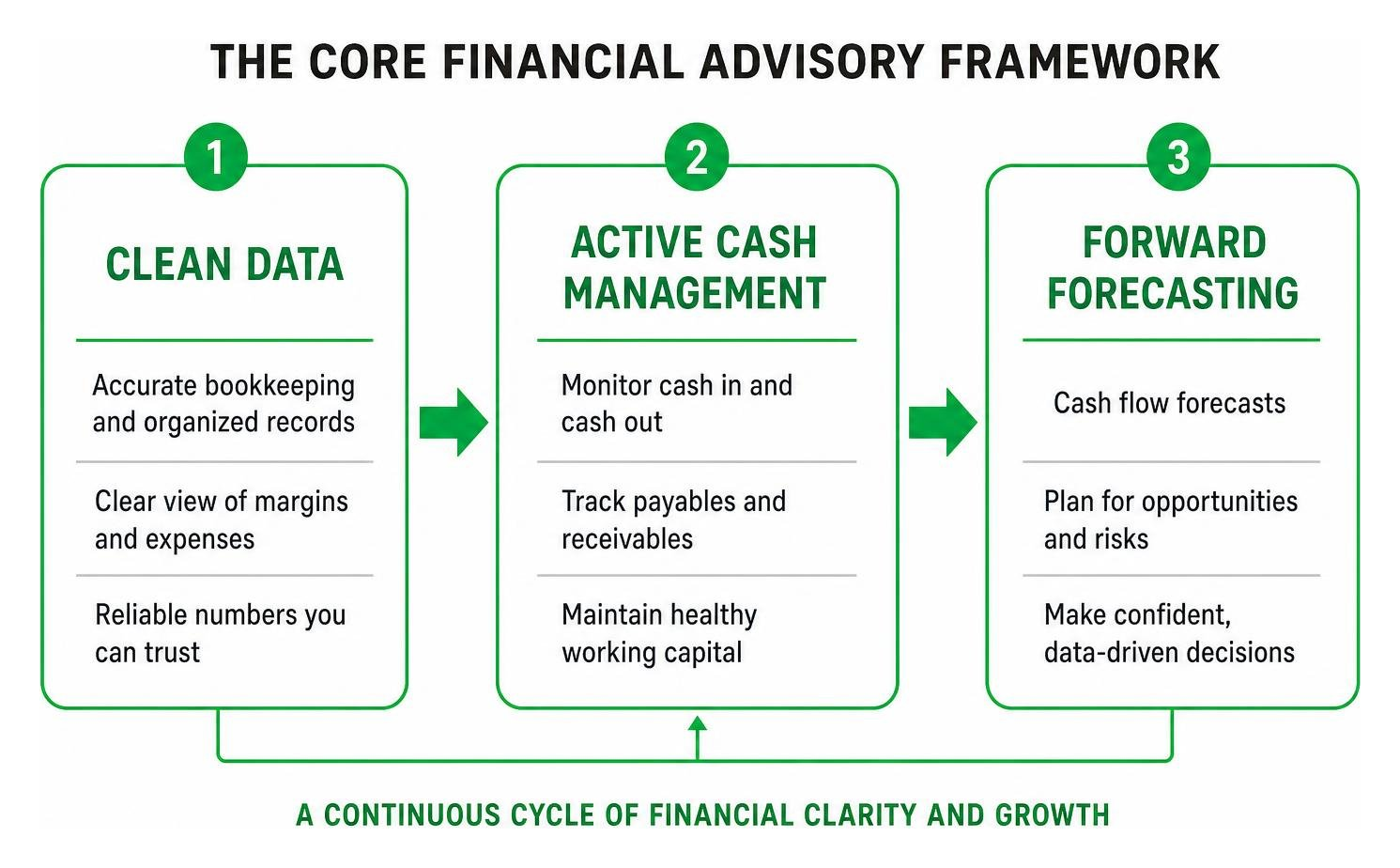
Through routine reviews, you experience the power of proper bookkeeping to manage key financial metrics. Instead of waiting until tax time to discover whether you turned a profit, financial advisory gives you monthly visibility over:
- Cash Flow Velocity: Pinpointing exactly when revenue enters your accounts and when vendor obligations leave them.
- Operating Margins: Tracking whether your cost of goods sold (COGS) or labor expenses are creeping up unexpectedly.
- Working Capital Ratios: Ensuring you maintain sufficient liquid reserves to handle unexpected market shifts or equipment needs.
Operational Strategy and Growth Consulting
Operational advisory steps in when the friction inside your business comes from capacity, workflow, or organizational bottlenecks. When an enterprise gains traction, the owner often becomes the central bottleneck. Every approval, customer escalation, and vendor agreement runs through a single desk.
Advisory consultants evaluate your workflows to implement practical solutions for financial management challenges and operational deadlocks. This involves:
- Fractional Leadership: Bringing executive-level operational guidance into your team without the full-time overhead expense.
- Succession and Exit Planning: Structuring standard operating procedures (SOPs) and financial audits so a family business or privately held company can transition smoothly to new leadership or a strategic buyer.
- Turnaround Roadmaps: Establishing strict accountability frameworks and cost-reduction plans for businesses navigating financial distress.
The Strategic Role of Public Small Business Advisory Committees
While private consulting helps you optimize within your business, public advisory committees protect and improve the economic ecosystem outside your front door. Local, state, and federal bodies frequently establish dedicated advisory boards to gather unfiltered insights directly from Main Street job creators.
Civic and Government Small Business Advisory Committees
Municipal leaders make decisions daily on commercial permitting, zoning changes, local tax incentives, and public infrastructure projects. Without direct input from entrepreneurs, local regulations can accidentally stifle enterprise.
In our home region, the Small Business Advisory Commission (SBAC) from the City of San Antonio serves as a bridge between commercial owners and municipal governance. Composed of local entrepreneurs and community stakeholders, this commission advises City Council on:
- Streamlining commercial permitting and licensing procedures.
- Evaluating the impact of municipal ordinances on daily business operations.
- Directing economic development funding and technical assistance programs to underserved commercial corridors.
By participating in or attending these public sessions, business owners ensure their operational realities inform the laws and policies shaping their community.
Federal vs. State and Municipal Policy Impact
Small business advisory bodies operate at every tier of government, each focusing on specific regulatory areas:
- Municipal Committees: Address hyper-local concerns such as commercial signage rules, street construction mitigation, local vendor bidding preferences, and municipal grant distribution.
- State-Level Councils: Focus on state tax burdens, workforce training programs, deregulation, and statewide enterprise funds. In Texas, initiatives like the Small Business Advisory Task Force from the Office of the Texas Governor actively evaluate regulatory hurdles to keep the state’s commercial climate competitive.
- Federal Bodies: The U.S. Securities and Exchange Commission (SEC) hosts the Small Business Capital Formation Advisory Committee, established under the SEC Small Business Advocate Act of 2016. This body meets quarterly in public sessions governed by the Sunshine Act to advise on federal securities rules, Regulation Crowdfunding caps, accredited investor criteria, and secondary market liquidity.
Key Challenges Solved by Advisory Support and Technical Assistance
Operating an independent enterprise involves balancing multiple roles simultaneously: product manager, bookkeeper, human resources director, and compliance officer. Technical assistance and professional advisory services relieve this burden by resolving complex structural hurdles.
Capital Access, Lender Readiness, and CDFI Programs
Securing debt financing or growth equity requires far more than filling out a generic loan application. Lenders, Community Development Financial Institutions (CDFIs), and equity partners demand comprehensive proof that your business generates reliable cash flow to service debt.
Advisors bridge the gap between business owners and capital providers by preparing underwriting packages. With organized records, trailing twelve-month profit-and-loss statements, and verifiable cash flow forecasts, founders can approach lenders and funding partners with clearer evidence of repayment capacity.
Reliable small business bookkeeping support can make that preparation easier by keeping transaction records, reconciliations, and management reports organized before a lender asks for them.
Having pristine books is essential because effective financial reporting is crucial for businesses is the primary factor banks evaluate during credit reviews. Clean reporting demonstrates management discipline, lowers your perceived underwriting risk, and accelerates loan approvals.
Regulatory Compliance, Tax Strategy, and Risk Management
Tax season should never be a surprise. Business owners who treat accounting as a once-a-year scramble often leave significant tax deductions unclaimed or face penalties for non-compliance.
Integrating year-round financial guidance highlights the role of financial advisory in tax planning. Strategic advisors work alongside your tax professionals to:
- Plan capital asset purchases around Section 179 depreciation rules.
- Structure owner compensation and distributions efficiently.
- Ensure strict compliance with payroll taxes, local commercial property declarations, and state sales tax collections.
Utilizing smart approaches to business accounting keeps your books audit-ready year-round, minimizing compliance risk while protecting your working capital.
How to Select and Engage the Right Advisory Support for Your Business
Finding the right advisory partner requires due diligence. You are sharing sensitive operational and financial details, so you need an advisor with proven integrity, industry-specific expertise, and clear communication.
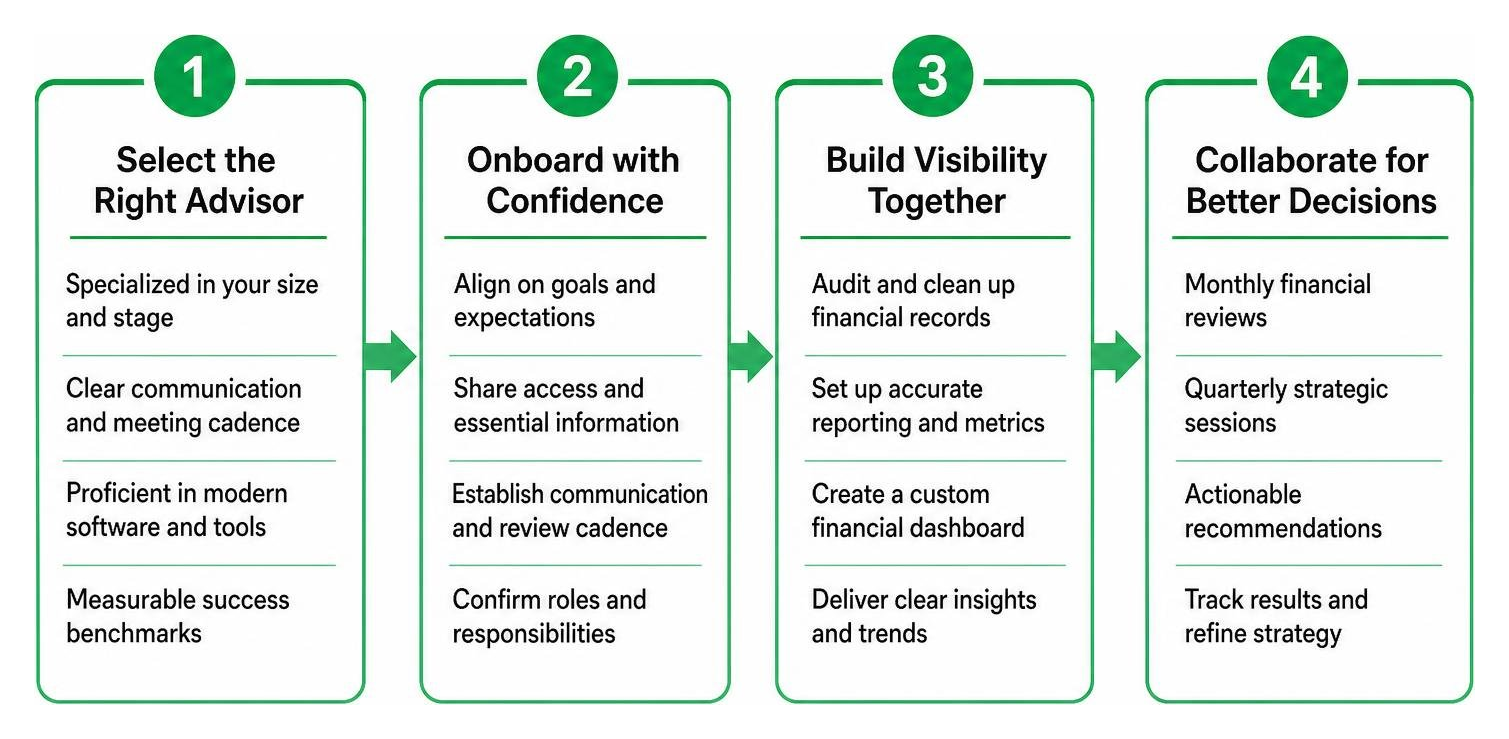
When interviewing potential advisors or fractional leadership firms, ask these essential vetting questions:
- Do you specialize in businesses of my size and revenue stage? A firm geared toward a large corporate enterprise will not provide practical support for a smaller local service company.
- How will we communicate, and how frequently will we meet? Look for established communication cadences, such as monthly financial reviews and scheduled quarterly strategic sessions.
- What specific software and tools do you use? Ensure they possess advanced proficiency in modern platforms like QuickBooks Online and integrated reporting dashboards.
- How do you measure success? Clear benchmarks, such as reduced days sales outstanding (DSO), increased gross margins, or completed financing packages, keep the advisory relationship accountable.
Evaluating Private Fractional Advisory Services
For small to mid-sized companies, hiring a full-time Chief Financial Officer or senior controller is often financially impractical. Fractional advisory bridges this gap by delivering executive-level financial oversight without adding a full-time executive role.
A strong advisory partner should also understand the bookkeeping software your business relies on, because clean integrations, accurate reconciliations, and useful reporting dashboards all affect the quality of your monthly financial insight.
Applying to and Participating in Public Advisory Boards
If you want to influence local commercial policy and give back to your business community, consider serving on a public municipal board or state task force.
The path to joining a public advisory committee typically involves:
- Tracking Open Seats: Monitor your municipal clerk’s board and commission directories or the Texas Governor’s appointments portal for vacancies.
- Submitting a Letter of Interest: Highlight your business background, industry expertise, and commitment to local economic development.
- Attending Public Meetings: Familiarize yourself with the committee’s current agenda, previous minutes, and open topics by attending public sessions.
- Securing Appointment: Complete background checks, ethics disclosures, and interviews with local council members or executive staff.
Frequently Asked Questions About Small Business Advisory
What is the primary purpose of a small business advisory committee?
A public small business advisory committee provides a formal bridge between independent business owners and government policymakers. These committees review proposed ordinances, evaluate regulatory burdens, study capital formation challenges, and deliver policy recommendations to city councils, state legislatures, or federal agencies like the SEC.
How do private advisors differ from public small business advisory councils?
Private advisors work directly for your enterprise under a confidential professional agreement to improve bookkeeping, increase profit margins, streamline operations, and prepare for financing. Public advisory councils are civic bodies that represent the broader business community to shape regional policy, improve municipal services, and reduce regulatory friction.
How can small business owners apply to join an advisory board?
Small business owners can apply by visiting their local city government or state appointment portals. Most entities require a formal application, a professional resume, a letter of interest detailing your relevant industry experience, and completion of standard public service background checks. Federal committees, such as the SEC Small Business Capital Formation Advisory Committee, invite interested candidates to submit direct letters of interest outlining their capital markets and small business experience.
Conclusion
Building a successful, resilient enterprise does not have to be an isolating journey. Whether you are navigating day-to-day cash flow adjustments or planning for multi-year expansion, securing trusted advisory support gives you the strategic clarity needed to make decisions with confidence.
At Cloud Bookkeeping, our team provides San Antonio business owners with precise bookkeeping, QuickBooks management, and actionable financial advisory support that eliminates operational guesswork. When you are ready to turn clearer books into better decisions, contact our small business advisory specialists.